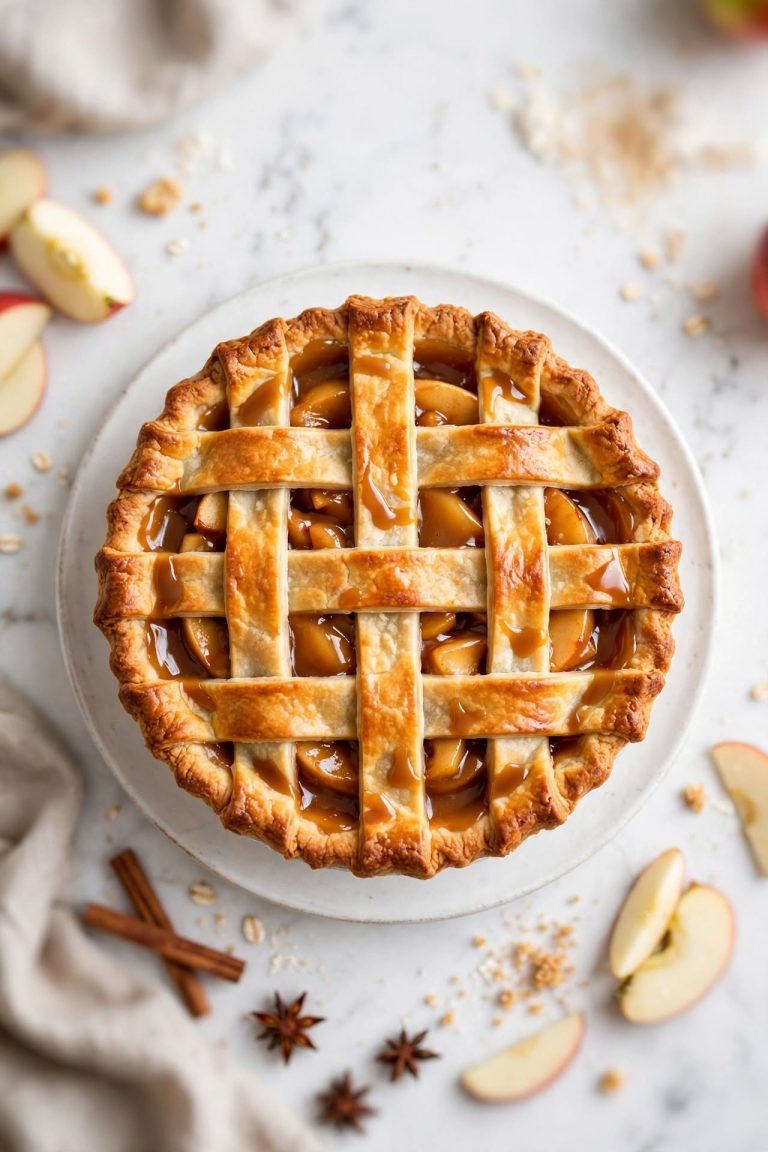
Peach cobbler with cake mix is an easy baked dessert made by layering canned peaches and dry yellow cake mix in a baking dish, then topping everything with sliced butter and baking until golden. It requires no mixing and uses three to four ingredients. Total bake time is 45 to 55 minutes. Best for anyone who wants a crowd-pleasing dessert with almost no active prep time.
This peach cobbler with cake mix recipe produces a golden, slightly crispy topping over a bubbling, syrupy peach filling — with no mixing required. It uses four ingredients and takes under 10 minutes to assemble. If your last cobbler came out doughy and undercooked in the center, the problem is almost always uneven butter distribution or the wrong bake temperature. I tested this recipe multiple times to nail down the exact butter placement and oven time that guarantees a fully cooked, golden topping every single time.
Why This Recipe Works
This version of Southern-style peach cobbler with cake mix does two things most recipes get wrong: it keeps the peach syrup and distributes the butter evenly in thin overlapping slices. Both steps are what separate a golden, crispy cobbler from a doughy, underbaked one.
- Four ingredients only — canned peaches with their syrup, yellow cake mix, butter, and optionally cinnamon. No eggs, no milk, no extra prep steps between you and the oven.
- No mixing at any stage — the layers bake themselves into a cohesive dessert. Stirring at any point disrupts the moisture flow from peach to mix and produces an uneven, partly raw result.
- Peach syrup stays in — the canned syrup is what hydrates the bottom of the cake mix layer. Without it, the topping bakes dry and powdery in the center instead of crisp on top and tender underneath.
- Thin-sliced butter coverage — butter sliced at ¼ inch and arranged in overlapping rows covers the mix evenly, so every part of the top gets golden rather than just the patches directly under a butter pat.
- Specific bake time and temperature — 350°F for 50 to 55 minutes gives the fruit time to bubble up through the mix while the top finishes to a deep golden color without burning at the edges.
- Made in one dish, start to finish — no separate bowls, no layers of pots to wash. The whole recipe is built directly in the pan it bakes in.
For more easy fruit dessert recipes, that collection has the same reliable approach to fruit and crumble combinations.
Ingredients for Peach Cobbler with Cake Mix
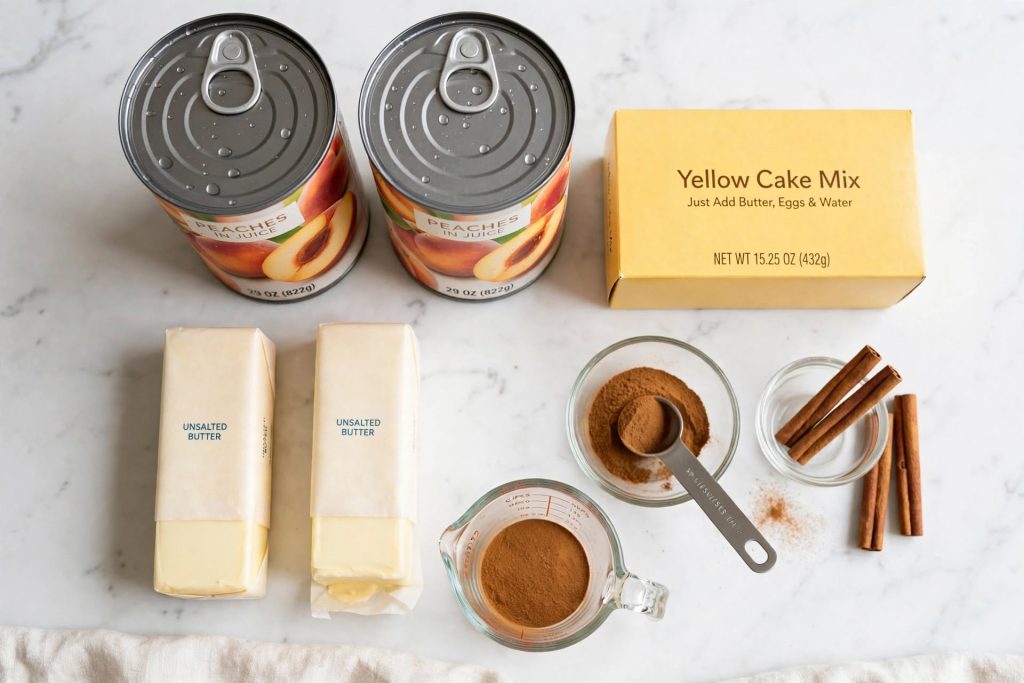
Every ingredient here has a specific job. Here is what each one does — and what to use if you need to make a substitution.
The Fruit Layer
| Ingredient | Amount | What It Does | Best Substitute + Impact |
|---|---|---|---|
| Canned peaches in heavy syrup | 2 cans (29 oz each) | Fruit layer + syrup hydrates the cake mix from below | Fresh peaches + ½ cup sugar + ¼ cup water — works but requires extra prep and 5–10 min extra bake time |
| Ground cinnamon (optional) | 1 tsp | Warm spice that deepens the fruit flavor and caramelizes with the butter | Pumpkin pie spice — adds more complexity; nutmeg alone is too sharp for the full quantity |
The Topping
| Ingredient | Amount | What It Does | Best Substitute + Impact |
|---|---|---|---|
| Yellow cake mix (dry, 15.25 oz box) | 1 box (dry only) | Topping layer — absorbs moisture from below and sets crisp on top; contains pre-balanced leaveners | White cake mix — milder, slightly less sweet; spice cake mix — excellent for fall serving |
| Unsalted butter (cold, sliced thin) | 1 stick (½ cup / 115g) | Fat layer that melts over the mix to create a golden, biscuit-like crust from above | Vegan butter sticks — direct swap, no flavor difference; coconut oil discs — dairy-free, slightly crunchier |
Key Ingredient Notes
Canned peaches: Use peaches in heavy syrup, not in juice or water — the extra sugar in heavy syrup is what makes the filling glossy and thick during baking. Two 29 oz cans give you the right fruit-to-topping ratio for a 9×13 pan; using smaller cans leaves the bottom layer too thin relative to the topping.
Cake mix: Use the dry powder only — do not add the eggs, oil, or water listed on the box. The moisture comes entirely from the peach syrup, which is why draining the cans is the most common mistake in this recipe and cannot be undone once it happens.
Butter: Cut your butter into slices no thicker than ¼ inch and lay them overlapping slightly, covering as much of the mix surface as you can. Any large patch of mix not touching butter will stay powdery and uncooked in the center — this is the number one cause of doughy cobbler, and it is entirely preventable.
Equipment You Need
- 9×13 baking dish (glass or ceramic — not dark metal, which can over-brown the fruit layer at the base)
- Knife and cutting board (for the butter slices)
- Can opener
- Oven — that is the full list
The Peach Guide
Your peach choice determines the flavor and texture of the entire filling. Here is what works, what requires adjustment, and what to skip entirely.
| Peach Type | Prep Required | Result in This Recipe | Recommended? |
|---|---|---|---|
| Canned in heavy syrup | None — pour directly into dish | Glossy, thick, sweet filling; consistently crispy top | ✅ Best choice |
| Canned in juice or water | Add ¼ cup brown sugar to the fruit layer | Slightly less sweet; filling is thinner and lighter in color | ⚠️ Acceptable |
| Fresh peaches (ripe) | Peel, slice, macerate with ½ cup sugar + ¼ cup water for 10 min | Fresh-forward flavor; needs 5–10 extra minutes of bake time | ⚠️ Acceptable |
| Frozen peaches (thawed) | Drain completely; pat dry before measuring | Good flavor; watery result if not drained and dried thoroughly | ⚠️ Use caution |
| Canned peach pie filling | None | Overly sweet; filling is thick and jammy rather than syrupy | ❌ Not ideal |
Visual cue for canned peaches: When you pour the cans into the dish, you should see syrup come up to about ¾ of the depth of the fruit layer. If the dish looks dry or the fruit is barely submerged in liquid, your cans were undersized — open a third can and pour in just the syrup to reach the right level.
Fresh peach tip: Choose peaches that give slightly under thumb pressure — not rock hard, not falling apart. Rock-hard peaches will not soften fully in the bake time and produce a grainy, undercooked filling. If your fresh peaches are very firm, add 10 minutes to the total bake time.
How to Make Peach Cobbler with Cake Mix — Step by Step
The only rule in this entire recipe: do not stir. Once your layers are in the pan, the oven does all the work. Stirring at any point disrupts the moisture flow from peach to mix and produces an uneven, partly raw result.
Step 1 — Prepare Your Pan and Preheat
Preheat your oven to 350°F. Lightly butter or spray a 9×13 baking dish. This prevents the fruit from caramelizing and sticking to the bottom corners during the long bake — it also makes clean-up significantly easier.
What to look for: The dish should feel lightly slick when you run a finger along the bottom — not pooled with grease, just an even thin coating.
Step 2 — Add the Peach Layer
Open both cans of peaches and pour them into the prepared dish — syrup and all. Spread the fruit into an even layer with a spoon. Sprinkle the cinnamon over the peaches now if you are using it.
What to look for: Peaches in a relatively even layer covering the entire base of the dish. The syrup should be visible between the fruit pieces — not fully absorbed. If you can see the bottom of the dish between pieces of fruit, your cans were undersized.
Step 3 — Sprinkle the Cake Mix
⚠️ Dry mix only — do not add water, eggs, or oil from the box instructions. The moisture comes from the peach syrup below.
Open the box of dry cake mix and pour the entire contents over the peach layer. Use your hands or the back of a spoon to spread it into an even layer — no clumps at the edges, no thick pile in the center.
What to look for: A flat, even layer of powder covering the peaches entirely — no holes exposing the fruit, no piled-up peaks. The mix should look like a smooth powder blanket across the full dish.
Step 4 — Distribute the Butter
⚠️ This is the most critical step in the recipe. Any large patch of mix without butter contact will bake dry and powdery — it cannot absorb enough moisture from below if the top seals before the fat reaches it.
Slice your cold butter into pieces roughly ¼ inch thick. Arrange them in overlapping rows across the entire surface of the cake mix — aim to cover at least 80% of the top. Leave small gaps between slices but do not leave patches wider than 1 inch uncovered.
What to look for: A mosaic of thin butter slices covering most of the mix surface. Some white mix visible between slices is fine — large white patches mean you need to redistribute or add slightly more butter.
For more on how fat ratios affect baked desserts, that guide covers it in the same level of detail.
Step 5 — Bake Until Golden
Bake at 350°F for 50 to 55 minutes. Do not open the oven before the 45-minute mark — the crust is still forming and needs uninterrupted heat to set evenly across the whole surface.
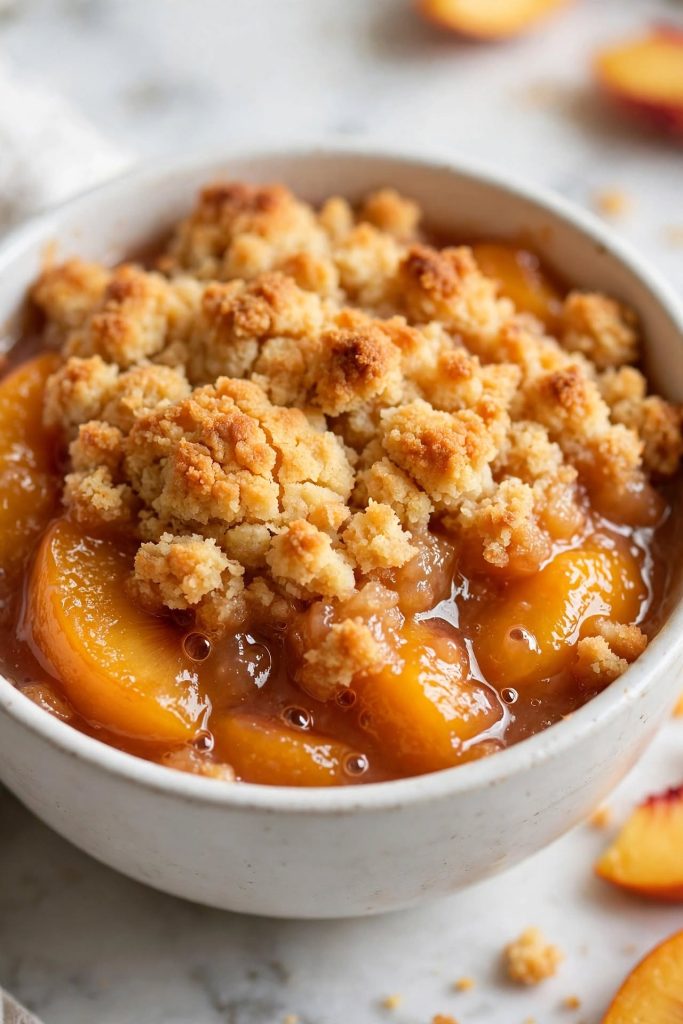
What to look for: A deep golden-brown top — not pale yellow — with visible bubbling of the peach syrup around the edges of the dish. The center should feel set when you press it lightly with the back of a spoon — not squishy or wet. If it still feels wet at 55 minutes, give it 5 more minutes and check again.
The Science Behind a Perfect Cobbler Topping
Understanding why this method works means you can fix it when something goes wrong — and it means you will not accidentally stir it, thinking it needs help.
Why Cake Mix Works Better Than Scratch Topping
A scratch cobbler topping requires precise ratios of flour, leavener, fat, and liquid — and those ratios shift slightly based on humidity, altitude, and oven calibration. Yellow cake mix is pre-balanced. It already contains the correct amounts of flour, sugar, baking powder, and salt in a ratio specifically engineered to absorb a consistent amount of moisture and produce a uniform result. The leaveners in the mix also react with heat to lift the topping slightly during baking — giving you something between a crispy crust and a tender biscuit without any additional effort or measuring.
Why You Keep the Peach Syrup
The syrup in a can of peaches in heavy syrup is roughly 65% sugar. That sugar does two things when it bakes: it dissolves the bottom layer of the cake mix during the first 15 minutes of baking, creating a soft, slightly caramelized transition layer between the fruit and the topping, and it carries flavor-saturated liquid up through the dry mix as it bubbles and vaporizes. Remove the syrup and you remove the moisture the whole recipe depends on — the mix stays dry and powdery in the center, the topping never reaches that golden color because there is no sugar in the liquid to caramelize, and the fruit layer tastes flat without the extra sweetness.
Why Butter Goes on Top, Not Mixed In
If you melt the butter and stir it into the cake mix before spreading, you create a batter — and batter bakes differently from the layered dump method. A batter forms a solid dome that traps steam below it and produces an undercooked, gummy center. Cold slices of butter placed on top melt gradually during baking, dripping through the dry mix slowly and evenly from above. That slow downward movement of fat through the dry mix is what creates the characteristic texture of an easy peach cobbler — crisp and golden on top, tender and slightly cakey just below, and juicy fruit at the base.
Tips for the Best Result
These are the specifics that separate a cobbler that gets second helpings from one that gets politely left in the dish.
- Cover the mix as fully as possible with butter — a full stick gives about 80% coverage on a 9×13 pan. For 100% coverage, use 1.25 sticks. More butter equals a more uniform, deeper golden color across the entire surface.
- Use a light-colored glass or ceramic pan — dark metal absorbs more heat at the base and can scorch the peach layer before the top finishes baking. A light-colored dish distributes heat more evenly across the full depth of the cobbler.
- Rest 10 minutes before serving — the filling is still flowing at high temperature when it comes out of the oven. Ten minutes of rest thickens the syrup enough to hold a served portion without it pouring off the spoon and onto the plate.
- Check the center for bubbling before pulling — the edges will bubble and set first. The cobbler is fully done when you can see active bubbling in the center of the dish, not just at the perimeter.
- Use cinnamon that is fresh enough to smell strongly — cinnamon ground more than 6 months ago has significantly diminished aromatic oils. If your cinnamon barely registers when you sniff it, use 1.5 teaspoons instead of 1.
- For a crunchier, more caramelized topping — brush the butter slices with a thin layer of honey before baking. The sugars caramelize faster and produce a more crackled, candy-like surface on the finished cobbler.
Common Mistakes to Avoid
❌ Stirring the Layers Together
Result: You create a batter-like mixture that bakes into a dense, doughy block rather than the distinct layers this recipe depends on. The crispy top and juicy fruit base only develop when the layers stay separate throughout the entire bake.
Fix: Pour each layer and leave it. The only deliberate action after the fruit layer is evening out the mix and placing the butter slices. Everything else bakes itself — stirring at any point, even once, produces an unrecoverable result.
❌ Using Butter Slices That Are Too Thick
Result: Thick butter slices take too long to melt through the full depth of the mix — they may pool in spots rather than distributing across the surface, leaving pockets of undercooked powder adjacent to over-buttered patches.
Fix: Slice your butter to ¼ inch. If it is very cold and crumbling when you cut it, let it sit at room temperature for 5 minutes before slicing — it cuts more cleanly and lays flat more easily.
❌ Draining the Peach Syrup
Result: The cake mix has no moisture source from below and bakes dry and powdery in the center. The fruit layer tastes flat and the topping never reaches a caramelized golden color because there is no sugar in the liquid to contribute to browning.
Fix: Pour both cans — syrup and all — directly into the dish. This step is not optional and cannot be compensated for by adding water later.
❌ Under-Baking the Cobbler
Result: The center of the topping looks golden from above but is still powdery and raw ½ inch below the surface — you will discover this when you try to serve it and the spoon goes through the crust into wet, uncooked mix.
Fix: Bake for the full 50 to 55 minutes at 350°F. Use the press test at the center — press lightly with a spoon at the very center of the dish. It should feel firm and spring back slightly, not give way and sink.
❌ Leaving Large Gaps in the Butter Coverage
Result: Those uncovered patches of mix will not receive enough fat during baking and will stay powdery and dry — producing an uneven topping with golden patches next to white, chalky ones.
Fix: Aim for overlapping slices across the full surface. Small gaps — anything less than 1 inch — are acceptable and will fill in as the butter melts. Large gaps require more butter or thinner slices before the dish goes in the oven.
❌ Using a Pan That Is Too Small
Result: The fruit layer is too deep relative to the topping layer — the mix does not have enough surface area to bake through, the bottom stays too wet, and the topping bakes thicker than intended, which extends the time needed for the center to cook.
Fix: This recipe is sized for a 9×13 pan. For an 8×8, use one 29 oz can of peaches and half a box of mix with half a stick of butter.
For more guides like this one, our no-bake dessert guides cover the same level of troubleshooting detail.
Variations Worth Trying
Spiced Peach Cobbler
What changes: Mix 1 teaspoon cinnamon, ½ teaspoon nutmeg, and ¼ teaspoon allspice into the dry cake mix before sprinkling over the fruit.
When: At the cake mix layer step — stir the spices into the dry mix in a separate bowl before adding.
Result: A warmer, more complex flavor that makes the cobbler feel appropriate for fall and winter serving. The spices caramelize with the butter and produce a noticeably deeper, more aromatic kitchen smell during baking.
Peach and Blueberry Cobbler
What changes: Replace one of the two peach cans with a 15 oz can of blueberries in syrup (or 1.5 cups fresh blueberries + 2 tablespoons sugar).
When: At the fruit layer step — mix peaches and blueberries together before spreading into the dish.
Result: The blueberries break down during baking and create a purple-streaked, jammy base that contrasts with the peach pieces. More complex flavour, noticeably more colourful, and a good way to use up mixed fruit at the end of summer. If you enjoy berry-forward baked desserts, our mixed berry crumble bars take the same approach in bar form.
Peach Cobbler with Cream Cheese Layer
What changes: Cut 8 oz of cold cream cheese into small cubes and scatter them over the peach layer before adding the dry cake mix.
When: After the peach layer is spread, before the cake mix goes on.
Result: The cream cheese melts into the filling during baking and creates a tangy, slightly cheesecake-like base under the crispy topping. The contrast between rich cream cheese and bright peach filling makes this the best version of the recipe for dinner parties and occasions.
Mini Peach Cobbler in Ramekins
What changes: Divide the peach layer among 6 to 8 individual ramekins (8 oz size), then top each with 2 to 3 tablespoons of dry mix and 1 to 2 butter pats.
When: Assemble in ramekins and reduce bake time to 30 to 35 minutes at 350°F.
Result: Individual servings that portion cleanly and are easy to plate at a dinner party. Each ramekin gets its own fully golden top — no fighting for the best corner of the pan.
Sugar-Free Version
What changes: Use peaches canned in water or juice (not syrup), replace the yellow cake mix with a sugar-free yellow cake mix, and add 2 tablespoons of your preferred granulated sweetener to the fruit layer.
When: Swap ingredients at their respective layers — no other changes to the method.
Result: A noticeably less sweet cobbler with a thinner filling. The topping will be slightly less crispy because there is less sugar caramelizing on top during baking. Best served warm with a sugar-free whipped cream or plain Greek yogurt.
How to Store
Room Temperature
Peach cobbler with cake mix can sit at room temperature for up to 2 hours after baking — this is a serving window, not a storage option. Cover loosely with foil or a clean dish towel. The filling is still slightly warm and fluid at this point; the flavor and texture are at their peak during this window, which is why serving it warm is always the first recommendation.
Refrigerator
Cover the baking dish tightly with plastic wrap, or transfer portions to an airtight container. Best quality for up to 4 days in the refrigerator. The topping will soften after day 1 — it absorbs moisture from the fruit layer overnight and loses most of its crispness. To restore texture, reheat individual portions uncovered in a 350°F oven for 8 to 10 minutes rather than microwaving, which steams the topping soft rather than crisping it back up.
Freezer — Complete Guide
This cobbler freezes well, though the topping will be softer after thawing due to moisture redistribution during the freeze-thaw cycle.
To freeze whole: Cool the cobbler completely to room temperature. Cover the dish with two layers of plastic wrap, then one layer of foil. Best quality for up to 2 months. Beyond 2 months it remains safe but the topping texture degrades noticeably.
To freeze in portions: Scoop individual portions into freezer-safe containers once fully cooled. Leave 1 inch of headspace — the fruit layer expands slightly as it freezes. Seal, label with the date, and freeze.
To thaw and reheat: Transfer from freezer to refrigerator overnight. For a single portion, 3 to 4 hours in the refrigerator is typically enough. Reheat uncovered in a 350°F oven for 10 to 15 minutes to bring back some topping texture. Use your judgment — if it smells off or shows any visible mold, discard it.
If you batch-make desserts ahead of time, this no-bake chocolate pie is a perfect make-ahead addition to that routine.
Classic Ways to Serve
- Warm, straight from the dish, with a large scoop of vanilla ice cream melting into the golden topping — the cold ice cream and hot cobbler create a temperature contrast that makes the whole dessert taste richer
- With a generous pour of cold heavy cream over the top — the cream soaks into the golden crust and deepens the richness without competing with the peach flavor
- Dusted lightly with powdered sugar or ground cinnamon immediately before serving, for a visual finish and a touch more aromatic spice
Upgraded and Occasion-Worthy
- Top each serving with a dollop of lightly sweetened whipped cream and a fresh peach slice for color and texture contrast
- Serve in individual ramekins with a sprig of fresh thyme — the herbal note cuts through the sweetness of the peach filling and reads as intentional rather than accidental
- Add a salted caramel drizzle over the ice cream for a Thanksgiving or holiday dessert spread — the salt and caramel add a bittersweet contrast to the pure sweetness of the cobbler
What it pairs well with: Strong black coffee, chamomile tea, or cold sweet tea. For summer serving, pair alongside a simple fruit salad — the cobbler handles the warm, baked richness while the fruit salad brings brightness and acidity to the same dessert course.
Frequently Asked Questions
Can I use fresh peaches instead of canned?
Yes — peel and slice 4 to 5 large ripe peaches (about 6 cups) and combine them with ½ cup granulated sugar and ¼ cup water. Let them macerate for 10 minutes to draw out the juice, then pour the peaches and their liquid into the dish in place of the canned peaches. Expect 5 to 10 extra minutes of bake time since fresh peaches release moisture more slowly during baking.
Can I use a different flavor of cake mix?
Yes — spice cake mix is the most popular alternative and pairs naturally with peaches. White cake mix produces a milder, slightly less sweet topping. Butter pecan cake mix adds a nutty flavor to the crust. French vanilla deepens the vanilla notes in the filling. Avoid chocolate or red velvet — the flavor contrast with peach is too sharp to work well.
Why is my cobbler topping still doughy?
Almost always one of two causes: not enough butter coverage, or under-baking. If large patches of cake mix were not covered by butter, those patches baked dry on the surface but stayed raw below. The fix is to bake it for another 10 minutes covered with foil (to prevent surface burning) and then uncovered for 5 more minutes to re-crisp the top. If the full surface looks pale and powdery, the oven temperature may be lower than indicated — use an oven thermometer to verify.
Do I need to mix anything together?
No — this recipe has no mixing at any step. Each ingredient goes in directly as a layer. The oven does all the work of melting, combining, and setting the layers into a cohesive dessert. Stirring at any point will produce a batter-like result that bakes into a dense, undivided mass rather than the distinct layered texture this recipe is designed to create.
Can I make this ahead of time?
Yes — assemble the cobbler with all layers in the dish, cover tightly with plastic wrap, and refrigerate for up to 24 hours before baking. When you are ready to bake, place the cold dish in a preheated 350°F oven and add 10 extra minutes to the bake time, since the dish starts cold. Do not let the assembled cobbler sit at room temperature before baking — the dry mix will begin absorbing moisture unevenly.
How long does peach cobbler last?
Best quality for up to 4 days in the refrigerator in a covered dish or airtight container. At room temperature, 2 hours is the safe serving window. After day 2 refrigerated, the topping softens significantly as it continues to absorb moisture from the fruit layer — the flavor stays good but the texture is noticeably different from day 1.
Can I freeze peach cobbler with cake mix?
Yes — cool completely to room temperature, cover tightly with plastic wrap and foil, and freeze for up to 2 months. Thaw overnight in the refrigerator. Reheat uncovered in a 350°F oven for 10 to 15 minutes to restore some topping crispness. The filling holds its structure well after freezing; the topping will be softer than fresh-baked but still enjoyable.
What can I use instead of butter?
Coconut oil sliced into thin discs works for a dairy-free version — the result is slightly crunchier with a mild coconut flavor that most people do not notice through the peach and spice. Vegan butter sticks such as Earth Balance work as a direct swap with no noticeable flavor or texture difference. Avoid margarine — its higher water content steams the topping rather than crisping it, and the result is noticeably softer.
Can I add cinnamon to the cake mix?
Yes — mix 1 teaspoon of ground cinnamon directly into the dry cake mix before sprinkling. For more complexity, add ¼ teaspoon of nutmeg as well. Stir the spices into the dry mix in a separate bowl if you want truly even distribution, then pour the spiced mix over the fruit layer as normal. The spices bake into the topping and caramelize slightly with the butter.
What size pan should I use?
A 9×13 baking dish is the correct size for this two-can recipe. An 8×8 pan requires halving the recipe — one 29 oz can of peaches, half a box of mix, and half a stick of butter. A 9×9 pan works with 1.5 cans of peaches, ¾ of a box of mix, and 6 tablespoons of butter. Bake times are the same regardless of pan size, but check the center at 45 minutes.
Can I make a double batch?
Yes — double all ingredients and use two 9×13 pans rather than one very large pan, which would be too deep to bake evenly. If baking both pans in one oven simultaneously, rotate them at the 25-minute mark — swap the top and bottom rack positions so both pans get equal heat. Expect an additional 5 to 8 minutes of bake time for the bottom pan in a standard oven.
Is this the same as a dump cake?
Technically yes — layering canned fruit, dry cake mix, and butter without mixing is the defining method of a dump cake. “Peach cobbler dump cake” and “peach cobbler with cake mix” describe the same recipe. The term “cobbler” is used because the golden, irregular topping over fruit visually resembles a traditional cobbler, even though the method is completely different. A true cobbler uses a biscuit or batter topping mixed from scratch. This recipe is simpler and faster — the result is its own distinct thing.
For a spiced seasonal dessert that takes the same no-fuss approach, this pumpkin cheesecake is a popular next step.
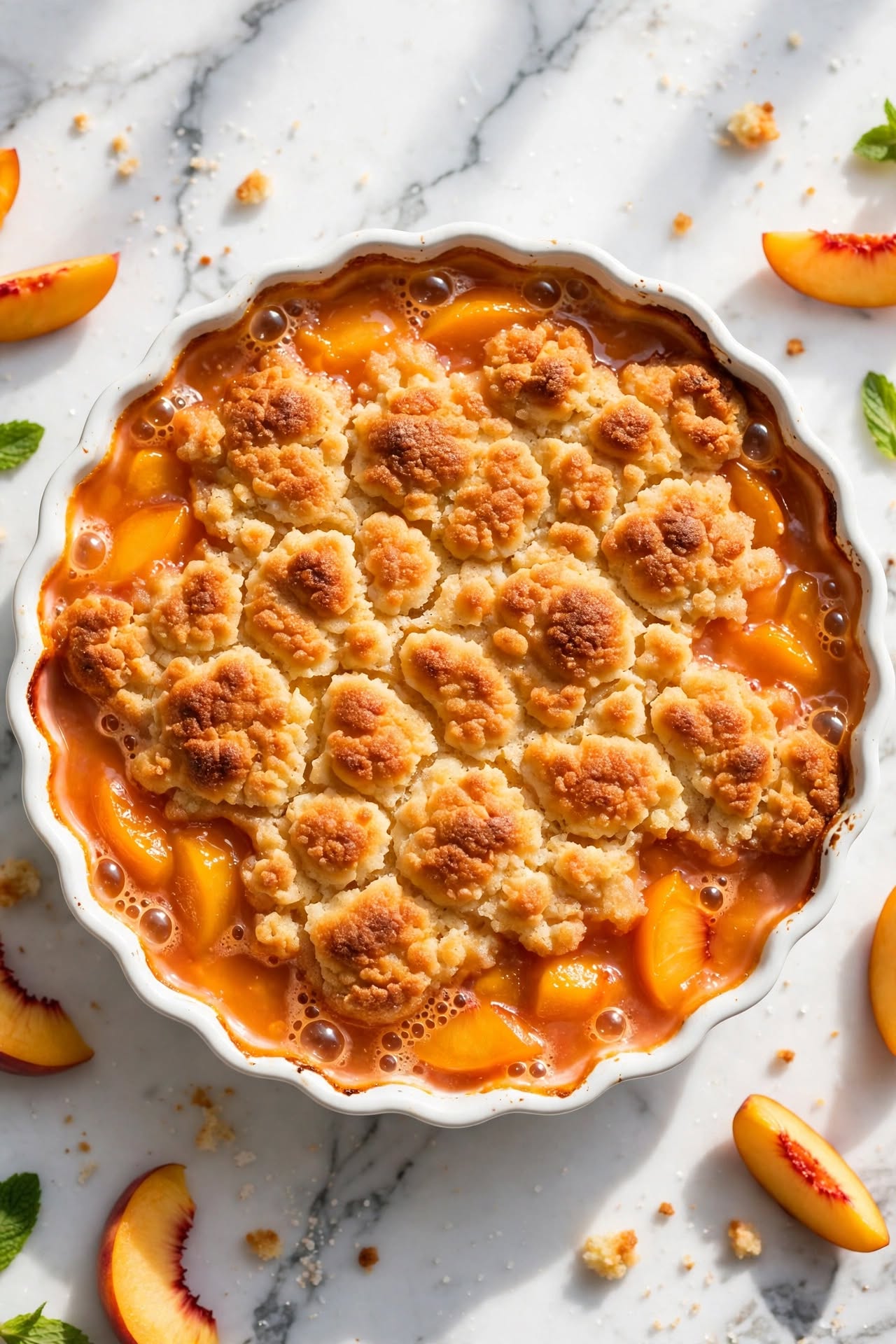

Peach Cobbler with Cake Mix
Ingredients
Method
- Preheat oven to 350°F. Lightly grease a 9×13 baking dish.
- Pour both cans of peaches — syrup and all — into the prepared dish. Spread into an even layer. Sprinkle cinnamon over the peaches if using.
- Pour the entire box of dry cake mix over the peach layer. Spread into an even, lump-free layer with the back of a spoon. Do not add water, eggs, or oil.
- Arrange cold butter slices in overlapping rows across the entire surface of the cake mix. Aim to cover at least 80% of the top. No large uncovered patches.
- Bake at 350°F for 50 to 55 minutes, until the top is deep golden-brown and the filling is visibly bubbling at the edges and center. Do not open the oven before the 45-minute mark.
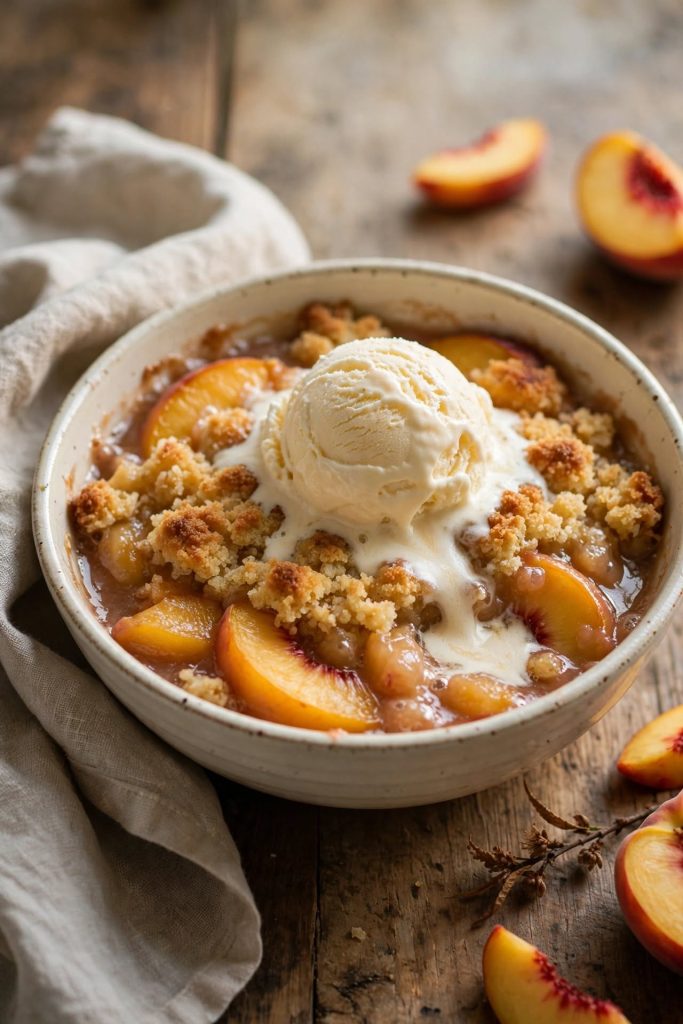
- Rest for 10 minutes before serving. Serve warm with vanilla ice cream.
Notes
More Easy Dessert Recipes You Will Love
- Caramel Apple Pie — Thick Filling, Flaky Crust, No Soggy Bottom
- Chocolate Peanut Butter Pie — No Bake
- No-Bake Cheesecake That Actually Sets Every Time
- Pumpkin Cheesecake — Creamy, Spiced, and Crack-Free Every Time
- Christmas Cheesecake — Creamy, Festive, and Ready the Night Before
Did you make this peach cobbler with cake mix? Leave a ⭐⭐⭐⭐⭐ rating below and tell me in the comments what variation you tried. I read every comment and would love to know how yours turned out.