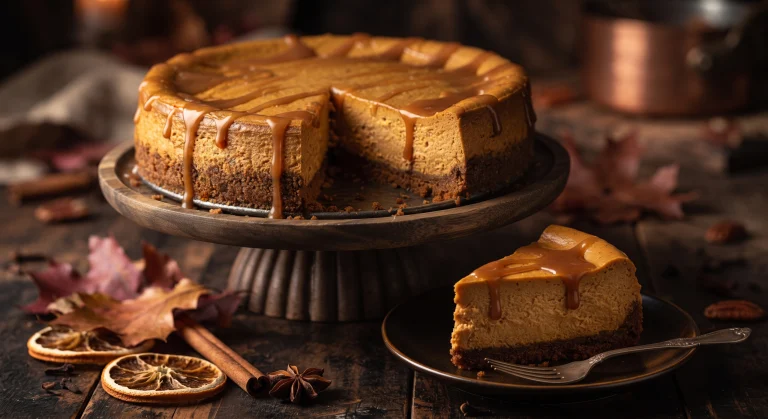
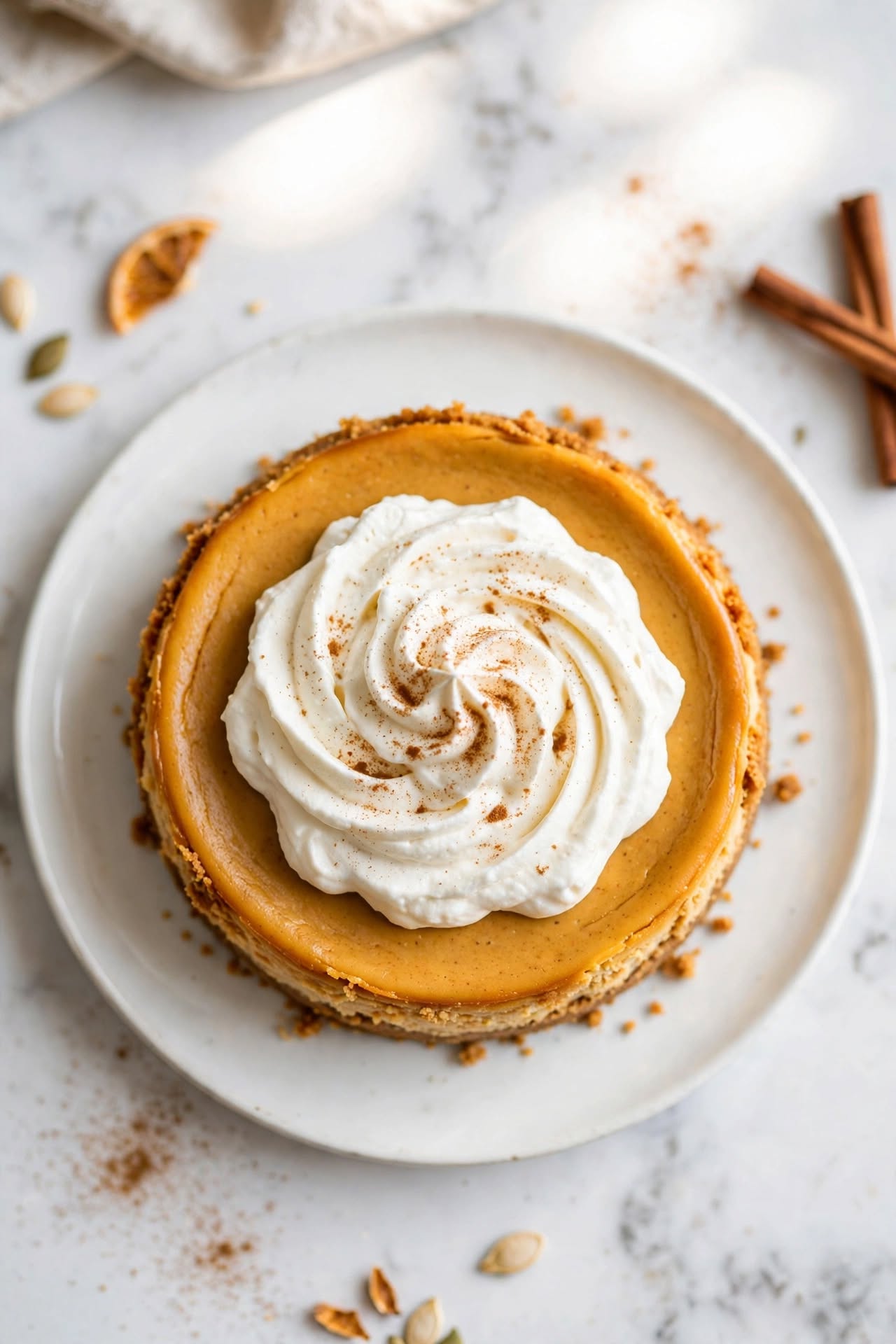
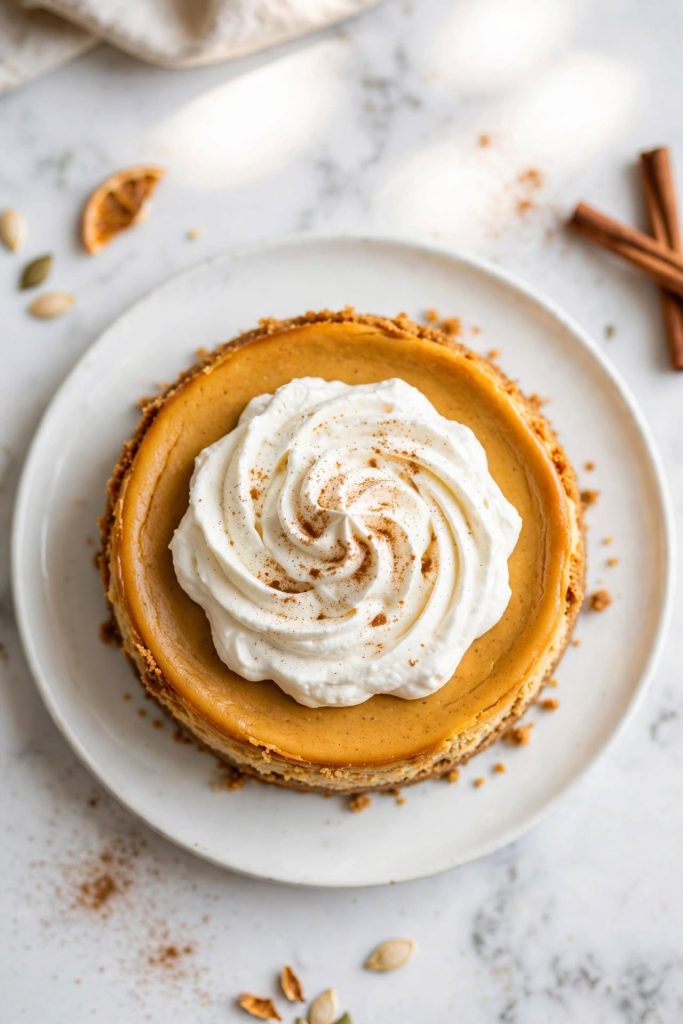
What is pumpkin cheesecake? Pumpkin cheesecake is a baked cream cheese dessert with a spiced pumpkin filling set over a graham cracker crust. It combines warm autumn spices — cinnamon, nutmeg, and ginger — into a dense, smooth filling that slices cleanly after chilling overnight. Prep takes about 25 minutes. Best for home bakers who want a showstopping Thanksgiving or fall dessert that holds up beautifully on a serving platter.
This pumpkin cheesecake delivers a dense, velvety filling with warm spice in every bite — no cracks, no sunken center, and no guesswork. The water bath method keeps the heat gentle and even, which is the single biggest factor in a smooth result. If your last cheesecake cracked or came out rubbery, this method fixes both. I tested this recipe four times, adjusting oven temperature and the water bath seal each time, before the method was reliable enough to publish.
Why This Recipe Works
Most pumpkin cheesecake recipes leave too much to chance. This one removes the variables.
- Room-temperature cream cheese — cold cream cheese traps air pockets and produces a grainy, uneven filling. Letting it sit out for a full 90 minutes is non-negotiable for a smooth result.
- A foil-wrapped water bath — the humid environment keeps the oven temperature around the pan at a steady 212°F, which prevents the edges from cooking faster than the center and eliminates cracking.
- Pure pumpkin purée, not pumpkin pie filling — the extra sugar and starch in pie filling changes the texture and throws off the spice balance entirely.
- A full overnight chill — the cheesecake continues setting as it cools. Cutting after only 4 hours gives you a soft, messy slice. Overnight gives you clean, bakery-style edges.
- Brown sugar in the filling — its molasses content adds depth that white sugar cannot match in a spiced dessert.
- One-bowl filling — no double boilers, no water baths on the stovetop, no tempering eggs. Every step is designed to be manageable for a home kitchen.
If you are looking for more fall baking guides, our seasonal baking collection is a solid place to start.
Ingredients for Pumpkin Cheesecake
Every ingredient here has a specific job. Here is what each one does — and what to use if you need to make a substitution.
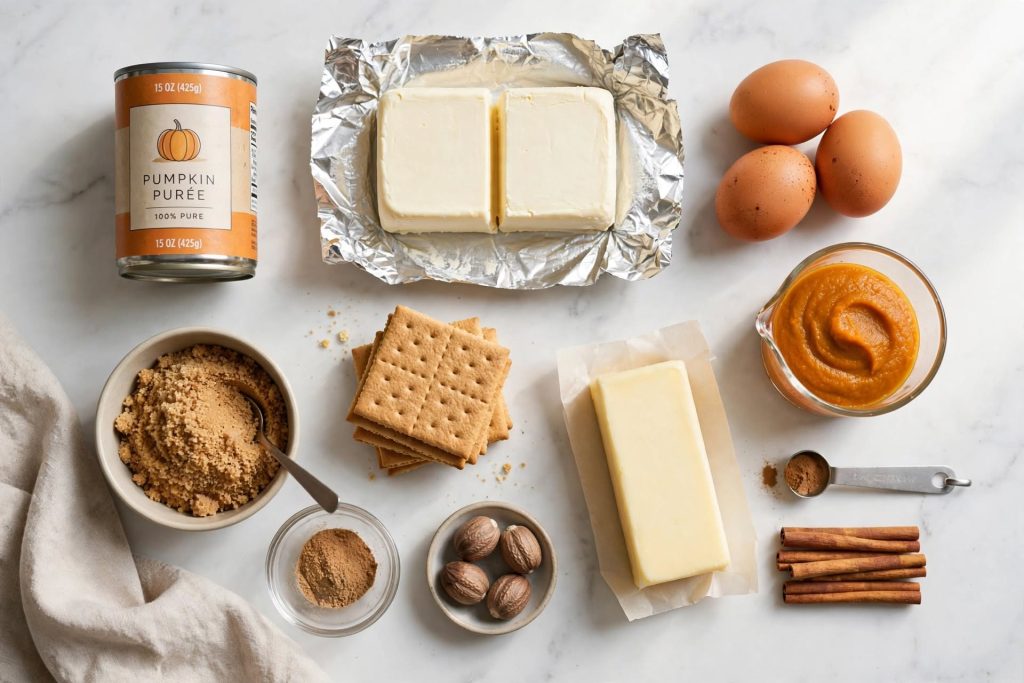
Every ingredient here has a specific job. Here is what each one does — and what to use if you need to make a substitution.
The Crust
| Ingredient | Amount | What It Does | Best Substitute + Impact |
|---|---|---|---|
| Graham cracker crumbs | 1½ cups | Forms the crisp, slightly sweet base | Digestive biscuits — slightly less sweet, same texture |
| Unsalted butter (melted) | 5 tablespoons | Binds the crumbs and creates a firm structure | Coconut oil — works, but crust is softer |
| Granulated sugar | 2 tablespoons | Adds light sweetness and helps the crust hold | Brown sugar — adds molasses note, works equally well |
| Ground cinnamon | ½ teaspoon | Ties the crust flavor into the filling’s spice profile | Optional — omit if you want a plain crust |
The Filling
| Ingredient | Amount | What It Does | Best Substitute + Impact |
|---|---|---|---|
| Cream cheese, full-fat block, room temp | 24 oz (3 blocks) | Provides the dense, tangy base of the filling | Light cream cheese — works but filling will be less firm |
| Pure pumpkin purée | 1 cup | Adds color, moisture, and the core autumn flavor | Butternut squash purée — nearly identical in flavor |
| Brown sugar, packed | ¾ cup | Sweetens and adds depth with a molasses undertone | White sugar — works but loses subtle richness |
| Eggs, large, room temp | 3 | Bind the filling and create a smooth, set texture | No reliable egg-free sub for baked cheesecake |
| Sour cream | ½ cup | Adds tang and a slightly looser, creamier texture | Full-fat Greek yogurt — same tang, same result |
| Ground cinnamon | 1½ teaspoons | Warmth and the primary autumn spice note | — |
| Ground ginger | ½ teaspoon | Sharpness that keeps the filling from tasting flat | ¼ teaspoon if using fresh ginger |
| Ground nutmeg | ¼ teaspoon | Adds earthy, slightly sweet depth | Allspice — use the same amount |
| Vanilla extract | 1 teaspoon | Rounds out the sweetness and balances spice | Vanilla bean paste — use same amount |
| Salt | ¼ teaspoon | Sharpens every other flavor in the filling | — |
Key Ingredient Notes
Cream cheese: Use full-fat, block-style cream cheese — not the spreadable kind in a tub. Spreadable cream cheese has more water and produces a filling that will not set firmly. Pull it from the refrigerator at least 90 minutes before you start, or let it sit in a warm kitchen for up to 2 hours.
Pumpkin purée: The can must say “100% pure pumpkin” — not “pumpkin pie filling.” Pumpkin pie filling already contains sugar, starch, and spices. Using it produces a filling that is too sweet, too loose, and unbalanced in flavor.
Eggs: Room-temperature eggs blend into the filling without causing the cream cheese to seize and lump. Pull them from the refrigerator when you pull out the cream cheese.
Equipment You Need
- 9-inch springform pan
- Stand mixer or hand mixer with beaters
- Large roasting pan (for the water bath)
- Heavy-duty aluminum foil — wide sheets, for wrapping the springform pan
- Kitchen scale or dry measuring cups
- Rubber spatula
The Pumpkin Purée Guide
Pumpkin purée is the single biggest variable in how your pumpkin cheesecake recipe turns out. Not all canned pumpkin is identical — and fresh purée adds one more complication.
| Type | Description | Use for This Recipe? |
|---|---|---|
| 100% pure canned pumpkin | Smooth, orange, no additives — the standard | ✅ Best choice |
| Pumpkin pie filling | Pre-sweetened and spiced — labeled clearly on the can | ❌ Do not use |
| Fresh pumpkin purée (sugar pumpkin) | Roasted and blended — higher water content | ⚠️ Pat dry with paper towels first |
| Butternut squash purée | Similar texture and sweetness, slightly milder flavor | ✅ Acceptable substitute |
| Kabocha squash purée | Drier, slightly sweeter — works well | ✅ Use as-is, no adjustment needed |
If you use fresh pumpkin purée, spread it on a paper-towel-lined plate and let it drain for 10 to 15 minutes before measuring. Extra moisture in the filling can prevent it from setting cleanly.
The visual cue for ideal purée: smooth, deep orange, with no visible water pooling around it.
How to Make Pumpkin Cheesecake — Step by Step
Follow these steps in order. The most important rule: mix the filling on low speed throughout — high speed whips in air bubbles that cause cracking during baking.
Step 1 — Prepare and Press the Crust
Preheat your oven to 325°F (163°C). Lightly grease the inside of a 9-inch springform pan and cut a circle of parchment to line the bottom. Mix the graham cracker crumbs, melted butter, sugar, and cinnamon together in a bowl until the mixture looks like damp sand and clumps when pressed. Press the mixture firmly and evenly into the bottom of the pan using the flat base of a measuring cup — press into the edges too. Bake for 10 minutes. Set aside to cool while you make the filling.
What to look for: The crust surface should look set and slightly golden at the edges — not wet or pale.
Step 2 — Beat the Cream Cheese Until Smooth
Add the room-temperature cream cheese to the bowl of your stand mixer fitted with the paddle attachment. Beat on medium speed for 2 minutes, stopping once to scrape down the sides. The cream cheese should look completely smooth and lump-free before you add anything else. If there are visible lumps at this stage, they will still be there in the finished baked pumpkin cheesecake — keep beating until they are gone.
What to look for: Cream cheese that looks silky, pale, and completely uniform — no visible chunks.
⚠️ Critical step: Do not rush this. Lumpy cream cheese at this stage cannot be fixed by mixing more after adding eggs — overbeating with eggs makes the filling puff and crack during baking.
Step 3 — Add the Pumpkin and Spices
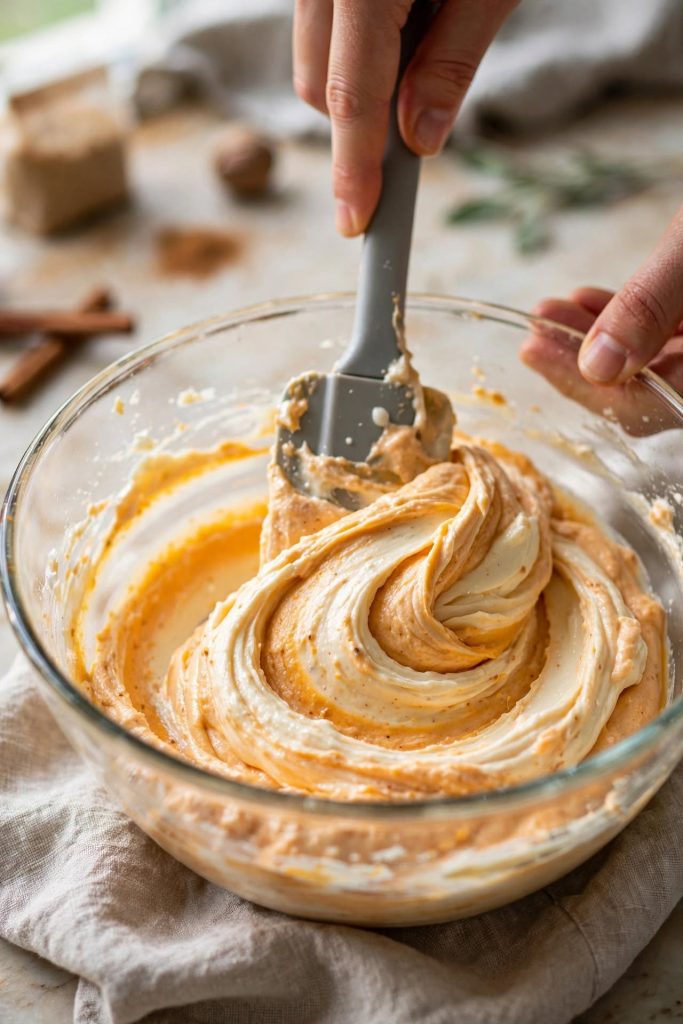
Add the brown sugar and mix on low speed for 30 seconds. Scrape down the bowl. Add the pumpkin purée, sour cream, cinnamon, ginger, nutmeg, vanilla, and salt. Mix on low speed until the filling is smooth and evenly orange — roughly 60 seconds. Add the eggs one at a time, mixing on low speed after each, just until each egg disappears into the batter. Stop mixing the moment the last egg is incorporated.
What to look for: A smooth, uniformly orange batter with no visible swirls or streaks of white cream cheese.
Step 4 — Fill the Pan and Set Up the Water Bath
Wrap the outside of the springform pan with two layers of heavy-duty aluminum foil, bringing the foil all the way up to the rim on the outside. This keeps water out. Place the wrapped pan in your roasting pan. Pour the filling over the cooled crust and smooth the top with a spatula. Place the roasting pan in the oven, then pour hot tap water into the roasting pan until it reaches 1 inch up the sides of the springform pan.
What to look for: The foil must show no gaps at the bottom edge — any gap lets water in and softens the crust.
⚠️ Critical step: Pour the water into the outer roasting pan, not over the cheesecake. One misplaced pour will damage the filling’s surface.
Once you are comfortable with the water bath method, this guide to baked cheesecake troubleshooting is worth reading before your next bake.
Step 5 — Bake, Cool, and Chill
Bake at 325°F for 55 to 65 minutes. The cheesecake is ready when the outer 2 inches look fully set and the center still has a slight jiggle — like gelatin, not like liquid. Turn off the oven, crack the door open by 2 inches, and leave the cheesecake inside for 1 hour. Transfer to the counter for 30 minutes, then refrigerate uncovered for at least 6 hours — overnight produces the cleanest slices and the most developed spice flavor.
What to look for: After chilling, the surface should be matte and firm to a light touch, with no visible soft spots at the center.
The Science Behind a Perfect Pumpkin Cheesecake
A smooth, crack-free result is not luck — it is the result of three ingredients doing specific, predictable jobs.
Cream cheese and eggs → The protein structure of this fall cheesecake forms when egg proteins set during baking. When oven heat is too high or too direct, the proteins tighten too quickly and the filling shrinks — which is what causes cracks. The water bath keeps the heat indirect, so the proteins set slowly and evenly across the entire surface.
Pumpkin purée → Pumpkin adds pectin — a natural thickener — which gives the filling its body. It also adds moisture that softens the final texture compared to a plain cheesecake. Too much pumpkin and the filling will not set; too little and the pumpkin flavor is lost. One cup is the calibrated amount for a 9-inch cheesecake.
Brown sugar → The molasses content in brown sugar acts as a humectant — it holds moisture in the filling after baking. Swap it for white sugar and your cheesecake will be noticeably drier and firmer by day two, with a less nuanced flavor in every bite.
The most critical rule: do not open the oven door in the first 45 minutes of baking. A sudden drop in oven temperature causes the filling surface to contract while the interior is still expanding — and the surface will crack.
Tips for the Best Result
These are the details that separate a good pumpkin cheesecake from one people ask you to make again.
- Pull dairy ingredients early — cream cheese, eggs, and sour cream all need to be at room temperature. Set them out 90 minutes before you start. Cold dairy produces a lumpy filling, and that cannot be fixed after the eggs go in.
- Use a 9-inch springform pan — you need to release the sides cleanly after chilling without cutting through the cheesecake. A 10-inch pan also works but produces a thinner filling that bakes in 45 to 50 minutes.
- Line the springform bottom with parchment — cut a circle to fit before pressing in the crust. Lifting slices onto plates is significantly cleaner.
- Smooth the top before baking — run a spatula over the surface in one flat pass. Any bumps or swirls will be permanent features after baking.
- Make it one to two days ahead — this Thanksgiving cheesecake recipe tastes better after 24 to 48 hours in the refrigerator. The spices develop and the texture firms up into clean slices.
- Dust with cinnamon right before serving — not before refrigerating, where it will absorb into the surface and turn dull.
- Run a thin knife around the inside edge before releasing the springform — this small step prevents the filling from pulling and tearing as the ring opens.
Common Mistakes to Avoid
❌ Using Cold Cream Cheese
Result: Your filling will have visible lumps and a slightly grainy texture in every slice.
Fix: Set cream cheese out on the counter for 90 minutes. If you forgot, cut it into small cubes and microwave at 50% power for 10 seconds at a time, checking after each pass, until it yields to gentle pressure.
❌ Skipping the Water Bath
Result: The top of your cheesecake will crack within the first 20 minutes of baking — often a large fracture across the entire surface.
Fix: If you do not have a roasting pan, place a separate pan of hot water on the oven rack below the cheesecake. Less effective than a direct water bath, but significantly better than nothing.
❌ Overbaking Until the Center Is Firm
Result: The filling sets rubbery and dense, and a crack is almost guaranteed as the cheesecake cools.
Fix: Pull the cheesecake when 2 inches of the edge look set and the center still jiggles. It will continue cooking from residual heat after the oven turns off.
❌ Cutting Before Fully Chilled
Result: Slices pull apart, the filling sticks to the knife, and the interior looks creamy rather than fully set.
Fix: Refrigerate for at least 6 hours. Overnight is the standard for a clean slice. Wiping the knife with a damp cloth between cuts also helps.
❌ Using Pumpkin Pie Filling Instead of Pumpkin Purée
Result: The filling is too sweet, the spices are out of balance, and the texture is looser than it should be because of the added starch and syrup.
Fix: Check the label before opening. The ingredient list should say “pumpkin” — nothing else.
❌ Wrapping the Springform Pan Too Loosely
Result: Water seeps through into the crust, which goes soggy and collapses when you remove the springform ring.
Fix: Use two overlapping layers of wide, heavy-duty foil and press the foil firmly up the entire outside of the pan — to the rim, not just the base.
For more in-depth guides like this one, our cheesecake troubleshooting guide covers every common failure in the same detail.
Variations Worth Trying
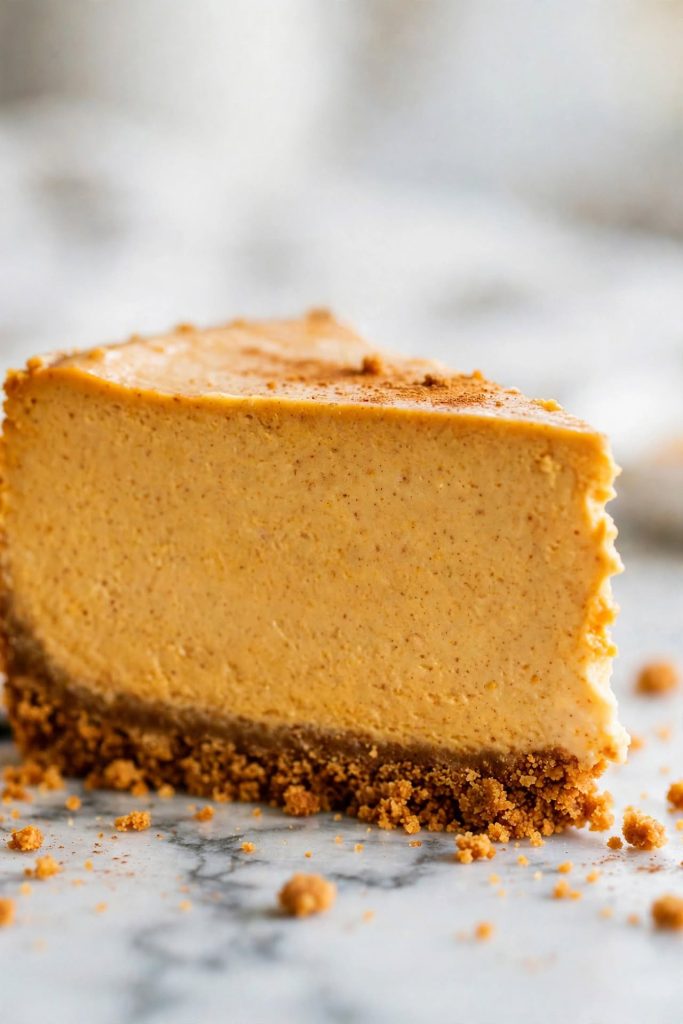
No-Bake Pumpkin Cheesecake
What changes: Replace eggs with 1½ teaspoons of unflavored powdered gelatin, bloomed in 2 tablespoons of cold water. Skip the oven and water bath entirely.
When: After whipping the filling smooth, fold in the bloomed gelatin and pour directly over the crust.
Result: A lighter, mousse-like texture with the same warm spice flavor — sets cleanly in 4 to 6 hours in the refrigerator.
Pumpkin Cheesecake Bars
What changes: Use a 9×13-inch baking pan lined with parchment. Halve the crust thickness. No springform needed.
When: Reduce baking time to 40 to 45 minutes at 325°F. No water bath is necessary — the thinner format bakes more evenly without one.
Result: Portable, easy-to-serve squares — the ideal format for a potluck, bake sale, or school event.
Gingersnap Crust Version
What changes: Replace graham cracker crumbs with finely crushed gingersnap cookies. Skip the added cinnamon in the crust.
When: Same prep, same baking time — only the crust ingredient changes.
Result: A sharper, spicier base that amplifies the ginger note already in the filling — a stronger match for a holiday cheesecake presentation.
Caramel Swirl Pumpkin Cheesecake
What changes: After pouring the filling, drizzle 3 tablespoons of salted caramel sauce over the top. Use a skewer or toothpick to swirl in circles.
When: Just before the pan goes into the oven.
Result: Visible caramel ribbons set into the filling after baking — adds a salty-sweet layer to every slice that pairs well with the spiced pumpkin cream cheese filling.
Mini Pumpkin Cheesecakes
What changes: Press the crust into a standard muffin tin lined with paper cups — about 1 tablespoon of crust per cup. Fill each cup two-thirds of the way with filling.
When: Bake at 325°F for 18 to 22 minutes — no water bath is needed at this size.
Result: Individual servings that set quickly and plate cleanly, popular for parties where you want no-fuss portioning.
How to Store
Room Temperature
Pumpkin cheesecake should not sit at room temperature for more than 2 hours — this is a food-safety guideline for egg- and dairy-based desserts, not just a quality note. If your kitchen is warm, return it to the refrigerator sooner. Cover loosely with plastic wrap if you are keeping it out briefly for serving.
Refrigerator
Store the cheesecake in an airtight container or cover the pan tightly with plastic wrap. Best quality for up to 5 days. After day 3, the crust softens noticeably and the spice flavor mellows slightly. Let slices sit at room temperature for 10 to 15 minutes before serving — cold cheesecake is denser and the flavor is less forward when served straight from the refrigerator.
Freezer — Complete Guide
Pumpkin cheesecake freezes well. The filling holds its texture after thawing; the crust softens slightly but remains intact.
To freeze whole: Let the cheesecake chill completely in the refrigerator first. Remove the springform ring. Wrap the entire cheesecake in two layers of plastic wrap, then one layer of aluminum foil. Freeze on a flat surface.
To freeze by the slice: Place individual slices on a parchment-lined sheet pan. Freeze uncovered for 1 hour until firm, then transfer to a zip-lock freezer bag with parchment between each slice.
Duration: Best quality for up to 2 months. Safe beyond this window but texture and flavor gradually decline. Use your judgment — if it smells off or shows freezer burn damage, discard it.
To thaw: Transfer from the freezer to the refrigerator the night before serving. Allow 6 to 8 hours for a whole cheesecake, 2 to 3 hours for individual slices. Avoid thawing at room temperature — the exterior softens before the center has thawed through.
If make-ahead baking is part of your routine, our freezer-friendly desserts guide fits perfectly into that approach.
How to Serve
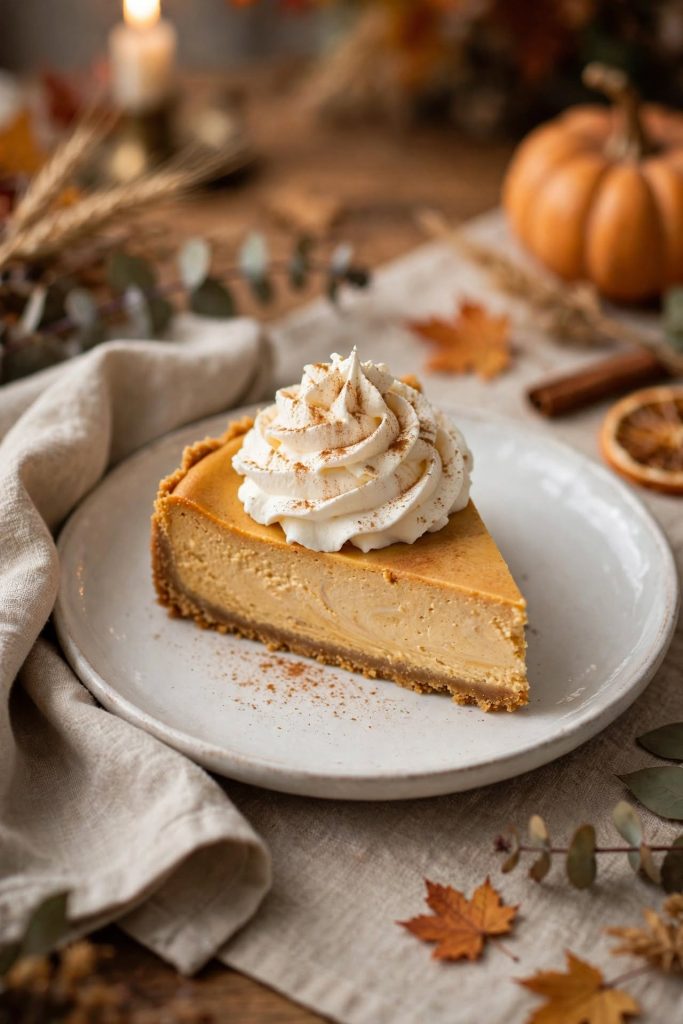
Classic Ways to Serve
- Chilled, straight from the refrigerator, with a light dusting of ground cinnamon
- With a spoonful of unsweetened whipped cream on top — the mild dairy note balances the filling’s sweetness without competing with the spice
- Alongside a hot cup of black coffee or spiced tea — the bitterness cuts through the richness of the cream cheese pumpkin dessert
Upgraded and Occasion-Worthy
- Drizzle warm salted caramel sauce over each slice right before serving — the contrast between cold cheesecake and warm caramel is a crowd moment
- For a holiday table: serve on a slate board with whole toasted pecans and a cinnamon stick as garnish — the visual impact requires zero extra effort
- To transport: leave the cheesecake in the springform pan and refrigerate until arrival — release the ring at the table for a cleaner, more impressive presentation
Pumpkin cheesecake pairs well with warm drinks, autumn fruit (poached pears, spiced apples), and any occasion from a quiet weeknight dinner to a Thanksgiving dessert table.
Frequently Asked Questions
Can I make pumpkin cheesecake without a water bath?
Yes, you can bake it without a water bath, but cracking is significantly more likely. Place a separate oven-safe pan filled with 1 inch of hot water on the rack below the cheesecake. This adds humidity to the oven and partially replicates the effect of a full water bath. Lower the oven temperature by 25°F and check for doneness at the 50-minute mark.
Why did my pumpkin cheesecake crack on top?
Cracking typically comes from one of three causes: overbaking, a sudden temperature change, or too much air whipped into the filling. Make sure you stop baking while the center still jiggles, turn the oven off and leave the door cracked rather than removing the cheesecake immediately, and mix the filling on low speed throughout. Cracks can be filled with whipped cream before serving — they do not affect flavor.
How do I know when pumpkin cheesecake is done?
The cheesecake is ready when the outer 2 inches of the filling look matte and fully set, and the center 2 to 3 inches still jiggle when you gently nudge the pan. The internal temperature at the center should read between 145°F and 150°F on an instant-read thermometer. If the entire top looks set and firm, it is overbaked.
Can I make pumpkin cheesecake ahead of time?
Yes — and this recipe tastes better made 1 to 2 days ahead. The spices develop more depth after a full 24 to 48 hours in the refrigerator, and the texture firms up into clean, bakery-style slices. Make it up to 3 days in advance and store covered in the refrigerator.
How long does pumpkin cheesecake last?
Best quality for up to 5 days in the refrigerator in an airtight container. The filling stays smooth and the spice flavor holds through day 3; after that, the crust softens and the flavor mellows. Use your judgment — if it smells off or shows mold, discard it.
Can I freeze pumpkin cheesecake?
Yes. Freeze individual slices or the whole cheesecake for best quality up to 2 months. Wrap tightly in plastic wrap first, then foil. Thaw overnight in the refrigerator before serving. If you enjoyed this recipe, our baked cream cheese desserts collection is the next place to look for your next project.
What can I substitute for graham crackers in the crust?
Digestive biscuits are the closest substitute — same texture, slightly less sweet. Gingersnap cookies make a spicier crust that pairs very well with the pumpkin filling. Vanilla wafers work but produce a softer crust. For a gluten-free option, use gluten-free graham crackers or 1 cup of almond flour combined with 3 tablespoons of melted butter.
Can I double this recipe?
Yes, with one change: use two separate 9-inch springform pans rather than one larger pan. Doubling the filling in a single pan increases thickness and requires significantly longer baking time that is difficult to predict accurately. Two pans at the same oven setting give you the same reliable result.
Why did my pumpkin cheesecake sink in the middle?
Sinking in the center usually comes from one of two causes: the filling was beaten on too high a speed (whipping in air that then deflates during baking), or the cheesecake was underbaked and the center set too softly to hold its shape. Mix on low speed and bake until the outer edges are visibly firm before removing from the oven.
What size pan works best for pumpkin cheesecake?
A 9-inch springform pan is the standard for this recipe. A 10-inch pan produces a slightly thinner cheesecake that bakes in roughly 45 to 50 minutes — reduce baking time accordingly. Do not use a pan smaller than 9 inches; the extra depth causes uneven baking where the outer edges overcook before the center is ready.
Can I use pumpkin pie filling instead of pumpkin purée?
No — pumpkin pie filling already contains added sugar, starch, and spices in unknown quantities. Using it throws off the spice balance, adds sweetness you cannot control, and changes the filling’s consistency. The can must say “100% pure pumpkin” with one ingredient listed.
What spices work best in pumpkin cheesecake?
Cinnamon, ginger, and nutmeg are the core three. Allspice adds a clove-like warmth and works well in smaller amounts — ¼ teaspoon maximum. Cardamom adds a floral note that pairs well with the pumpkin flavor but can become dominant; use no more than ⅛ teaspoon. Avoid pre-mixed pumpkin pie spice if possible — the ratios vary by brand and the result is less predictable than building your own blend.

Pumpkin Cheesecake
Method
- 1½ cups (150g) graham cracker crumbs
- 5 tablespoons (70g) unsalted butter, melted
- 2 tablespoons granulated sugar
- ½ teaspoon ground cinnamon
- 24 oz (680g) full-fat block cream cheese, room temperature
- ¾ cup (150g) packed brown sugar
- 1 cup (240g) 100% pure pumpkin purée
- ½ cup (120g) full-fat sour cream, room temperature
- 3 large eggs, room temperature
- 1½ teaspoons ground cinnamon
- ½ teaspoon ground ginger
- ¼ teaspoon ground nutmeg
- 1 teaspoon vanilla extract
- ¼ teaspoon salt
Notes
- Do not use spreadable cream cheese — the extra water content prevents the filling from setting properly.
- Fresh pumpkin purée works, but drain it on paper towels for 15 minutes first to remove excess moisture.
- This cheesecake can be made up to 3 days ahead and stored covered in the refrigerator.
- For the cleanest slices, wipe the knife blade with a damp cloth between every cut.
- Serve with unsweetened whipped cream and a light dusting of cinnamon right before plating.Tip tPreheat oven to 325°F (163°C). Grease a 9-inch springform pan and line the bottom with parchment. Mix crumbs, butter, sugar, and cinnamon until it resembles damp sand. Press firmly into the pan base. Bake 10 minutes. Cool. Beat cream cheese in a stand mixer on medium speed for 2 minutes until completely smooth. Scrape the bowl. Add brown sugar; mix on low 30 seconds. Add pumpkin, sour cream, spices, vanilla, and salt. Mix on low until smooth. Add eggs one at a time on low speed, mixing just until each disappears. Stop immediately after the last egg. Wrap the outside of the springform pan with two overlapping layers of heavy-duty foil, pressing up to the rim. Pour filling over the crust and smooth the top. Set wrapped pan in a roasting pan. Pour hot water into the roasting pan to reach 1 inch up the springform sides. Bake 55 to 65 minutes, until the edges look set and the center still jiggles gently. Turn off the oven. Crack the door open 2 inches. Leave cheesecake inside for 1 hour. Remove from the water bath. Cool on the counter 30 minutes. Refrigerate uncovered at least 6 hours or overnight. Run a thin knife around the inside edge. Release the springform ring. Slice with a warm, damp knife.ext
More Dessert Recipes You Will Love
- No-Bake Oreo Cheesecake — Same creamy texture, zero oven time — ideal when you need a crowd-pleaser without heating up the kitchen.
- Caramel Apple Crumble — All the flavors of autumn in one dish, with a buttery oat topping that takes 10 minutes to prepare.
- Pecan Pie Bars — The filling of a classic pecan pie baked into portable squares — a smart choice for a holiday dessert table with multiple options.
- Spiced Carrot Cake with Cream Cheese Frosting — The same warm spice profile as this cheesecake, in a cake that feeds a crowd in a single bake.
- Brown Butter Snickerdoodles — The most low-effort cookie on the site, ready in 25 minutes, with a caramelized edge that stays soft for days.
Did you make this pumpkin cheesecake? Leave a ⭐⭐⭐⭐⭐ rating below and let me know in the comments how it turned out. I read every comment and would love to know what worked for you.