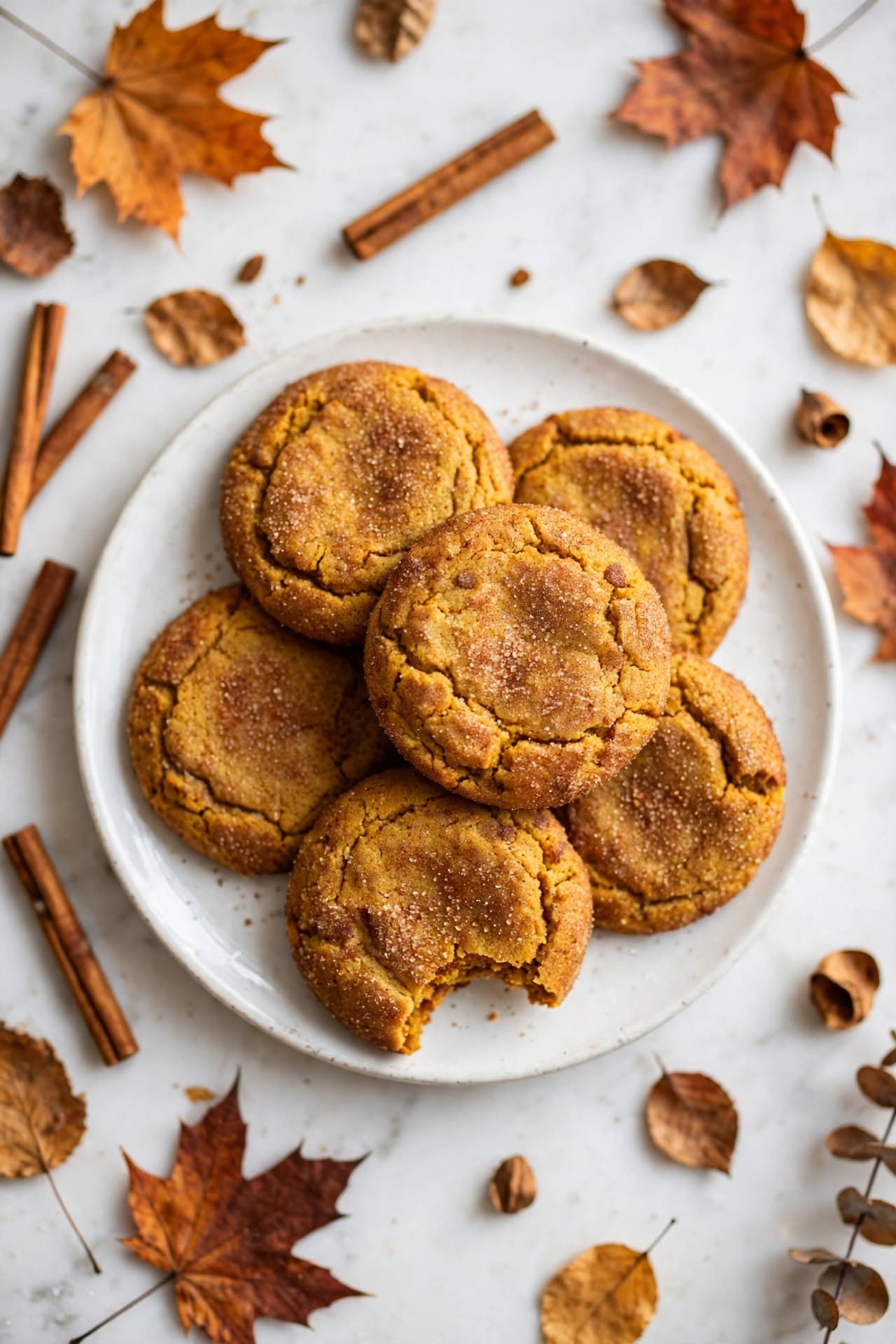
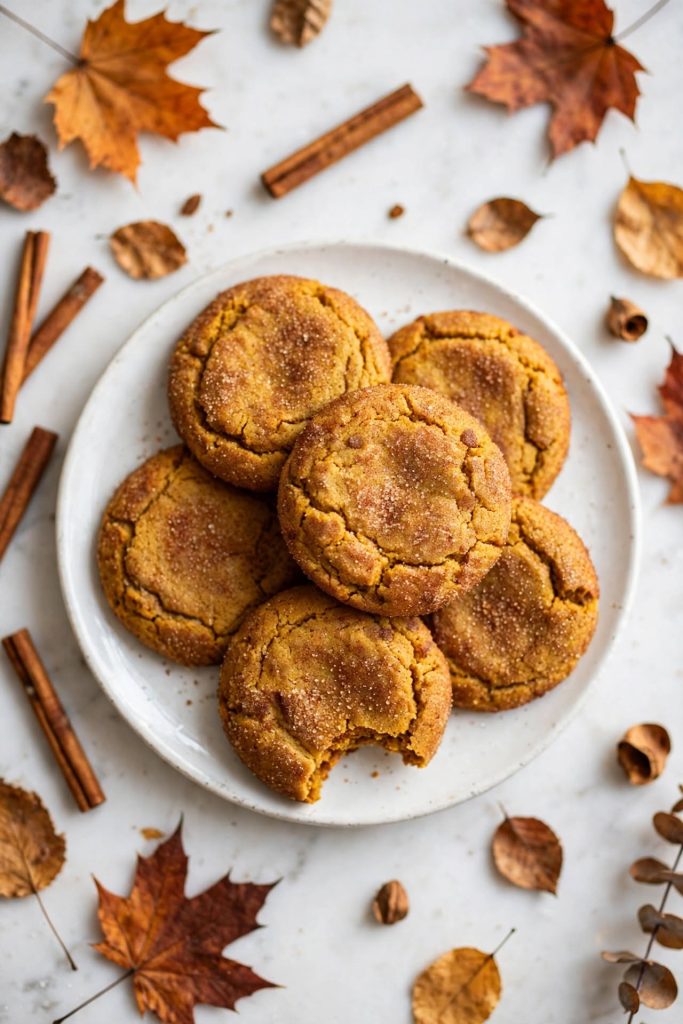
What are pumpkin cookies? Pumpkin cookies are a soft, spiced fall cookie made with canned pumpkin puree, warm spices, and brown sugar. The pumpkin adds natural moisture that keeps the crumb tender for several days. They bake in 11 to 13 minutes after a required 30-minute chill, and are rolled in cinnamon sugar before baking for a lightly sparkly, slightly crisp exterior. Best for home bakers who want a reliable seasonal cookie that is distinctly pumpkin-flavoured — not a pumpkin-tinted sugar cookie.
These pumpkin cookies are soft, warmly spiced, and rolled in cinnamon sugar for a lightly crisp exterior that contrasts with the tender crumb inside. The recipe uses one bowl, one crucial prep step — blotting the pumpkin puree — and a 30-minute chill that makes the difference between a cookie and a cake round. If your biggest concern is pumpkin cookies that come out cakey, flat, or flavourless, the method here addresses all three directly. I tested this recipe multiple times before publishing to make sure the ratios produce the same result across different ovens and different pumpkin puree brands.
Why These Pumpkin Cookies Work
Pumpkin cookies have a reputation for turning out cakey and soft in the wrong way — more like a muffin top than a cookie. Every decision in this recipe exists to fight that tendency and produce a cookie with genuine chew and a defined edge.
- Blotted pumpkin puree — removing excess moisture from the puree before measuring is the single biggest change you can make to a pumpkin cookie recipe. Unblotted puree adds so much water to the dough that no amount of flour can compensate.
- Egg yolk only — whole eggs add both fat and water; yolks add only fat. The fat enriches the crumb and promotes chew; the removed water prevents the puffed, cakey texture that ruins most pumpkin cookie recipes.
- Brown sugar only — brown sugar’s molasses content keeps the cookie moist and tender for days longer than white sugar would. It also adds a deep caramel undertone that pairs perfectly with the warm spice blend.
- Mandatory chill time — pumpkin adds significant moisture to the dough. Without chilling, the dough is too loose to shape and the cookies spread excessively. Thirty minutes minimum; one hour is better.
- Cinnamon sugar coating — rolling the dough balls in cinnamon sugar before baking creates a lightly crisp exterior shell as the sugar caramelises in the oven — a textural counterpoint to the soft interior.
- Pulled before they look done — pumpkin cookies do not brown the way standard butter cookies do. Waiting for visual browning means overbaking. Pull them when edges are set and centres still look soft.
🔗 IL-1: “If you are looking for more [fall baking recipes], our autumn cookie guide is a great place to start.” — Replace anchor text and URL before publishing.
Ingredients for Pumpkin Cookies
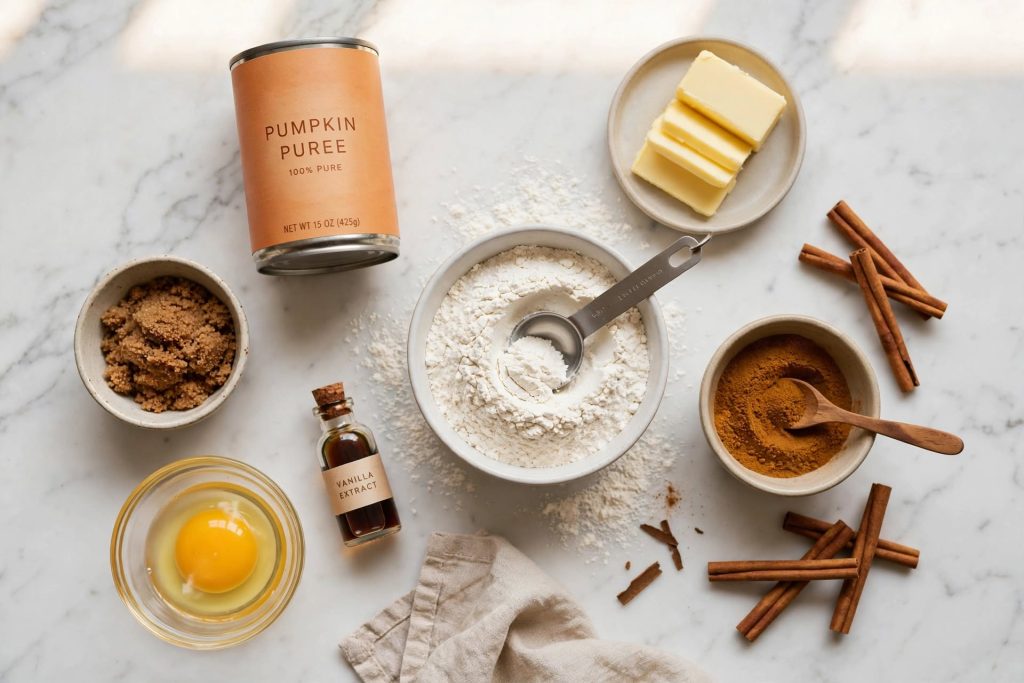
Every ingredient here has a specific job. Here is what each one does — and what to use if you need to make a substitution.
The Cookie Dough
| Ingredient | Amount | What It Does | Best Substitute + Impact |
|---|---|---|---|
| Canned pumpkin puree, blotted | 130g / ½ cup | Flavour, moisture, natural colour — measured after blotting | Fresh roasted pumpkin puree — must be blotted even more thoroughly |
| Unsalted butter, softened | 115g / ½ cup | Fat base for flavour, richness, and structure | Salted butter — omit the added salt; result is slightly saltier |
| Packed light brown sugar | 200g / 1 cup | Sweetens, retains moisture, adds caramel depth | Dark brown sugar — stronger molasses note, same texture outcome |
| Egg yolk, room temperature | 1 large | Fat and binding — without the water a whole egg would add | 1 tbsp unsweetened applesauce — slightly softer crumb |
| Vanilla extract | 1 tsp | Rounds out the spice blend and adds warmth | Vanilla bean paste — same quantity, slightly stronger |
| All-purpose flour | 225g / 1¾ cups | Structure — more than a standard cookie to absorb pumpkin’s moisture | 1:1 gluten-free flour blend — slightly more crumbly |
| Baking soda | 1 tsp | Lift and light browning at the edges | No substitute — do not skip |
| Pumpkin pie spice | 1½ tsp | Primary spice flavour — cinnamon, ginger, cloves, nutmeg blend | DIY blend: 1 tsp cinnamon + ¼ tsp ginger + ⅛ tsp cloves + ⅛ tsp nutmeg |
| Ground cinnamon | ½ tsp | Reinforces the warmth of the spice blend | N/A — part of the spice structure |
| Salt | ¼ tsp | Balances sweetness and amplifies spice flavour | N/A |
The Cinnamon Sugar Coating
| Ingredient | Amount | What It Does | Notes |
|---|---|---|---|
| Granulated white sugar | 50g / ¼ cup | Creates a lightly caramelised, sparkly exterior shell | Do not substitute brown sugar — it makes the coating damp instead of crisp |
| Ground cinnamon | 1 tsp | Adds extra cinnamon flavour to the exterior | Increase to 1½ tsp if you prefer a stronger cinnamon crust |
Key Ingredient Notes
Pumpkin puree: Always use plain canned pumpkin puree — not pumpkin pie filling. Check the label: the only ingredient should be pumpkin. The blotting step is not optional regardless of which brand you use. Libby’s is the most consistent brand for baking; store brands vary more in moisture content.
Egg yolk: The single yolk is deliberate and non-negotiable for this recipe. Substituting a whole egg reintroduces the water the blotting step removed and the cookies will be cakey. Separate the egg cold from the fridge; use the white for another purpose (meringue, an omelette, or freeze it).
Brown sugar: Pack it firmly into the measuring cup. Loosely measured brown sugar gives you significantly less moisture and sweetness than the recipe needs.
Flour: This recipe uses slightly more flour than a typical cookie because of the pumpkin’s residual moisture. Measure by weight where possible — scooping from the bag packs the flour and can add 20 to 30g more than the recipe intends.
Equipment You Need
- Stand mixer or electric hand mixer
- Paper towels (4 to 6 sheets) for blotting
- Two baking sheets lined with parchment paper
- 1½-tablespoon cookie scoop for even portions
- Wire cooling rack
- Kitchen scales for accurate measurements
- Small bowl for the cinnamon sugar coating
The Pumpkin Puree Guide
Pumpkin puree is not interchangeable between types, brands, and preparations — the moisture content varies enough to change the texture of the entire batch.
| Type | Moisture Level | Use for This Recipe? | Special Handling |
|---|---|---|---|
| Canned pumpkin puree (Libby’s) | Moderate — consistent batch to batch | ✅ Best — the benchmark | Standard blotting (2 to 3 min) |
| Canned pumpkin puree (store brand) | Moderate to high — varies | ✅ Works — blot extra thoroughly | Extended blotting (4 to 5 min) |
| Fresh roasted pumpkin puree | High — more water than canned | ✅ Works — with extra effort | Blot until paper towels barely show moisture; can take 8 to 10 min |
| Pumpkin pie filling (canned) | High — also contains sugar, spices, milk | ❌ Do not use — changes the entire recipe | N/A — not a substitute |
| Butternut squash puree | Similar to pumpkin — slightly drier | ✅ Works as substitute | Standard blotting; flavour is milder than pumpkin |
🎃 How to Blot Pumpkin Puree — The Right Way
- Spoon the pumpkin puree onto the centre of 3 to 4 stacked paper towels laid flat on a plate or cutting board.
- Fold the paper towels over the puree and press firmly with your palm — hold for 10 seconds.
- Unfold, discard the used paper towels, and move the puree to fresh paper towels. Repeat twice more.
- The puree is ready when a fresh paper towel pressed onto it comes away with only a faint orange stain — not visibly wet.
- Measure the blotted puree by weight: you need exactly 130g / ½ cup after blotting, not before.
Visual cue: unblotted pumpkin puree looks glossy and wet on the spoon. Properly blotted puree looks matte and holds its shape when scooped — similar in consistency to thick hummus.
How to Make Pumpkin Cookies — Step by Step
Blot the pumpkin puree first — everything else follows in order from there.
Step 1: Blot the Pumpkin Puree
Spread the pumpkin puree across 3 to 4 layers of paper towels. Press firmly and repeatedly with fresh paper towels, replacing as they become saturated. Continue until a fresh sheet pressed to the puree comes away with only a light stain, not visible wetness. Measure 130g / ½ cup of blotted puree and set aside. This step takes 3 to 5 minutes and is the most important step in this entire recipe.
What to look for: the blotted puree should look matte and hold a scooped shape — not slide or pool on the spoon.
Step 2: Preheat Your Oven and Prepare Your Baking Sheets
Preheat your oven to 175°C / 350°F (160°C fan). Line two baking sheets with parchment paper. You will preheat the oven before mixing rather than after, since the dough needs to chill and you want the oven ready exactly when the chill time ends.
Note: if chilling for 1 hour or overnight, preheat the oven 15 minutes before the chill ends rather than at the start of mixing.
Step 3: Mix the Dry Ingredients
Whisk the flour, baking soda, pumpkin pie spice, cinnamon, and salt together in a medium bowl until evenly combined. Whisking distributes the spices through the flour so every cookie in the batch gets the same flavour intensity.
What to look for: the mixture should look slightly tan-coloured from the spices, with no visible streaks of one spice clumped together.
Step 4: Cream the Butter and Brown Sugar
Beat the softened butter and packed brown sugar together on medium speed for a full 3 minutes. The mixture will not turn pale the way white sugar creaming does — brown sugar produces a darker, denser cream — but it should feel lighter and slightly airy when rubbed between fingers after 3 minutes.
What to look for: the mixture should increase slightly in volume and look smoother and more uniform than it did at the start — no visible sugar grains when you rub a small amount between your fingers.
Step 5: Add Pumpkin, Egg Yolk, and Vanilla
⚠️ Critical step: Add the blotted pumpkin puree, egg yolk, and vanilla extract all at once and beat until just combined — about 20 to 30 seconds. Do not overbeat at this stage. The mixture may look slightly broken or curdled — this is normal and corrects when the flour goes in.
What to look for: a combined but not necessarily smooth mixture — some streaking is acceptable at this point.
Step 6: Combine Wet and Dry Ingredients
⚠️ Critical step: Add the flour mixture all at once and mix on low speed until just combined — stop the moment you no longer see dry flour streaks. The dough will look softer and stickier than a typical cookie dough. This is expected — the chill time in Step 7 firms it to a workable consistency. Once you are confident with this technique, [our fall cookie round-up] has more recipes that use the same method. [IL-2 — replace before publishing]
What to look for: a combined, soft, slightly tacky dough that holds together when pressed but is too soft to roll at room temperature. Refrigeration firms it to a rollable consistency.
Step 7: Chill, Shape, and Bake
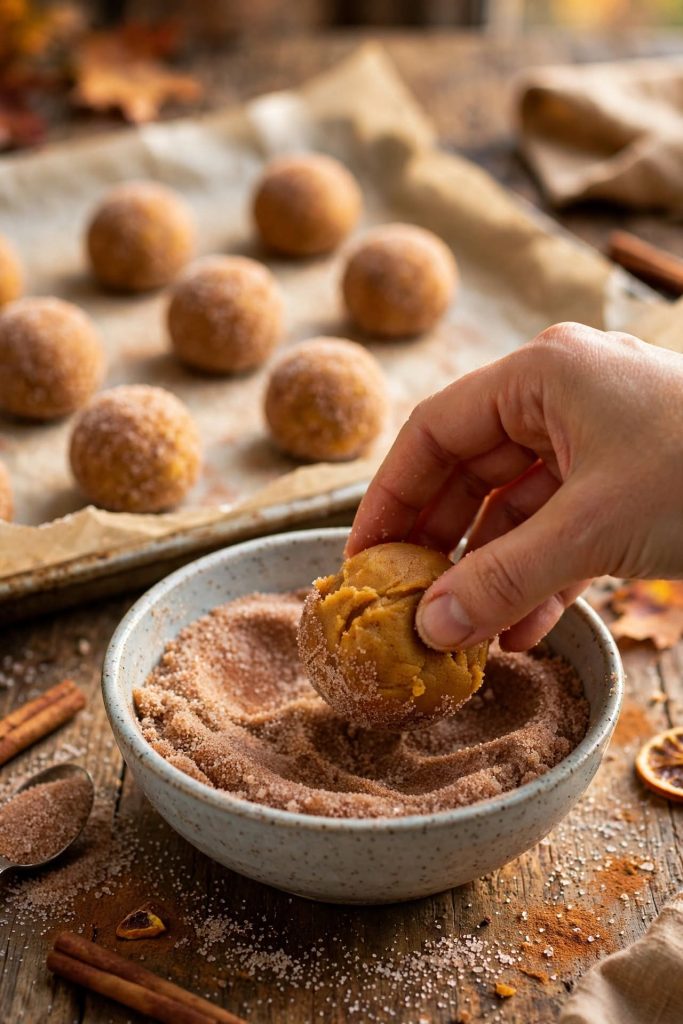
Cover the dough tightly with cling film pressed directly onto its surface and refrigerate for at least 30 minutes — 1 hour gives better results and overnight is fine. When ready to bake, mix the cinnamon sugar in a small bowl. Scoop the chilled dough into 1½-tablespoon balls, roll between palms until smooth, then roll in cinnamon sugar to coat fully. Place 5cm / 2 inches apart on the prepared trays. Bake one tray at a time on the centre rack for 11 to 13 minutes.
What to look for: the edges should look set and the centres should still look slightly soft and pale. Pumpkin cookies do not brown visibly the way butter cookies do — edge-set is your cue, not colour change.
The Science Behind a Soft, Non-Cakey Pumpkin Cookie
Pumpkin is a challenging baking ingredient because it carries a large amount of water. Every element of this recipe is calibrated to manage that water rather than ignore it.
Why Egg Yolk Instead of a Whole Egg
A large egg contains roughly 30ml of water (almost entirely in the white) and about 15ml of fat (almost entirely in the yolk). In a standard cookie with minimal moisture from other ingredients, that water is absorbed and contributes to spread and structure. In a pumpkin cookie, the puree has already introduced a significant amount of water — adding a whole egg’s worth on top pushes the dough past its absorption capacity and produces a batter that bakes into a soft, puffy round instead of a flat cookie. Using only the yolk keeps the fat (which promotes richness and chew) while removing the water (which causes cakey texture). This single swap is the most impactful change you can make to any pumpkin cookie recipe.
Why Blotting the Pumpkin Puree Matters
Canned pumpkin puree contains roughly 85 to 90% water by weight. Even after blotting, a significant amount of moisture remains — which is by design, as the puree needs some moisture to integrate into the dough and provide its flavour and colour. The blotting step removes the surface-level free water — the water that is not bound to the pumpkin’s fibres — which is what causes cookies to spread flat or puff into cakey rounds. Properly blotted puree contributes moisture in a controlled, even way. Unblotted puree overwhelms the flour’s ability to absorb it and the structure collapses in the oven.
Why Brown Sugar Only
Brown sugar pulls double duty in this recipe. Its molasses content is hygroscopic — it draws and retains moisture from the surrounding air — which keeps pumpkin cookies soft and tender for 3 to 4 days after baking instead of drying out overnight. It also produces a denser, more structured cookie than white sugar would, because the molasses adds body to the dough that helps counteract pumpkin’s natural tendency to make cookies spread thin. The deep caramel notes in brown sugar also complement the warm spice blend in a way that white sugar’s neutral sweetness does not.
Tips for the Best Results
Blot the Pumpkin — Every Time
Even if you have made this recipe before and know the steps, blot the puree every single time. The moisture content of canned pumpkin varies between cans of the same brand — a can opened in winter can release noticeably more liquid than the same can in summer due to storage temperature and humidity. Three minutes of blotting guarantees a consistent dough regardless of what the can gives you.
Do Not Skip the Chill Time
Thirty minutes is the minimum; one hour is better. The chill firms the fat back to a solid state after the mixing process warmed it, which gives the dough enough structure to roll into clean balls and hold its shape during baking. Unchilled pumpkin cookie dough is too soft to roll — it sticks to your hands and spreads flat on the tray before even reaching the oven.
Roll in Cinnamon Sugar Right Before Baking
Roll each ball in cinnamon sugar immediately before placing it on the tray — do not coat them in advance and let them sit. The sugar begins drawing moisture from the dough on contact and rolling too far ahead makes the coating damp and sticky rather than crisp and sparkly. Keep the cinnamon sugar bowl beside the baking sheet and roll, place, roll, place in one continuous motion.
Use a Cookie Scoop for Consistent Size
Pumpkin cookie dough is soft enough that hand-portioning becomes messy — a 1½-tablespoon cookie scoop portions the chilled dough cleanly and consistently. Consistent size means every cookie in the batch finishes baking at the same time. A mix of large and small cookies on the same tray means some will be overbaked by the time the largest ones finish.
Underbake by One Minute
Start checking at 11 minutes. If the edges look set and the centre still looks puffy and slightly moist, pull them. Pumpkin cookies do not provide the same visual cue as butter cookies — they do not spread, flatten, or visibly brown. The rule is: set edges, soft centre, out of the oven. Every additional minute past that point makes the cookie noticeably drier.
Cool on the Tray Before Moving
Five minutes on the hot tray is not optional — pumpkin cookies are fragile when warm because of the high moisture content. Moving them too soon causes them to break at the centre or lose their shape. After 5 minutes on the tray, the edges firm enough to slide a spatula under cleanly. Transfer to a wire rack and allow at least 15 more minutes before stacking or storing.
Common Mistakes to Avoid
These are the six errors that consistently produce cakey, flat, or flavourless pumpkin cookies even when the rest of the recipe is followed correctly.
❌ Using Pumpkin Pie Filling Instead of Pumpkin Puree
Pumpkin pie filling is a sweetened, spiced, dairy-enriched product that contains far more sugar, liquid, and additional flavourings than the recipe accounts for. Using it in place of plain puree makes the cookies too sweet, too wet, and unpredictably spiced. Always check the label — plain pumpkin puree lists one ingredient: pumpkin. If it lists sugar, spices, or condensed milk alongside pumpkin, it is pie filling, not puree.
❌ Skipping the Blotting Step
This is the most commonly skipped step and the most consequential. Unblotted pumpkin puree adds enough free water to the dough to produce cookies that bake into soft, domed cake rounds with no chew and no defined edge — exactly what most people are trying to avoid when they search for a pumpkin cookie recipe. Three minutes of blotting changes the entire result. For more guides like this one, [our pumpkin baking guide] covers the same detail across pumpkin bread, muffins, and cake. [IL-3 — replace before publishing]
❌ Using a Whole Egg
A whole egg adds approximately 30ml of water to the dough via the white. In a recipe that is already managing pumpkin’s moisture carefully, that extra water tips the balance and produces a cakey result. The yolk alone provides all the fat and binding the cookie needs. If you accidentally add a whole egg, add an extra 2 tablespoons of flour and chill the dough for 1 hour instead of 30 minutes — it will not fully correct the texture but it reduces the damage.
❌ Skipping the Chill Time
Unchilled pumpkin cookie dough cannot be shaped into balls — it is too soft and sticky. Attempting to bake it without chilling produces flat, misshapen cookies that spread unevenly across the tray. Even 20 minutes in the freezer is better than no chill at all, but 30 minutes in the refrigerator is the minimum for reliable results.
❌ Overbaking
Because pumpkin cookies do not visibly brown or flatten the way standard cookies do, it is easy to leave them in for too long while waiting for a visual cue that will not come. An overbaked pumpkin cookie is dry throughout — not just the edge — and loses the soft, spiced interior that makes the recipe worth making. Pull them at 11 to 12 minutes regardless of how they look, and trust the carry-over baking on the tray to finish the job.
❌ Measuring Flour by Scooping
Scooping the measuring cup directly into a flour bag packs the flour into the cup and adds 20 to 30g more than the recipe intends. In a recipe where moisture is already carefully balanced, excess flour makes the cookie dry and dense. Spoon flour into the cup and level it off, or better yet, measure by weight: 225g / 1¾ cups.
Variations Worth Trying
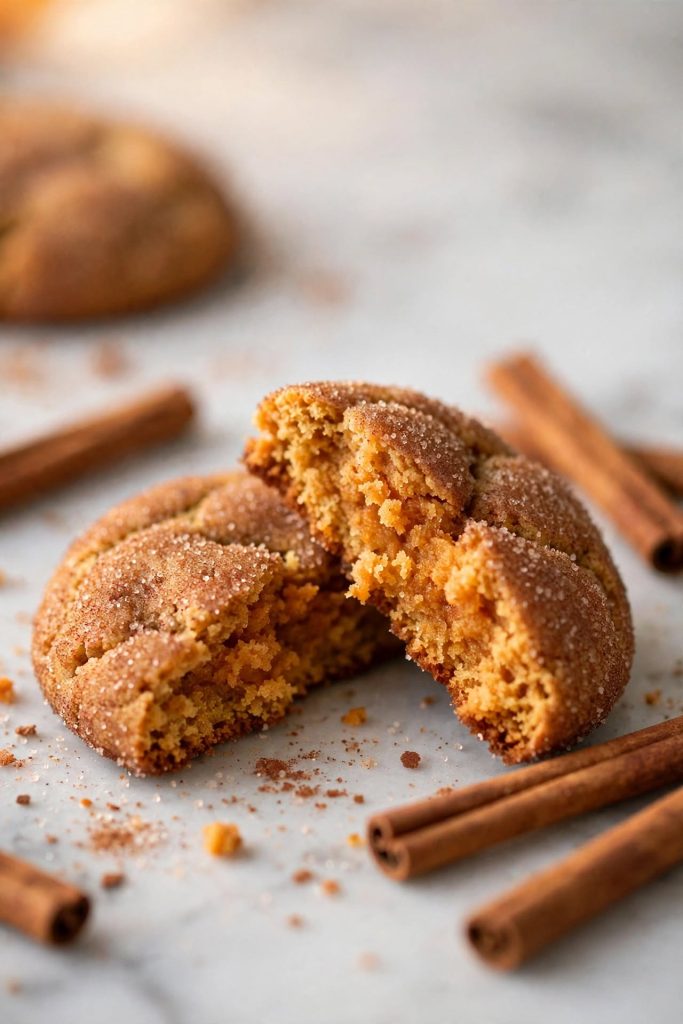
Pumpkin Chocolate Chip Cookies
What changes: Fold 100g / ½ cup of semi-sweet chocolate chips into the dough after the flour is incorporated. Skip the cinnamon sugar rolling and bake plain, or keep the coating — both work.
When: After Step 6, before chilling — the chips hold better in firm chilled dough than in soft warm dough.
Result: The bittersweet chocolate and warm pumpkin spice is one of the most popular fall flavour combinations. The chips add richness and a pockets-of-chocolate texture against the soft crumb.
Cream Cheese Frosted Pumpkin Cookies
What changes: Skip the cinnamon sugar coating. After baking and cooling completely, frost with cream cheese buttercream: 115g / ½ cup softened cream cheese + 60g / ½ cup sifted icing sugar + ½ tsp vanilla, beaten until smooth.
When: After the cookies are fully cooled on the wire rack.
Result: The tang of cream cheese against the warm pumpkin spice is the classic pairing — these are the most popular version at fall bake sales and Thanksgiving dessert tables. Refrigerate any frosted cookies not consumed within a few hours.
Pumpkin Snickerdoodles
What changes: Add ½ tsp cream of tartar to the dry ingredients. Use the standard cinnamon sugar coating but increase to 2 tsp cinnamon per 50g sugar.
When: Add cream of tartar at the dry ingredient stage; adjust the coating ratio before rolling.
Result: The cream of tartar adds the characteristic tang of a snickerdoodle to the pumpkin base, and the heavier cinnamon sugar coating creates a more defined exterior crust. The best version of pumpkin cookies for people who love snickerdoodles.
Pumpkin Oatmeal Cookies
What changes: Replace 60g / ½ cup of the all-purpose flour with 60g / ½ cup of old-fashioned rolled oats. Add ½ tsp extra cinnamon to the dough.
When: At the dry ingredient stage — whisk oats in with the flour, spices, and salt.
Result: A heartier, more textured cookie with a slightly rustic appearance. The oats add chew and a nutty background note. Chill time increases to 45 minutes minimum as the oats absorb some moisture and stiffen the dough.
Brown Butter Pumpkin Cookies
What changes: Brown the butter before using it: melt in a light-coloured pan over medium heat, swirling until the milk solids turn golden brown and smell nutty (about 4 to 5 minutes). Cool to room temperature until solid before creaming.
When: Before Step 4 — the brown butter must be cooled and re-solidified before creaming with the sugar, which takes about 30 minutes at room temperature or 10 minutes in the refrigerator.
Result: The nutty, toasted depth of brown butter transforms the flavour of the base recipe — more complex, slightly caramel-forward, and noticeably different from the standard version. Worth the extra step for a special occasion.
How to Store
Room Temperature
Pumpkin cookies keep for best quality for up to 4 days at room temperature in an airtight container. The high moisture content from the pumpkin keeps them soft longer than most cookies — but that same moisture means they can go off faster in warm or humid conditions. If your kitchen is above 22°C / 72°F, refrigerate after day 2.
Store in a single layer with parchment paper between layers if stacking — the soft texture means they compress and stick together more easily than drier cookies.
Refrigerator
Pumpkin cookies keep for best quality for up to 7 days refrigerated in an airtight container. Cold temperatures firm the texture slightly — bring to room temperature for 15 to 20 minutes before serving for the best soft, chewy result.
Unbaked dough keeps refrigerated for up to 3 days, tightly wrapped in cling film. The flavour actually improves overnight as the spices meld. Bake straight from the fridge, adding 1 to 2 minutes to the bake time.
Freezer — Complete Guide
Can you freeze pumpkin cookies? Yes — both baked cookies and unbaked dough freeze well.
To freeze baked cookies: cool completely, layer between sheets of parchment in an airtight container. Best quality for up to 3 months. The cinnamon sugar coating softens slightly after thawing but re-crisps if warmed for 3 to 4 minutes in a 160°C / 325°F oven.
To freeze unbaked dough balls: freeze before rolling in cinnamon sugar — coat them just before baking. Freeze on a parchment-lined tray for 1 hour until firm, then transfer to a zip-lock bag. Best quality for up to 3 months.
To bake from frozen: roll in cinnamon sugar straight from frozen, place on lined tray, and bake at the same temperature adding 2 to 3 extra minutes. Do not thaw first — the dough softens too much during thawing and loses its shape.
To thaw baked cookies: move to the counter for 20 to 25 minutes. The texture is very close to freshly baked after thawing at room temperature.
Use your judgment — pumpkin’s moisture means baked cookies can develop mould faster than lower-moisture cookies if not stored correctly. If in doubt, freeze rather than refrigerate for long-term storage.
🔗 IL-4: “If batch baking and freezing ahead is something you enjoy, [our make-ahead fall baking guide] covers the full seasonal cookie lineup.” — Replace before publishing.
How to Serve
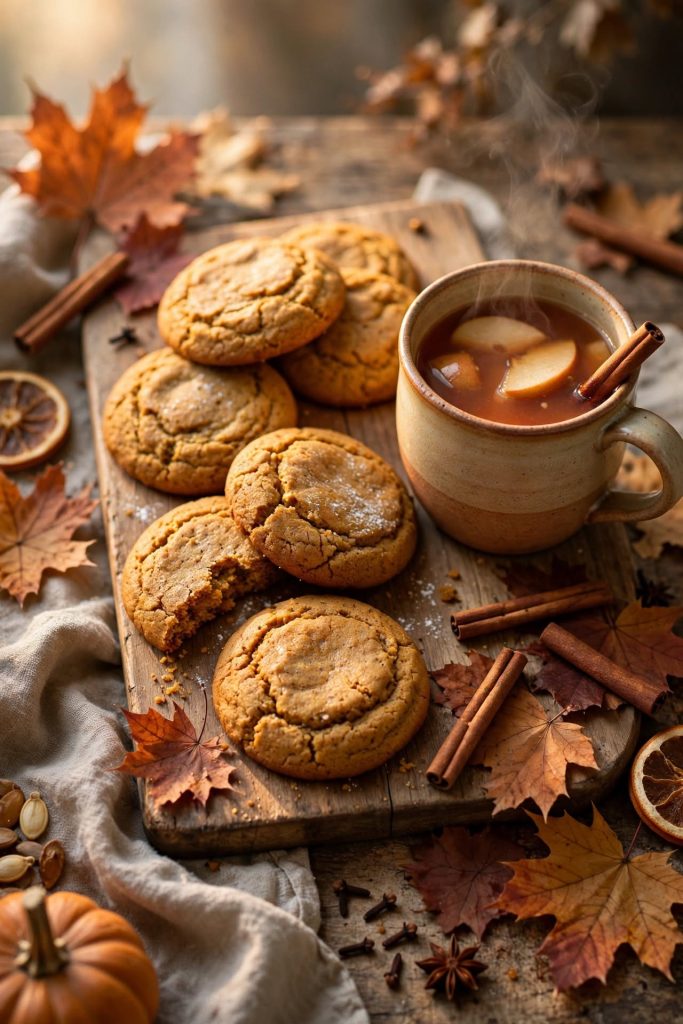
Classic Ways to Serve
- Warm from the tray with a mug of spiced apple cider or pumpkin spice latte — the warm spices echo each other perfectly
- At room temperature on a fall cookie platter alongside snickerdoodles, gingersnaps, and apple cider doughnuts
- Stacked and tied in a cellophane bag with a cinnamon stick as a fall gifting option — the cinnamon sugar coating gives them an attractive sparkly appearance
Upgraded and Occasion-Worthy
- Sandwich two cookies with a thin layer of cream cheese frosting or maple buttercream for a soft cookie sandwich — particularly good at Thanksgiving gatherings
- Serve alongside a small pot of warm salted caramel sauce as a dipping option — caramel and pumpkin spice is one of the most well-matched fall flavour combinations
- Crumble over vanilla ice cream or pumpkin ice cream for a warm-spice cookie crumble topping — press the crumble into the top of a scoop immediately before serving
Pairs well with: spiced apple cider, pumpkin spice latte, chai tea, black coffee, maple ice cream, or salted caramel sauce.
Best occasions: Thanksgiving dessert tables, Halloween parties, fall bake sales, autumn gifting, October potlucks, and any occasion where a seasonally recognisable dessert is the right call.
Frequently Asked Questions
Can I use fresh pumpkin instead of canned?
Yes, but with extra preparation. Roast a sugar pumpkin or pie pumpkin, scoop out the flesh, and blend it smooth. Then spread it on paper towels and blot aggressively — fresh pumpkin puree contains significantly more water than canned and must be dried down to the same thick, matte consistency before using. Measure only after blotting. The flavour is slightly more delicate than canned; for a more robust result, add an extra ¼ tsp of cinnamon to the dry ingredients.
Why are my pumpkin cookies cakey?
Cakey pumpkin cookies are almost always caused by too much moisture in the dough. The three most common reasons: using a whole egg instead of just the yolk, skipping the pumpkin blotting step, or not chilling the dough before baking. Address all three and the texture changes dramatically. The egg yolk substitution alone is typically the biggest single improvement for people who have made cakey pumpkin cookies before.
How do I know when pumpkin cookies are done?
Pull them when the edges look set and the centres still look slightly underdone and puffy. Pumpkin cookies do not spread much or brown the way butter-only cookies do — the visual cue is set edges with a soft, matte centre. Start checking at 11 minutes. The cookies firm up significantly as they cool on the hot tray for 5 minutes — what looks underdone in the oven is correct.
Can I make the dough ahead of time?
Yes — and the chill time actually works in your favour. The dough keeps in the refrigerator for up to 3 days, tightly wrapped in cling film. The flavour intensifies as it rests — the spices meld more fully overnight. You can also portion the dough into balls and refrigerate them on the tray, ready to roll in cinnamon sugar and bake directly from cold, adding 1 to 2 minutes to the bake time.
How long do pumpkin cookies last?
Pumpkin cookies keep for best quality for up to 4 days at room temperature or up to 7 days refrigerated. The high moisture from the pumpkin keeps them softer longer than most cookies, but also means they can spoil faster than a standard low-moisture cookie. If you enjoyed these, [our pumpkin bread recipe] uses the same blotting technique on a larger scale. [IL-5 — replace before publishing]
Can I freeze pumpkin cookies?
Yes. Baked cookies freeze well for up to 3 months. Cool completely before freezing, then layer between sheets of parchment in an airtight container. Unbaked dough balls also freeze for up to 3 months — freeze before rolling in cinnamon sugar, then coat just before baking. Bake from frozen, adding 2 to 3 minutes, without thawing first.
What can I substitute for pumpkin pie spice?
Make your own: 1 tsp cinnamon + ¼ tsp ground ginger + ⅛ tsp ground cloves + ⅛ tsp ground nutmeg. This produces roughly the equivalent of 1½ tsp of commercial pumpkin pie spice. Alternatively, if you only have cinnamon, use 2 tsp total — the cookies will still taste warm and spiced, just with a simpler, cinnamon-forward flavour profile.
Can I double this recipe?
Yes. Double every ingredient. The blotting and chill steps become more important at double quantity — blot the doubled puree in two batches to ensure thoroughness. Bake in batches on the centre rack, one tray at a time. Doubled dough can be chilled for up to 3 days, so you can spread the baking across two sessions if preferred.
Why did my pumpkin cookies spread too much?
Excessive spread is almost always caused by skipping or shortening the chill time, or by butter that was too warm. The pumpkin puree adds significant moisture to the dough and without adequate chilling, the excess water causes the cookies to spread flat. Chill for the full 30 minutes minimum — 1 hour is better. If spreading persists after proper chilling, add 2 tablespoons more flour and chill again for 15 minutes.
Can I use pumpkin pie filling instead of puree?
No — do not substitute pumpkin pie filling for plain pumpkin puree in this recipe. Pumpkin pie filling already contains sugar, spices, and sweetened condensed milk or evaporated milk, which dramatically changes the sweetness, moisture level, and spice balance of the dough. Always use plain canned pumpkin puree. The label should list one ingredient only: pumpkin.
Do I really need to chill the dough?
Yes — this is the one step in this recipe that cannot be skipped. Pumpkin puree adds a large amount of moisture to the dough. Without chilling, the dough is too soft to shape properly, the cookies spread excessively, and the texture is cakey rather than soft and slightly chewy. A minimum of 30 minutes in the refrigerator is required; 1 hour gives better results. You can also chill overnight for even more flavour development.
Can I make pumpkin cookies without eggs?
Yes. Replace the egg yolk with 1 tablespoon of unsweetened applesauce or 1 tablespoon of aquafaba (the liquid from a can of chickpeas). Both provide enough binding without adding noticeable flavour. The texture will be slightly softer — you may need an extra tablespoon of flour to keep the dough firm enough to shape after chilling.

Pumpkin Cookies
Ingredients
Method
- Blot the pumpkin: Spoon the pumpkin puree onto 3 to 4 layers of paper towels. Press firmly with fresh paper towels repeatedly until a fresh sheet comes away with only a faint stain — not visibly wet. Measure 130g / ½ cup of blotted puree and set aside.
- Whisk flour, baking soda, pumpkin pie spice, cinnamon, and salt in a medium bowl. Set aside.
- Beat softened butter and packed brown sugar on medium speed for 3 minutes until the mixture is smooth and slightly fluffy.
- Add the blotted pumpkin puree, egg yolk, and vanilla extract. Beat for 20 to 30 seconds until just combined. The mixture may look slightly curdled — this is normal.
- Add the flour mixture all at once. Mix on low speed until just combined — stop the moment you no longer see dry flour streaks.
- Cover the dough tightly with cling film pressed directly onto its surface. Refrigerate for at least 30 minutes (1 hour recommended).
- Preheat oven to 175°C / 350°F (160°C fan). Line two baking sheets with parchment paper. Stir together the granulated sugar and cinnamon in a small bowl.
- Scoop dough into 1½-tablespoon balls. Roll between palms until smooth, then roll in cinnamon sugar to coat fully. Place 5cm / 2 inches apart on the prepared trays.
- Bake one tray at a time on the centre rack for 11 to 13 minutes, until the edges are set and the centres still look slightly underdone.
- Cool on the baking sheet for 5 minutes, then transfer to a wire rack. Cool completely before storing.
Notes
- Pumpkin puree: Always use plain canned pumpkin puree — not pumpkin pie filling. Libby’s is the most consistent brand.
- Blotting is not optional: Measure after blotting, not before. Unblotted puree produces cakey, flat results.
- Egg yolk only: Do not substitute a whole egg — it reintroduces the water the blotting removed and produces cakey cookies.
- Cakey result? Check that you blotted thoroughly, used only the yolk, and chilled for at least 30 minutes.
- Too much spread? Chill for the full 30 to 60 minutes. Add 2 tbsp more flour if spreading persists.
- Pumpkin pie spice substitute: 1 tsp cinnamon + ¼ tsp ginger + ⅛ tsp cloves + ⅛ tsp nutmeg.
Estimated Nutrition Per Cookie
Approximate per cookie (1 of 20). Use a nutrition calculator for precise figures before publishing.More Fall Baking Recipes You Will Love
- Pumpkin Bread — a one-bowl quick bread using the same blotted pumpkin puree method; moist, deeply spiced, and ideal for slicing and toasting through the week.
- Apple Cider Doughnuts — reduced apple cider baked into a spiced doughnut batter; the quintessential fall baked good that pairs naturally with pumpkin cookies on an autumn dessert table.
- Snickerdoodles — the base cookie that inspired the pumpkin snickerdoodle variation; soft, tangy, and rolled in cinnamon sugar for the same sparkly exterior.
- Pumpkin Pie Bars — the filling flavour of a classic pumpkin pie in a shortbread-based bar format; easier to serve at large gatherings than individual slices.
Did you make these pumpkin cookies? Leave a ⭐⭐⭐⭐⭐ rating below and let me know in the comments how they turned out — especially if you tried the blotting step for the first time. I read every comment and would love to hear what worked for you.