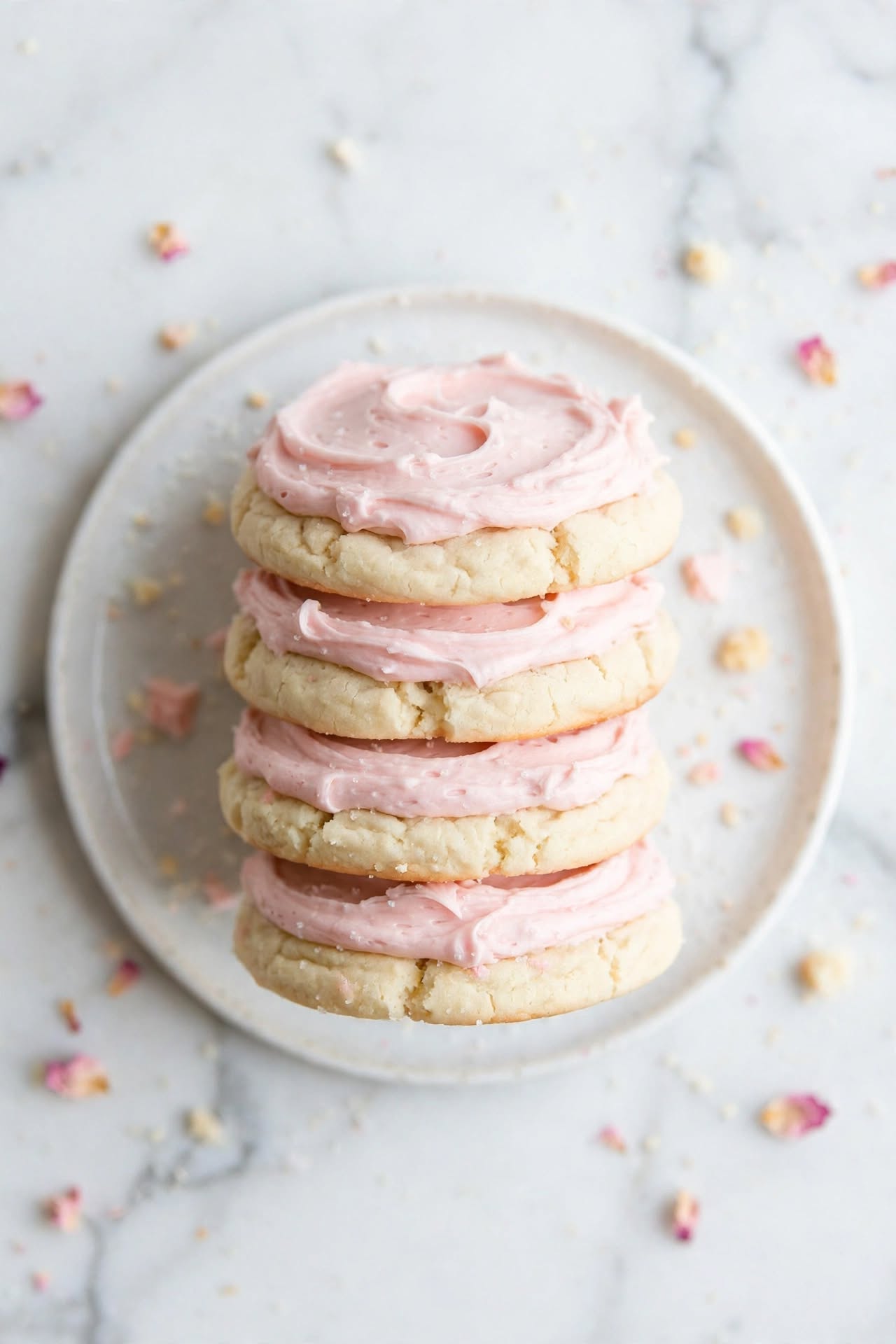
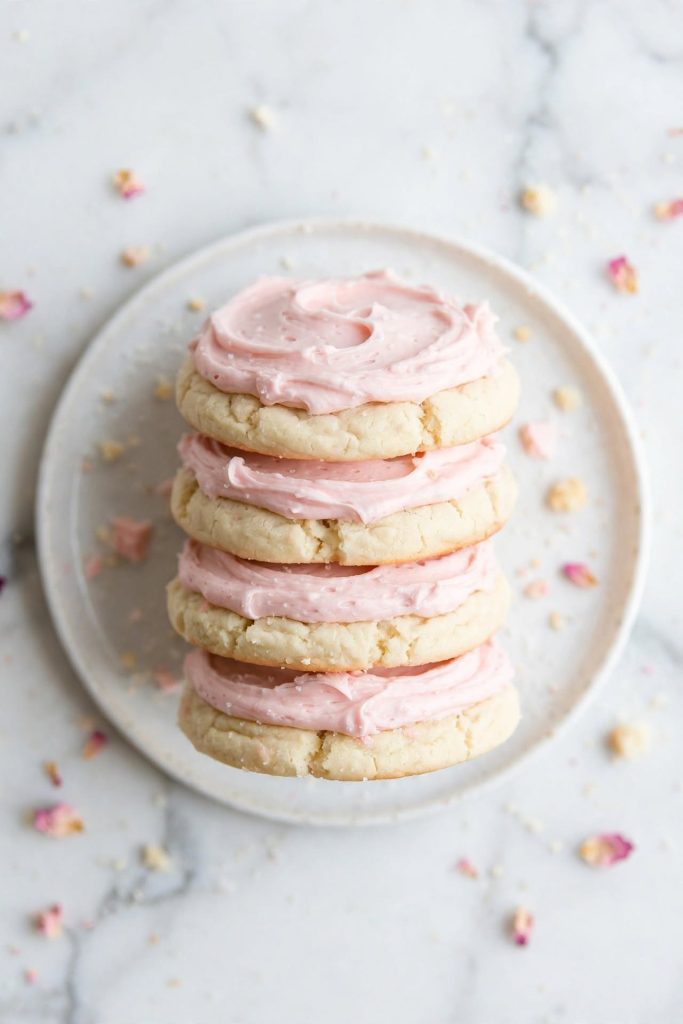
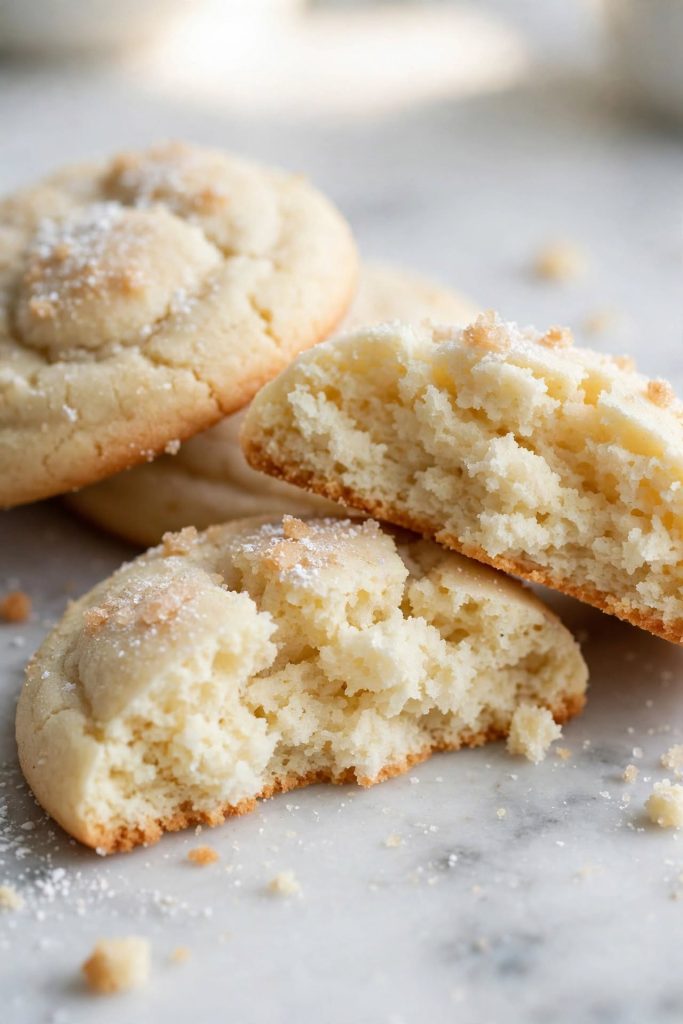
Soft sugar cookies are thick, tender drop or cut-out cookies made from butter, cream cheese, sugar, and flour that bake in under 12 minutes per batch. They use cream cheese and cornstarch instead of extra flour to keep the crumb soft and prevent spreading. Total active time is about 20 minutes, with 1 hour of dough chilling. Best for home bakers who want a bakery-style soft sugar cookie that holds its shape and stays soft for days.
This soft sugar cookies recipe gives you thick, pillowy cookies with a tender crumb that does not harden after cooling — the exact result that makes people ask for the recipe. It uses cream cheese as a secret ingredient to lock in moisture, one bowl of dry ingredients, and a reliable chill-and-cut method. If your sugar cookies have been spreading flat or turning crisp the next day, these two changes fix both. I tested this recipe eight times before publishing, adjusting the cream cheese ratio and chill time until every batch came out consistently thick and soft.
Why These Soft Sugar Cookies Work
Most sugar cookie recipes use only butter and flour — which gives you a cookie that is fine the day it is baked and noticeably firmer the next morning. This recipe adds two ingredients that change that outcome entirely.
- Cream cheese in the dough — full-fat cream cheese adds fat and a small amount of acidity that weakens gluten strands and traps moisture. The result is a crumb that stays soft and slightly dense — closer to a bakery cookie than a home-baked one — for up to five days.
- Cornstarch instead of extra flour — two tablespoons of cornstarch replace some of the starch in the flour without adding gluten. This keeps the crumb tender without making the dough too loose to roll.
- Mandatory 1-hour chill — chilling the dough firms the fat so the cookies hold their shape in the oven and rise up rather than spreading out. No chill means flat cookies with crispy edges.
- A precise bake temperature — 175°C / 350°F is lower than most cookie recipes. The slower bake sets the crumb gently and prevents the edges from drying before the center has time to finish.
- Pull-early rule — these cookies come out of the oven looking underdone on purpose. The center firms up entirely as they cool on the pan, so what looks raw at 10 minutes is the correct end result at 15.
- Works for both cut-outs and drop cookies — the same dough handles both methods. Rolled and cut for holidays and birthdays; scooped and flattened slightly for a weeknight batch with no rolling required.
If you want to go deeper on the role of fat in cookie texture, our guide to baking with dairy is a good place to start.
Ingredients for Soft Sugar Cookies
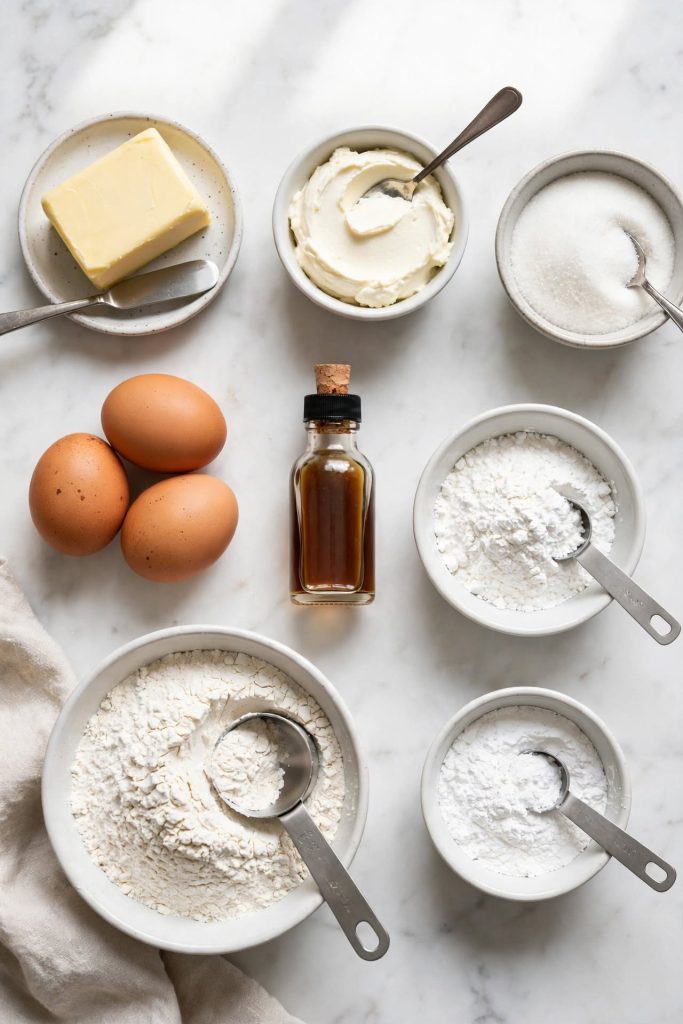
The Cookie Dough
| Ingredient | Amount | What It Does | Best Substitute + Impact |
|---|---|---|---|
| Unsalted butter, room temp | 225g (1 cup) | Fat base, richness, structure | Salted butter — reduce added salt to ¼ tsp |
| Full-fat cream cheese, room temp | 115g (4 oz) | Softness, moisture retention, slight tang | Full-fat sour cream — slightly more cakey |
| White granulated sugar | 300g (1½ cups) | Sweetness, spread control, crisp edge | Caster sugar — finer grain, same result |
| Large eggs | 2 | Structure, binding, moisture | 2 flax eggs — slightly denser, less lift |
| Pure vanilla extract | 2 tsp | Classic flavor base | Vanilla bean paste — stronger, speckled result |
| Pure almond extract | ½ tsp | Bakery-style flavor depth | Omit and increase vanilla to 2½ tsp |
| All-purpose flour | 360g (3 cups) | Structure, body | 1:1 GF flour blend — same weight, longer chill |
| Cornstarch | 2 tbsp | Tender crumb, prevents spread | Arrowroot powder — same ratio |
| Baking powder | 1 tsp | Slight lift, keeps cookies thick | None — do not skip |
| Fine sea salt | ½ tsp | Flavor balance | Kosher salt — use ¾ tsp |
Key Ingredient Notes
Cream cheese: Use full-fat block cream cheese — not the spreadable kind in a tub. Spreadable cream cheese contains stabilizers and extra water that will make your dough too soft to roll and your cookies more prone to spreading. Both the butter and cream cheese must be at true room temperature before you start — cold fat will not cream properly and will leave lumps.
Cornstarch: Do not skip this. Two tablespoons replaces a small portion of the gluten-forming starch in the flour with a non-gluten starch. This is the difference between a crumb that snaps and one that stays soft. It also helps the cookies hold their cut shapes by reducing gluten elasticity in the dough.
Almond extract: At just ½ teaspoon, this is the flavor that makes people say “what is in these?” without being able to identify it. It is the classic bakery sugar cookie flavor. If you have a nut allergy in your household, leave it out entirely — the cookies will still taste very good.
Equipment You Need
- Stand mixer or hand mixer with paddle attachment
- Large mixing bowl
- Rolling pin with thickness guides (or two ¼-inch dowels)
- Cookie cutters in your chosen shapes
- Baking sheets — light-colored, not dark
- Parchment paper
- Plastic wrap (for chilling dough discs)
The Butter Consistency Guide
Butter temperature is the single biggest variable in whether your soft sugar cookies stay thick or spread flat. Here is the full range — and exactly where you need to be.
| Stage | Description | Use for This Recipe? |
|---|---|---|
| Cold (straight from fridge) | Firm, will not cream — leaves lumps | ❌ No |
| Too cold but slightly softened | Waxy, does not fluff when beaten | ❌ No — give it 10 more minutes |
| Room temperature (correct) | Holds a finger indent, not greasy | ⭐ Yes — this is the target |
| Slightly too warm | Looks shiny, smears rather than holds shape | ⚠️ Refrigerate 10 minutes first |
| Melted or very soft | Liquid, pourable | ❌ No — cookies will spread flat |
Visual test for correct butter temperature: Press one finger firmly into the butter. Your finger should leave a clean indent without the butter feeling greasy or collapsing around your finger. If it slides away or feels slick — it is too warm. Return to the fridge for 10 minutes and test again.
The cream cheese must pass the same test. Both fats must be at the same temperature before creaming — combining cold cream cheese with warm butter creates an uneven base and inconsistent cookie texture.
How to Make Soft Sugar Cookies — Step by Step
Follow these steps in order. Do not rush the creaming or chilling stages — both are critical to getting the texture right.
Step 1 — Cream the Butter, Cream Cheese, and Sugar
Beat room-temperature butter and cream cheese together on medium speed for 1 minute until combined. Add the sugar and beat on medium-high for 3 to 4 minutes until the mixture is pale, light, and fluffy — it should nearly double in volume and look almost white.
What to look for: The mixture should be visibly lighter in color than when you started, cling to the sides of the bowl, and feel airy when you scrape it with a spatula. Do not shortcut this step — under-creaming is the most common reason for dense homemade sugar cookies.
⚠️ Do not cream on high speed the entire time. Start on medium to combine, then increase to medium-high. High speed from the start can cause the butter and cream cheese to separate rather than blend.
Step 2 — Add Eggs, Vanilla, and Almond Extract
Add eggs one at a time, beating on medium for 30 seconds after each addition. Add the vanilla and almond extract and mix until just incorporated — about 15 seconds.
What to look for: The mixture should look smooth and uniform. If it looks curdled or separated, the eggs were too cold — keep mixing for 30 seconds more and it will come together.
Step 3 — Fold in the Dry Ingredients
In a separate bowl, whisk together the flour, cornstarch, baking powder, and salt. Add the dry ingredients to the butter mixture in two additions, folding on low speed just until no flour streaks remain after each addition.
What to look for: A soft, slightly sticky dough with no visible flour patches. It will be softer than you expect — this is correct. Do not add more flour.
⚠️ Overmixing after the flour goes in builds gluten — that is what turns your soft sugar cookies into something tough with a bready texture. Stop the mixer the moment the flour disappears.
Once you are comfortable with this method, our complete guide to mixing cookie dough is worth reading next.
Step 4 — Chill the Dough
Divide the dough into two equal portions. Flatten each into a disc about 1 inch thick, wrap tightly in plastic wrap, and refrigerate for a minimum of 1 hour. Overnight chilling gives you the best-defined edges and most tender crumb.
What to look for: The dough should feel firm when you press it after chilling — not hard as a rock, but with real resistance. If it still feels soft, chill for another 30 minutes before rolling.
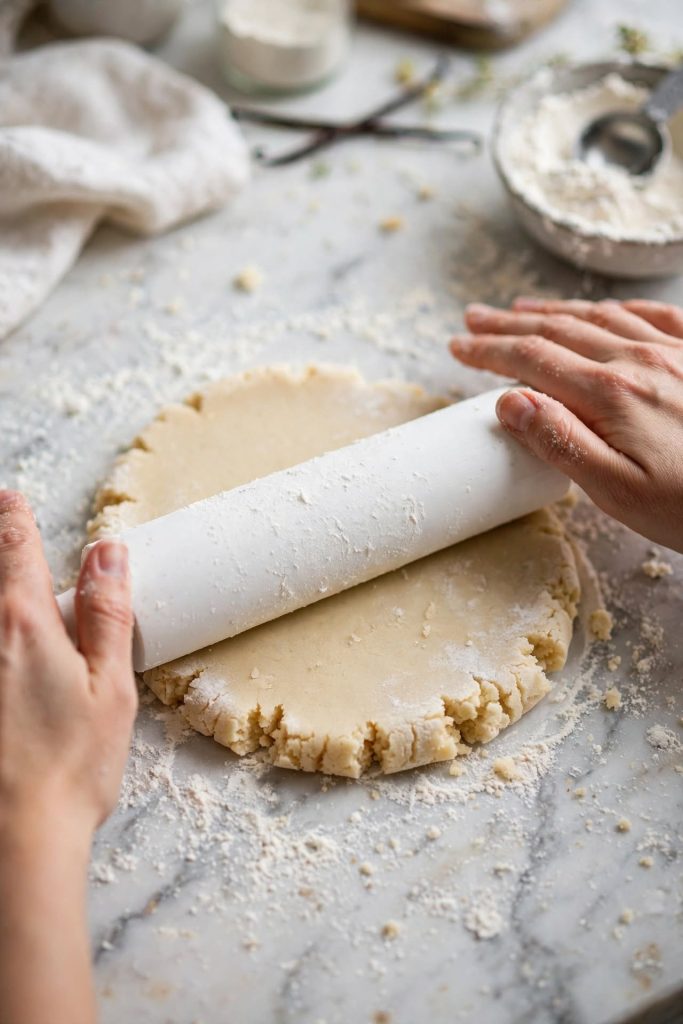
Step 5 — Roll, Cut, and Bake
Preheat your oven to 175°C / 350°F. Line baking sheets with parchment paper. Working with one disc at a time (keep the other in the fridge), roll the dough to exactly ¼ inch thick on a lightly floured surface. Cut shapes and transfer to the baking sheet using a thin spatula. Space cookies 4cm apart. For the sharpest edges, chill the cut shapes on the baking sheet for 10 minutes before baking. Bake for 9 to 11 minutes.
What to look for: Edges just set and opaque; centers still look slightly shiny and underdone. The tops should not have any color — if they are golden, they are overbaked.
Step 6 — Cool Completely Before Frosting
Let cookies cool on the baking sheet for 5 minutes, then transfer to a wire rack. Allow to cool completely — at least 30 minutes at room temperature — before applying any frosting. Warm cookies will melt buttercream and cause it to slide off.
What to look for: Cookies should feel completely cool to the touch on both the top and the bottom before any frosting goes on. The bottom should not feel even slightly warm.
The Science Behind a Soft Sugar Cookie
A soft, thick result is not luck — it is the result of three specific ingredients doing predictable work inside a moderate oven.
Why Cream Cheese Makes the Difference
Full-fat cream cheese contains both fat and a small amount of acid (from the culturing process). The fat coats more flour particles than butter alone does, which limits gluten development and gives you a more tender crumb. The acid also slightly tenderizes the gluten strands that do form. The combined result is a cookie that stays soft rather than setting firm as it cools — the exact quality that separates a bakery sugar cookie from a home-baked one that turns crisp by morning.
Why Cornstarch Creates a Softer Crumb
Cornstarch is pure starch with no gluten-forming proteins. Adding two tablespoons to the flour mix dilutes the overall protein content without making the dough too wet. Lower protein content means less gluten forms during mixing, which means a more tender, soft-bite crumb after baking. It also absorbs some moisture during baking in a way that flour starch does not — which helps the center stay slightly dense and moist rather than drying through.
Why Chilling Controls Spread
When cookie dough hits a hot oven, the fat melts first — and how fast it melts determines how much the cookie spreads before the structure sets. Cold fat from a chilled dough melts slowly, giving the flour and eggs time to set the crumb before the cookie has a chance to spread wide. Unchilled dough enters the oven with soft fat that melts immediately — the cookie spreads before the structure has time to set, and you end up with a thin, flat result.
Tips for the Best Result
These are the details that separate a good batch from one people ask you to bring to every event.
- Use thickness guides on your rolling pin — rubber bands, wooden dowels, or rolling pin rings set to ¼ inch ensure every cookie is the same thickness and bakes in the same time.
- Chill cut shapes before baking — after cutting, slide the parchment onto a tray and return to the fridge for 10 minutes. This extra chill keeps even intricate shapes sharp and prevents any spreading at the edges.
- Dip cutters in flour — a lightly floured cutter releases cleanly without dragging the dough. Tap off the excess flour before each cut so it does not accumulate on the surface of the cookie.
- Bake one sheet at a time on the center rack — the center rack gives the most even heat. Two sheets at once means the lower one gets bottom-heavy heat and the upper one gets less — both bake unevenly.
- Make the frosting while cookies bake — frosting needs about 10 minutes to come together, and it can sit at room temperature while cookies cool. You will be ready to frost the moment they are fully cool.
- Re-roll scraps no more than twice — scraps that have been worked too many times develop more gluten, which makes those cookies noticeably tougher. Use the second re-roll batch for household eating and keep the first-cut cookies for any occasion where texture matters most.
- Store immediately after cooling — sugar cookies lose moisture quickly in open air. Transfer to an airtight container within 30 minutes of cooling to preserve the soft center.
Common Mistakes to Avoid
❌ Using Butter or Cream Cheese That Is Too Warm
Result: The fat cannot hold air during creaming — your dough will be too soft, your cookies will spread wide and thin, and the crumb will be greasy rather than light.
Fix: Both fats should hold a clean finger indent without feeling slick. If either feels greasy, return to the fridge for 10 minutes before mixing.
❌ Skipping the Dough Chill
Result: Cookies spread significantly in the oven — cut shapes lose their edges, and drop cookies become flat discs with no soft center.
Fix: Chill wrapped dough discs for at minimum 1 hour. If you are in a hurry, 30 minutes in the freezer works as a partial substitute — but 1 hour in the fridge gives the most consistent result.
❌ Rolling Dough Too Thin
Result: Thin cookies bake through too quickly — the edges crisp and the center dries out before the color tells you anything is wrong. They will be hard by the next day.
Fix: Roll to exactly ¼ inch. Use a rolling pin with guides or place two wooden dowels of equal height on either side of the dough as rails.
❌ Overbaking Even by One Minute
Result: The crumb loses its moisture in the oven — cookies that look fine at pickup will harden as they cool and lose their soft texture entirely by the next day.
Fix: Pull the tray the moment the edges are set and the centers still look slightly shiny. Set your timer for 9 minutes and check — do not wait for color on top.
❌ Frosting Before Cookies Are Fully Cool
Result: Warm cookies melt buttercream — the frosting slides, pools, and never sets properly. The surface also becomes tacky when the frosting re-solidifies.
Fix: Wait the full 30 minutes on a wire rack. The bottom of the cookie must feel room temperature — not just the top.
❌ Re-rolling Scraps More Than Twice
Result: Each re-roll works the dough more, developing additional gluten — the third and fourth re-roll produces noticeably tougher cookies that lose the soft bite entirely.
Fix: Gather all scraps from the first cut into one disc, chill briefly, and roll once more. After that second cut, use the remaining scraps for taste-testing only.
For more guides like this one, our cookie baking troubleshooting guide covers every common problem with the same level of detail.
Variations Worth Trying
Lemon Soft Sugar Cookies
What changes: Add the zest of 2 lemons and 1 tablespoon of fresh lemon juice to the dough. Replace the almond extract with ½ teaspoon of lemon extract.
When: Add the zest with the butter and sugar at Step 1. Add the lemon juice with the eggs at Step 2.
Result: A bright, citrusy version that pairs well with a lemon glaze or cream cheese frosting. The flavor is noticeably more complex than a plain version and works particularly well for spring and summer occasions.
Frosted Birthday-Style Version
What changes: Add 2 tablespoons of rainbow sprinkles to the dough. Frost with a thick vanilla almond buttercream and top with additional sprinkles.
When: Fold sprinkles in at the very end of Step 3 with 3 to 4 slow strokes — overmixing bleeds the dye into the dough.
Result: The classic bakery-style frosted birthday cookie with confetti inside and out. These are the homemade sugar cookies people associate with celebration and ask you to make for every occasion afterward.
Gluten-Free Version
What changes: Replace the all-purpose flour with a 1:1 gluten-free flour blend that contains xanthan gum (same weight: 360g).
When: Use exactly as written at Step 3.
Result: Slightly denser texture and a touch more crumbly at the edges. Chill the dough for at least 90 minutes — gluten-free dough needs longer to hydrate and firm. Cut shapes stay surprisingly clean.
No-Chill Drop Cookie Version
What changes: Reduce the flour by 30g (¼ cup). After mixing the dough, scoop into 1½-tablespoon balls and press flat to ⅜ inch with the bottom of a glass dipped in sugar.
When: No chilling required — bake immediately at 175°C / 350°F for 9 to 10 minutes.
Result: A faster weeknight version with crinkled tops and slightly chewier centers. Less defined than cut-out shapes but just as soft and a fraction of the prep time.
Holiday Cut-Out Version
What changes: Add ½ teaspoon of ground cinnamon and ¼ teaspoon of ground nutmeg to the dry ingredients. Use holiday-themed cutters and tint the frosting with food-coloring gel.
When: Add spices with the flour at Step 3.
Result: A warmly spiced version of the base recipe that works for Christmas trees, snowflakes, or any seasonal shape. The spice is subtle — present without overpowering the classic sugar cookie base.
How to Store
Room Temperature
Store baked, unfrosted soft sugar cookies in an airtight container at room temperature. They stay at their best quality for up to five days. If the cookies are frosted, store in a single layer or place a sheet of parchment paper between each layer to protect the frosting — stacking without parchment will smear the decoration. A piece of bread in the container helps maintain moisture if you notice the crumb starting to firm up after day three.
Refrigerator
Refrigerating baked cookies is not ideal — cold air dries the crumb faster than room temperature does, and the cream cheese in the dough does not make them more perishable than a standard cookie. If you must refrigerate (for example, if your frosting contains fresh cream), use an airtight container and aim to eat within five days. Let refrigerated cookies come to room temperature for 15 minutes before serving — the texture improves noticeably as it warms.
Freezer — Complete Guide
Soft sugar cookies freeze well both baked and unbaked. For baked unfrosted cookies: cool completely, layer in an airtight container with parchment between layers, and freeze for up to two months at best quality. Thaw at room temperature for 20 to 30 minutes. For baked frosted cookies: freeze uncovered on a flat tray for 1 hour until the frosting is solid, then transfer to a container with parchment between layers. Thaw uncovered so condensation does not form on the frosting. For unbaked dough: wrap the dough discs in plastic wrap and place in a freezer bag. Freeze for up to two months. Thaw overnight in the refrigerator before rolling. Use your judgment — if cookies smell off or show any mold, discard them.
If batch baking for events or the freezer is part of your routine, our guide to freezer-friendly baking fits perfectly into this workflow.
How to Serve

Classic Ways to Serve
- Frosted with classic vanilla almond buttercream and sprinkles — the standard that earns the most requests
- Unfrosted with a dusting of powdered sugar — takes 30 seconds and is the right move for a weeknight batch
- Stacked in cellophane bags tied with ribbon — the easiest homemade gift that holds up beautifully in transport
Upgraded and Occasion-Worthy
- Decorated with royal icing for weddings, showers, or any occasion where clean, detailed decoration matters — the thick cookie holds intricate designs without breaking
- Sandwiched with cream cheese frosting between two cookies for a cookie sandwich that works as a plated dessert
- Arranged on a tiered stand with two other cookie types for a dessert table — soft sugar cookies anchor any cookie spread because of their size and visual impact
- Packaged in a window gift box as favors for birthdays, baby showers, or holiday parties — individually wrapped, they stay fresh for three days in transit
These cookies pair well with black coffee, tea, a glass of cold milk, or hot chocolate. They are the right bake for birthday parties, holiday events, bake sales, care packages, and any occasion where you need something that looks impressive and can be made several days ahead.
Frequently Asked Questions
Can I make soft sugar cookies without cream cheese?
Yes — replace the cream cheese with an equal weight of full-fat sour cream or Greek yogurt (115g). The cookies will still be soft but slightly less rich and a touch more cakey. Full-fat block cream cheese gives the densest, most bakery-like texture, so it is worth using if you can find it.
Why did my soft sugar cookies spread too much?
The most common causes are butter or cream cheese that was too warm when mixed, or skipping the dough chill. Both allow the fat to melt too quickly in the oven. A third cause is rolling the dough too thin — anything under ¼ inch will spread and lose its soft center. Check all three before your next batch.
How do I know when soft sugar cookies are done?
Pull them from the oven when the edges are just set and the centers still look slightly shiny and underdone — they will not look fully baked. The residual heat from the pan finishes cooking them in the next 5 minutes. If the tops look matte and dry in the oven, they are already overbaked and will harden as they cool.
Can I make the dough ahead of time?
Yes — the dough keeps well in the refrigerator for up to 3 days, wrapped tightly in plastic wrap. For longer storage, freeze the dough discs for up to 2 months and thaw overnight in the refrigerator before rolling. The texture actually improves with a longer chill as the flour fully hydrates.
How long do soft sugar cookies last?
Unfrosted, they stay at their best quality for up to five days in an airtight container at room temperature. Frosted cookies with buttercream are best within three days. Store frosted cookies in a single layer or with parchment between layers to protect the decoration.
Can I freeze soft sugar cookies?
Yes — baked unfrosted cookies freeze well for up to two months in an airtight container with parchment between layers. Thaw at room temperature for 30 minutes before frosting. Frosted cookies can also be frozen if you freeze the frosting solid on an open tray first, then transfer to a container. If you enjoyed these, our lemon shortbread recipe is the next one worth making.
What can I substitute for almond extract?
Simply leave it out and increase the vanilla to 2½ teaspoons. The cookies will taste slightly less complex but still very good. Alternatively, ½ teaspoon of lemon extract adds brightness that pairs well with vanilla frosting. Do not substitute imitation almond flavoring — it is noticeably sharper and less balanced than pure extract.
Can I double this recipe?
Yes — double every ingredient exactly. A stand mixer handles double batches more easily than a hand mixer. Divide into 4 dough discs rather than 2 so each portion chills and rolls more evenly. Bake one sheet at a time on the center rack for the most consistent result across the batch.
Why did my cookies come out hard after cooling?
The most common cause is overbaking — even one extra minute at 175°C dries the crumb completely. Pull them when the centers look slightly underdone. A second cause is rolling too thin — dough under ¼ inch bakes through too fast and hardens as it cools. Store cookies in an airtight container immediately after cooling to lock in moisture.
What thickness should I roll the dough?
Roll to exactly ¼ inch (6mm) for the classic soft result. This gives you a cookie that holds its shape during baking but stays tender and thick throughout. Slightly thicker at ⅜ inch gives an even softer, cake-like center. Thinner than ¼ inch gives crispy edges and a harder texture after cooling — the opposite of what you want from soft sugar cookies.
Do I need a stand mixer?
No — a hand mixer works well for this recipe. The key step is creaming the butter and cream cheese until pale and fluffy, which takes 3 to 4 minutes with a hand mixer on medium-high. Do not try to mix by hand — the creaming step requires sustained aeration that a whisk or spoon cannot achieve consistently.
Can I use this recipe for cut-out shapes?
Yes — this dough is designed for cut-out shapes. The cream cheese and cornstarch keep the cookies from spreading, so your edges stay sharp after baking. Chill the cut shapes on the baking sheet for 10 minutes before putting them in the oven for the cleanest definition. Use lightly floured cutters and re-roll scraps no more than twice for the best texture on every cookie.

Soft Sugar Cookies
Ingredients
Method
- Beat butter and cream cheese on medium speed for 1 minute. Add sugar and beat on medium-high for 3 to 4 minutes until pale and fluffy.
- Add eggs one at a time, beating 30 seconds after each. Add vanilla and almond extract; mix until smooth.
- Whisk flour, cornstarch, baking powder, and salt in a separate bowl. Add to the butter mixture in two additions, folding on low just until no flour streaks remain.
- Divide into two discs, wrap in plastic wrap, and refrigerate for 1 hour minimum.
- Preheat oven to 175°C / 350°F. Roll one disc to ¼ inch thick on a lightly floured surface. Cut into shapes and transfer to parchment-lined baking sheets 4cm apart. Optionally chill cut shapes 10 minutes for sharpest edges.
- Bake 9 to 11 minutes — edges just set, centers still slightly shiny. Do not wait for color on top.
- Cool on the pan 5 minutes, then transfer to a wire rack. Cool completely before frosting — at least 30 minutes.
Notes
More Dessert Recipes You Will Love
- Frosted Lemon Cookies — the same soft, pillowy texture as this recipe but with bright lemon zest in the dough and a tangy cream cheese glaze that sets firm enough to stack.
- Snickerdoodles — a cinnamon-sugar classic with a crinkled top, a soft center, and crispy edges that come from cream of tartar reacting with baking soda.
- Shortbread — three ingredients, no eggs, and a melt-in-the-mouth texture that comes entirely from the right ratio of butter to flour. No chilling required.
- Funfetti Blondies — all the birthday-cookie flavor of the sprinkle variation above but in a bar format that takes half the time and feeds a crowd easily.
- Cream Cheese Brownies — uses the same cream cheese principle as this recipe but in a fudgy brownie with a swirled cheesecake layer on top. Keeps soft for five days.
Did you make these soft sugar cookies? Leave a ⭐⭐⭐⭐⭐ rating below and let me know in the comments how they turned out. I read every comment and would love to know what worked for you.