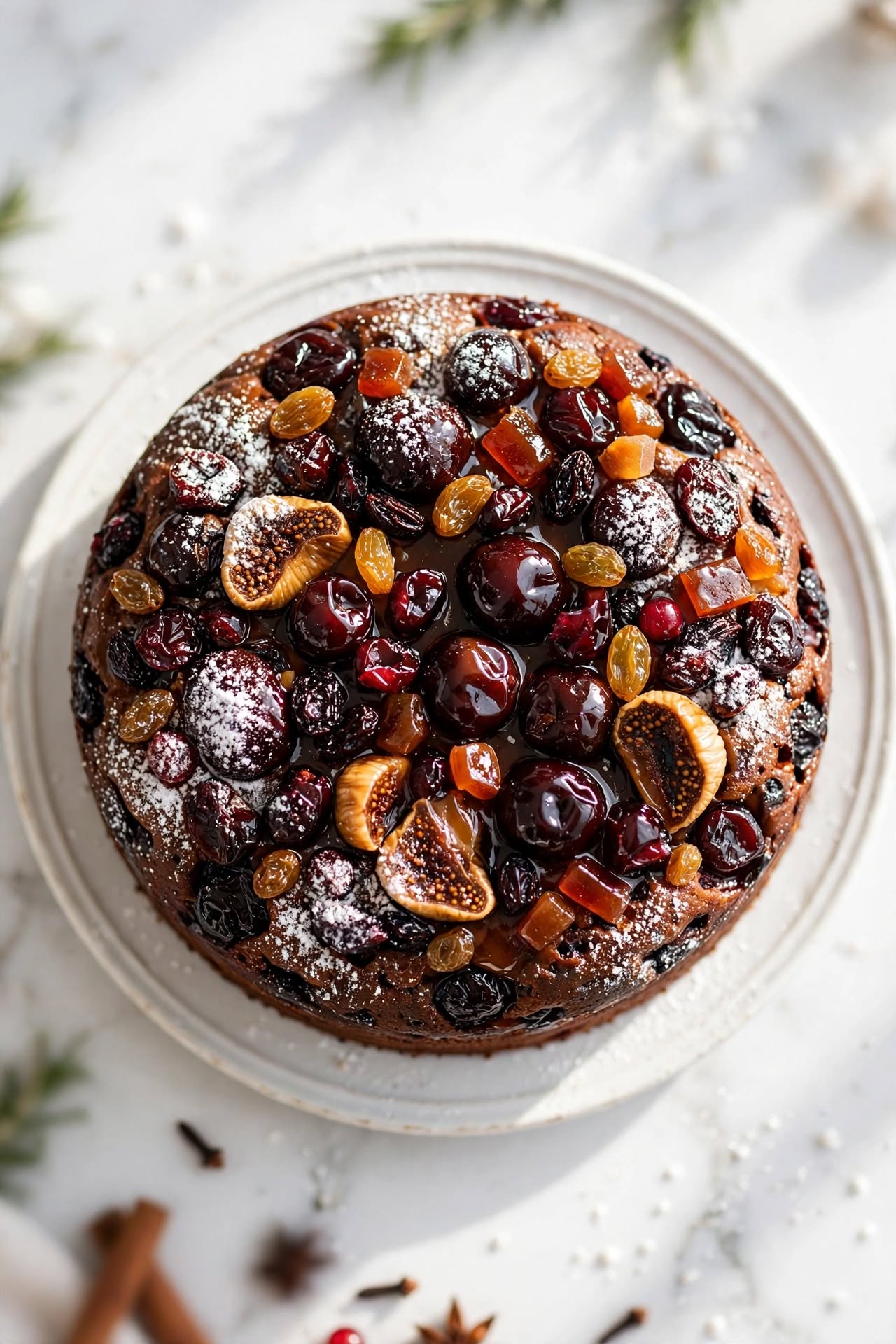
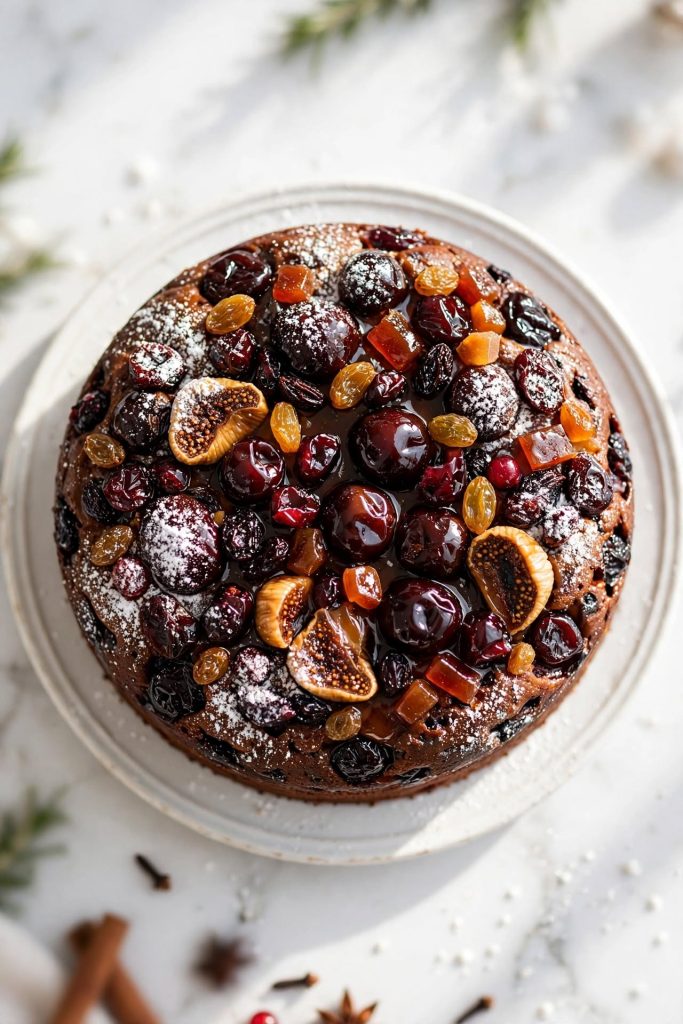
Christmas cake is a dense, brandy-soaked fruit cake made with dried fruit, warm spices, and dark brown sugar, slow-baked at low heat for 3 to 4 hours. It uses a soaked fruit base that keeps the crumb moist for weeks — even months — without refrigeration. Total prep is under 30 minutes. Best for anyone who wants a showstopping centrepiece that genuinely tastes better the longer you wait.
This Christmas cake recipe delivers a deeply rich, spiced fruit cake that holds its moisture for up to 3 months — no dry crumble, no hollow centre. Six dried fruit varieties, dark brown sugar, and low-heat baking do the work. The most common problem with Christmas cake is dryness, and this recipe solves that at every stage: soaking before baking, wrapping immediately after, and feeding with brandy in the weeks that follow. I tested this 5 times with different fruit soaking times before publishing — the method here is the one that gave me a consistently moist crumb and clean-slicing texture every time.
Table of Contents
Why This Recipe Works
Most Christmas cake recipes fail at moisture. They bake dry, they stale fast, and the fruit sinks to the bottom. This one is built differently — from the fruit soak to the final wrap — and here is exactly why:
- 24-hour fruit soak, minimum. Soaking dried fruit overnight in brandy lets each piece fully absorb liquid before baking — the fruit releases that moisture slowly into the crumb during baking, keeping it tender from the inside out.
- Dark brown sugar throughout. The high molasses content in dark brown sugar adds depth, keeps the crumb moist for longer than white sugar, and gives the characteristic deep amber colour without food colouring.
- Ground almonds in the batter. Adding 100g of ground almonds to the flour creates a slightly denser, more resilient crumb that holds moisture across weeks of storage — this is the ingredient most home recipes leave out.
- Low oven, long bake. 150°C (300°F) for 3 to 3.5 hours means the interior cooks through gently without the outside hardening. A rushed high-heat bake produces a dry, cracked top over a dense, underbaked centre.
- Built for making ahead. This recipe is specifically designed to be baked up to 3 months early — each weekly feed of brandy builds another layer of flavour that no same-day cake can match.
- Fruit stays distributed. Tossing the soaked fruit in a tablespoon of flour before folding into the batter stops it sinking to the base — you get an even distribution in every slice.
If you want to explore more holiday baking recipes, that is a solid place to start building your festive baking calendar.
Ingredients for Christmas Cake
Every ingredient here has a specific job. Here is what each one does — and what to use if you need to make a substitution.
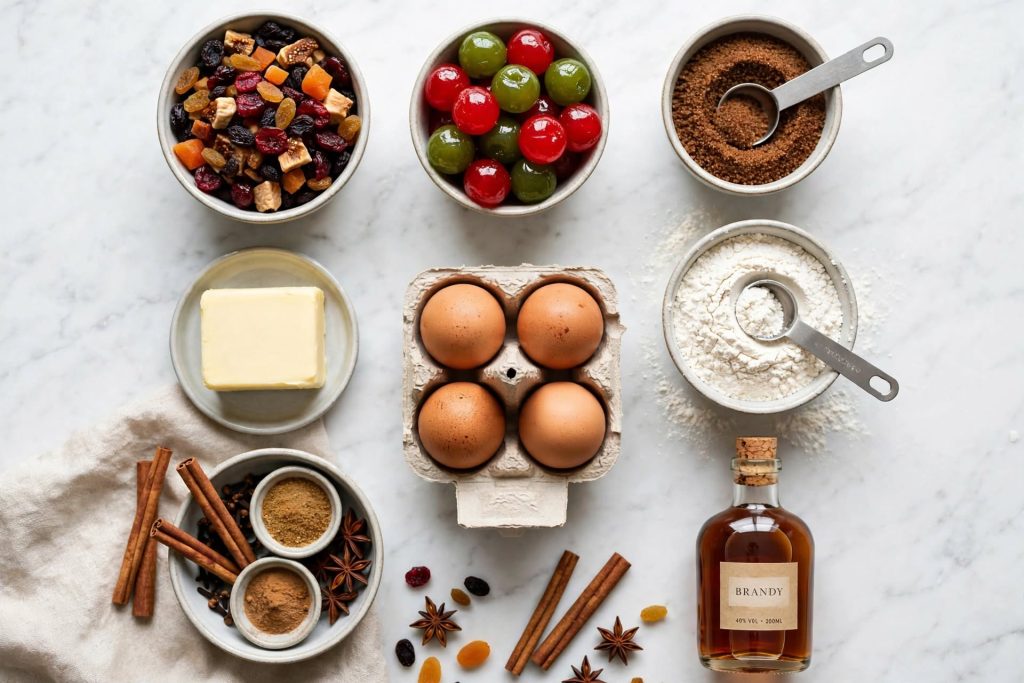
The Fruit Mix
| Ingredient | Amount | What It Does | Best Substitute + Impact |
|---|---|---|---|
| Mixed dried fruit (raisins, currants, sultanas) | 500g | Core moisture source — absorbs brandy and releases it slowly during baking | Any single dried fruit (all raisins, all currants) — flavour becomes less complex |
| Glacé cherries | 100g, halved | Adds colour and a light sweetness against the dense base fruit | Dried cranberries — tarter result, works well |
| Mixed candied peel | 75g | Provides citrus depth and texture contrast | Zest of 2 oranges — less chewy, similar flavour |
| Brandy | 100ml | Soaks into fruit; acts as a preservative; builds flavour over weeks | Orange juice, cold tea, rum, or whisky — alcohol-free works, flavour differs |
The Cake Batter
| Ingredient | Amount | What It Does | Best Substitute + Impact |
|---|---|---|---|
| Unsalted butter | 225g, room temperature | Creates a rich, tender crumb through creaming; carries fat-soluble flavours | Baking margarine — crumb slightly less rich; avoid spreadable butter |
| Dark brown soft sugar | 225g | Adds molasses depth and moisture retention | Light brown sugar — lighter colour and flavour; less complex |
| Large eggs | 4, room temperature | Binds and lifts; room temperature prevents curdling | No reliable substitute for a full egg |
| Plain flour | 225g | Structure — plain flour keeps the crumb dense and slice-clean | Gluten-free plain flour blend — add ½ tsp xanthan gum; texture slightly more crumbly |
| Mixed spice | 1 tsp | Warmth and the defining Christmas flavour note | Equal parts cinnamon, allspice, nutmeg — same effect |
| Ground cinnamon | 1 tsp | Deepens the spice base alongside mixed spice | Omit if using extra mixed spice — reduce by ½ tsp |
| Freshly grated nutmeg | ½ tsp | Adds a slightly sharp, warming note — pre-ground works but is less intense | Ground nutmeg at ¼ tsp |
| Black treacle | 1 tbsp | The colour agent — gives the interior its characteristic dark richness | Dark molasses — identical result; golden syrup gives a lighter, sweeter cake |
| Ground almonds | 100g | Holds moisture in the crumb across long storage; adds subtle nuttiness | Omit — crumb will dry faster; compensate by feeding more frequently |
| Orange and lemon zest | 1 of each | Lifts the dense flavours with a bright citrus top note | Lemon zest only — slightly sharper profile |
Key Ingredient Notes
Butter temperature: Your butter must be genuinely soft — not melted, not straight from the fridge. Press your finger into it; it should leave an easy indent. Cold butter will not cream properly with the sugar — the mixture stays grainy instead of becoming pale and fluffy, and you lose the air that lightens the batter.
Eggs at room temperature: Cold eggs added to creamed butter cause the mixture to curdle — the fat separates and you end up with a lumpy batter that never fully recovers. Take eggs out of the fridge at least 1 hour before you bake.
Brandy quality: The brandy you use for soaking and feeding becomes a flavour component of the finished cake. It does not need to be premium — a standard VS cognac or cooking brandy is fine. What matters is that you use enough of it at both stages: do not reduce the soak to save money.
Equipment You Need
- 20cm (8-inch) round, deep cake tin — at least 7cm deep. Springform works but a fixed-base tin with greaseproof lining is more reliable.
- Double layer of greaseproof paper — for the base and sides, plus a collar extending 5cm above the tin rim. This protects the edges from over-browning during the long bake.
- Electric hand mixer or stand mixer — creaming butter and sugar by hand takes considerable effort; a mixer gives you a better result in less time.
- Large mixing bowl — you need room to fold in over 600g of soaked fruit without overflow.
- Metal skewer — for the doneness test and for the feeding holes.
The Fruit Soaking Guide
The soaking time is the single biggest factor in how your Christmas cake turns out. Rushed soaking = dry cake. Here is exactly what to expect at each stage:
| Soaking Time | What the Fruit Looks and Feels Like | Use for This Recipe? |
|---|---|---|
| 2 hours | Fruit slightly plumped, still firm; most liquid still in the bowl | Emergency only — results are noticeably drier |
| Overnight (8–12 hrs) | Fruit fully plumped; most liquid absorbed; soft throughout | ✅ Minimum recommended |
| 24 hours | Deeply plumped; sticky; fragrant; no visible pooling liquid | ✅ Best standard result |
| 48 hours | Maximum absorption; fruit very soft and intensely flavoured | ✅ Best possible result — recommended |
| 72+ hours (refrigerated) | No additional benefit; fruit may become too soft and break down | Not recommended |
Workaround for rushed soaking: If you only have 2 to 3 hours, warm the brandy gently (do not boil) before pouring over the fruit, and cover with cling film — the warmth accelerates absorption. Still inferior to overnight, but significantly better than cold liquid on cold fruit.
What fully soaked fruit looks like: The bowl should have no visible pool of liquid at the bottom. Each piece of fruit should feel plump and give slightly when pressed — not squishy, but no longer hard or leathery at the centre.
How to Make Christmas Cake — Step by Step
Follow these steps in order. The one rule that matters most: do not open the oven before the 2.5-hour mark.
Step 1 — Soak Your Fruit Overnight
Combine all dried fruit, glacé cherries, and mixed peel in a large bowl. Pour over 100ml of brandy or orange juice and stir until every piece of fruit is coated. Cover with cling film and leave at room temperature for a minimum of 8 hours — 24 to 48 hours gives you a noticeably better result.
The liquid should be almost fully absorbed when you return to it. If a small amount of liquid remains in the bowl, add it to the batter — do not discard it.
What to look for: Fruit that looks glossy, feels plump to a gentle squeeze, and smells deeply of spice and brandy.
Step 2 — Prepare Your Tin and Preheat the Oven
Preheat your oven to 150°C (130°C fan / 300°F / Gas Mark 2). Line the base and sides of a 20cm round deep tin with a double layer of greaseproof paper, and create a collar that extends 5cm above the top of the tin — this prevents the edges from burning during the long bake.
⚠️ Do not skip the double lining. A single layer of paper is not enough for a 3.5-hour bake at any temperature — the edges will over-darken or burn before the centre is done.
What to look for: Paper sitting flat against the tin walls with no gaps at the corners; collar standing upright above the rim.
Step 3 — Cream the Butter and Sugar
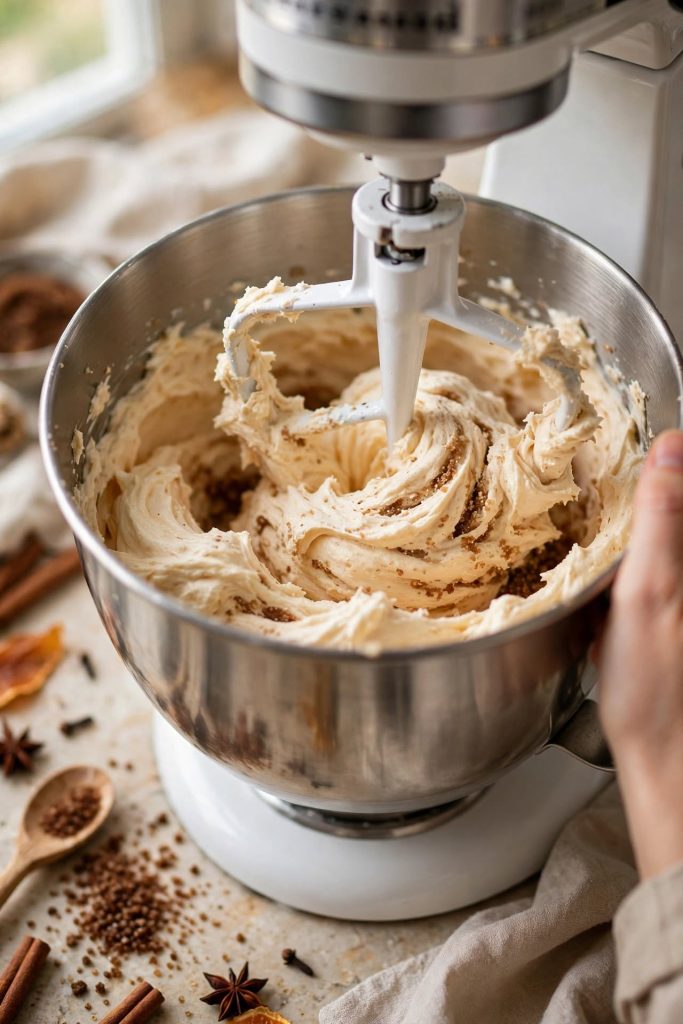
Beat the room-temperature butter and dark brown sugar together with an electric mixer on medium-high speed for 4 to 5 full minutes. Stop the mixer and scrape down the sides once partway through. The mixture should shift from dark and grainy to paler, fluffier, and noticeably lighter in colour.
⚠️ Do not rush this step. Under-creamed butter and sugar means less air in the batter — that air is what lifts the crumb during baking. Three minutes of creaming produces a visibly denser cake than five minutes.
What to look for: A pale caramel mixture that is fluffy enough to hold soft peaks briefly when you pull the beater away.
Once you are comfortable with this method, classic butter cake techniques are worth exploring for the same creaming principles applied across other bakes.
Step 4 — Add the Eggs One at a Time
Add the eggs one at a time, beating well after each addition before adding the next. The mixture may look slightly curdled between eggs — this is normal and will smooth out once the flour goes in. If the curdling looks severe, add a tablespoon of the weighed flour and beat briefly; this stabilises the emulsion.
Add the tablespoon of black treacle with the final egg and beat until incorporated. The mixture will deepen in colour to a dark mahogany.
What to look for: A thick, glossy mixture with a slight wobble, evenly coloured throughout.
Step 5 — Fold in the Flour and Spices
Sift in the plain flour, mixed spice, cinnamon, and grated nutmeg together. Add the ground almonds. Using a large metal spoon or spatula, fold gently from the bottom of the bowl up and over — do not use the mixer at this stage.
Stop folding the moment you see no more dry flour streaks. The batter will be thick and heavy — this is correct. Overworking it from here develops the gluten in the flour, which transforms the final texture from tender-dense to rubbery-dense.
What to look for: A uniformly dark, spiced batter with no visible flour pockets and no streaks of unmixed mixture.
Step 6 — Add the Soaked Fruit and Zest
Before adding the fruit to the batter, toss it quickly in a tablespoon of flour — this light coating helps it stay suspended in the batter during baking rather than sinking to the base. Add the orange and lemon zest at the same time. Fold the fruit through the batter in large, deliberate strokes until it is evenly distributed.
What to look for: Fruit visible throughout the batter with no large clusters sinking to the bottom of the bowl.
Step 7 — Pour, Level, and Bake
Spoon the batter into the prepared tin. It will be thick enough that you need to press it into the corners with the back of a spoon. Level the top, then make a very slight dip in the centre with the back of a wet spoon — this counteracts the dome that forms as the cake rises, giving you a flatter, easier-to-ice top.
Bake at 150°C for 3 hours to 3 hours 30 minutes. Check with a metal skewer at the 3-hour mark. The skewer should come out clean. If it comes out with wet batter, return for 20-minute intervals and check again.
What to look for: A deep mahogany top that is firm to a gentle press; the edges just beginning to pull from the tin sides; a skewer with no wet batter.
Step 8 — Feed the Cake After Baking
While the cake is still warm (not hot — wait 15 minutes after removing from the oven), make 8 to 10 small holes across the top using a metal skewer. Brush generously with 2 tablespoons of brandy. Leave to cool completely in the tin — this takes 2 to 3 hours.
Once cool, remove from the tin, peel off the bottom paper, and wrap tightly: first a layer of greaseproof paper, then a layer of foil. Store in an airtight tin. From this point, brush with 1 to 2 tablespoons of brandy every 1 to 2 weeks until you are ready to ice or serve.
What to look for: The skewer holes closing slightly as the brandy absorbs; the top surface taking on a slight gloss.
The Science Behind a Perfect Christmas Cake
A great Christmas cake result is not luck — it is the result of four ingredients and one technique doing specific, predictable jobs.
Why Brown Sugar Creates Depth
Dark brown sugar → contains 6 to 10% molasses by weight → the molasses is hygroscopic, meaning it actively draws moisture from the air and holds it in the crumb. You can observe this directly: a slice of Christmas cake made with dark brown sugar feels noticeably less dry on day 10 than one made with caster sugar, even under identical storage conditions. Swap to white sugar and your cake will stale faster — you will notice it by day four.
Why Soaking Fruit Matters
Dried fruit → rehydrates in brandy → acts as a moisture reservoir inside the baked crumb. During baking, the plumped fruit slowly releases its absorbed liquid into the surrounding batter — the same way a sponge releases water under gentle pressure. Unsoaked fruit does the opposite: it pulls moisture from the batter as it rehydrates in the oven heat, leaving the surrounding crumb drier. The difference between a 2-hour soak and a 48-hour soak is measurable in the final texture: longer soaking equals a moister crumb at every stage of the cake’s shelf life.
Why Low and Slow Baking Wins
150°C (300°F) → the interior reaches temperature gradually → proteins and starches set without the outside hardening before the centre cooks through. At 180°C (the standard cake temperature), a dense, fruit-heavy batter like this one would burn on the outside by the time the centre reached the correct internal temperature. The low temperature is not optional — it is what makes a 3.5-hour bake possible and a moist crumb achievable.
The single most critical rule: Do not raise the temperature to speed up the bake. If your cake is taking longer than expected, check your oven thermometer — most home ovens run 10 to 20 degrees colder than the dial shows at lower settings.
Tips for the Best Result
These are the details that separate a good Christmas cake from one people ask you to make again.
- Use an oven thermometer. Most home ovens are inaccurate at low temperatures — the setting of 150°C may actually be 130°C or 165°C. A £6 thermometer tells you your actual oven temperature and saves you from a dry or underbaked cake.
- Bring butter and eggs to room temperature before you start. Place them on the counter at least 1 hour before baking. Cold butter does not cream; cold eggs curdle the batter. Both result in a denser, less even crumb.
- Line your tin with a paper collar. The collar extending 5cm above the tin rim prevents the top from overbrowning before the interior is done. This is not optional for a bake longer than 2.5 hours.
- Toss the fruit in flour before folding. A tablespoon of plain flour tossed through the soaked fruit before it goes into the batter creates a light coating that stops the heavier pieces sinking during baking.
- Feed on a schedule. Mark your calendar: once a week or once every two weeks, unwrap the cake and brush with brandy. The flavour difference between a once-fed cake and a 6-times-fed cake is not subtle.
- Make one large and one small. Use the recipe as written for a 20cm round, and divide a small amount of extra batter into a lined loaf tin — you get a tasting cake for mid-December and keep the main cake intact for Christmas Day.
- Doubling: Bake in two separate 20cm tins, not one large one. A single oversized tin bakes unevenly — the outside sets long before the dense centre is done.
Common Mistakes to Avoid
These are the six errors that reliably ruin Christmas cake — and exactly what to do instead.
❌ Under-Soaking the Fruit
Result: Your fruit will pull moisture from the surrounding batter during baking, leaving the crumb noticeably drier — especially within the first week of storage.
Fix: Soak for a minimum of overnight — 24 to 48 hours if your schedule allows it.
❌ Using Cold Butter
Result: Cold butter will not cream with the sugar — you end up with a gritty, unmixed base that produces a dense, flat crumb instead of a structured, tender one.
Fix: Take butter out of the fridge at least 1 hour before baking; press your finger in before starting — it should yield easily.
❌ Opening the Oven Too Early
Result: Opening the oven before the batter has fully set — typically in the first 90 minutes — causes the interior structure to collapse. You end up with a sunken centre that no extra baking time can fix.
Fix: Do not open the oven before the 2.5-hour mark. Use the oven light to check the colour through the glass.
❌ Skipping the Cake-Feeding Step
Result: A Christmas cake that has never been fed after baking dries out significantly within 2 to 3 weeks — the texture becomes noticeably drier and the flavour shallower.
Fix: Feed with 1 to 2 tablespoons of brandy every 1 to 2 weeks from baking day until you are ready to ice.
❌ Baking at Too High a Temperature
Result: The outside of your Christmas cake will overbrown and harden before the dense centre reaches the correct internal temperature — you get a burnt crust over an underbaked middle.
Fix: Verify your oven temperature with a thermometer; bake at a true 150°C (300°F). If browning too fast, lay a double sheet of greaseproof paper loosely over the top for the final hour.
❌ Using the Wrong Pan Size
Result: A tin that is too small causes overflow and uneven baking; one that is too large spreads the batter thin, producing a flat cake that bakes too fast and dries out.
Fix: Use a 20cm (8-inch) round, deep tin — minimum 7cm depth. If using a square tin, reduce to 18cm (7-inch).
For more guides on avoiding common baking mistakes, that page covers the same level of detail across other classic bakes.
Variations Worth Trying
The base recipe is a reliable framework. These five variations each require a small change at a specific point in the process.
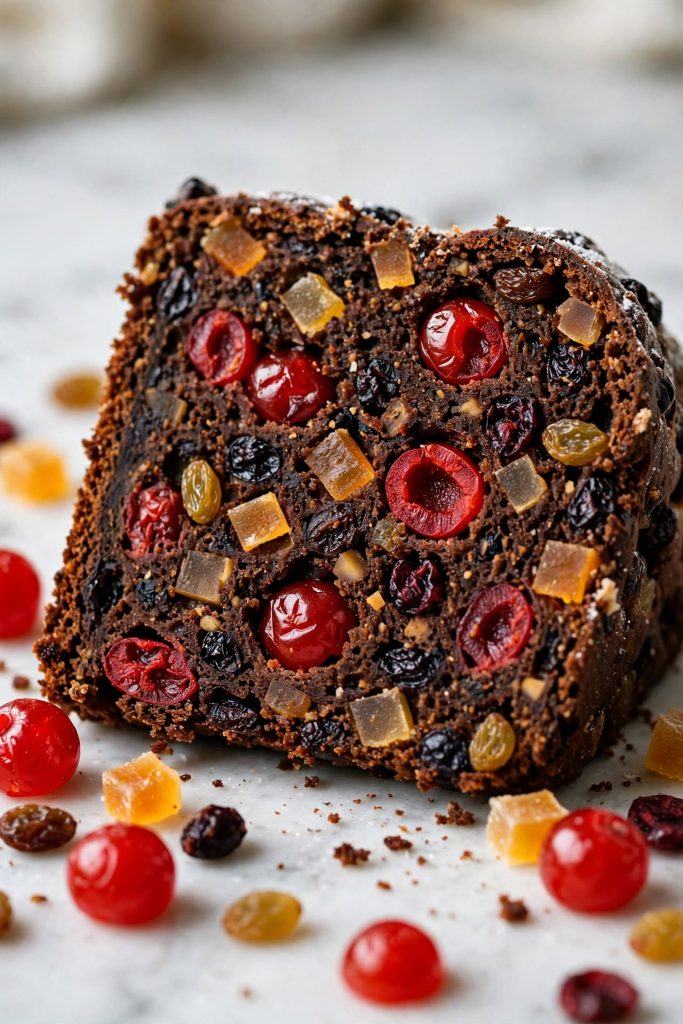
Alcohol-Free Christmas Cake
What changes: Replace brandy with freshly squeezed orange juice for the soak, and use a 50/50 mix of cold strong black tea and orange juice for the weekly feeds.
When: Substitute at the soaking stage and at every feeding.
Result: A lighter, brighter flavour profile with citrus as the dominant note instead of warm brandy. The crumb stays moist — just less complex in depth.
Chocolate Christmas Cake
What changes: Replace 50g of the plain flour with 50g of good-quality cocoa powder, and add 100g of dark chocolate chips to the fruit mix at Step 6.
When: At the flour measuring stage (Step 5) and the fruit folding stage (Step 6).
Result: A darker, richer cake with a slight bitterness that cuts through the sweetness of the glacé cherries. Soak the fruit in rum instead of brandy for an even more pronounced result.
Mini Christmas Cakes
What changes: Divide the batter between 6 to 8 greased and lined 10cm (4-inch) individual round tins.
When: At the pouring stage (Step 7). Bake at the same temperature for 1 hour to 1 hour 20 minutes — check from the 55-minute mark.
Result: Individual cakes that work as gifts or portion-controlled servings. Each one can be decorated separately.
Gluten-Free Version
What changes: Swap plain flour for a gluten-free plain flour blend at a 1:1 ratio. Add ½ teaspoon of xanthan gum to the dry ingredients if your blend does not already contain it.
When: At Step 5.
Result: A slightly more crumbly slice — the gluten network that holds the dense fruit in place is weaker in GF flour. The flavour is essentially identical. Leave to cool completely in the tin before attempting to slice.
Tropical Fruit Version
What changes: Replace the standard dried mixed fruit with a combination of dried mango, dried pineapple, dried papaya, and desiccated coconut — keep the total weight the same at 500g. Soak in white rum or pineapple juice instead of brandy.
When: At the soaking stage (Step 1).
Result: A golden, fragrant cake with a very different flavour profile — lighter, sweeter, and with a tropical character that makes it a striking alternative for anyone who finds traditional fruit cake too heavy.
How to Store
Room Temperature
An undecorated, fed Christmas cake stores well at room temperature for best quality for up to 3 months — wrapped first in greaseproof paper, then tightly in a double layer of foil, and kept in an airtight tin away from direct heat and light. What degrades first at room temperature is not moisture (that is maintained by the feeding) but the freshness of the citrus zest notes, which fade after 3 months. Continue feeding every 1 to 2 weeks throughout the storage period.
Refrigerator
Refrigerating Christmas cake is generally not recommended for the undecorated, uncut cake — the cold temperature can dry out the crumb over time, which is the opposite of what you want. If you refrigerate, use an airtight container and bring slices to room temperature for 30 minutes before eating — cold fat in the crumb mutes the flavour significantly. Best quality for up to 6 weeks refrigerated. Once the cake is iced with marzipan and royal icing, refrigeration is unnecessary and can cause the icing to crack.
Freezer — Complete Guide
Can it be frozen? Yes — Christmas cake freezes very well. Freeze the undecorated, unfed cake only; iced cakes do not freeze successfully.
How to wrap: Wrap the completely cooled cake in a double layer of cling film, then a double layer of foil. Label with the bake date. For individual slices, wrap each in cling film then place in a zip-lock freezer bag.
Duration: Best quality for up to 3 months frozen. Safe beyond this window but the quality — particularly the spice freshness and fruit texture — begins to decline after 3 months.
How to thaw: Transfer to the refrigerator the night before and leave wrapped until fully thawed. Then unwrap and leave at room temperature for 2 hours before serving. For a whole cake: begin the feeding process once thawed, 1 to 2 weeks before decorating.
Texture note: The dense crumb holds up exceptionally well to freezing — you will not notice a significant texture change. The one thing that may diminish slightly is the intensity of the brandy aroma.
If make-ahead baking is a regular part of your routine, that guide fits well alongside this one.
How to Serve
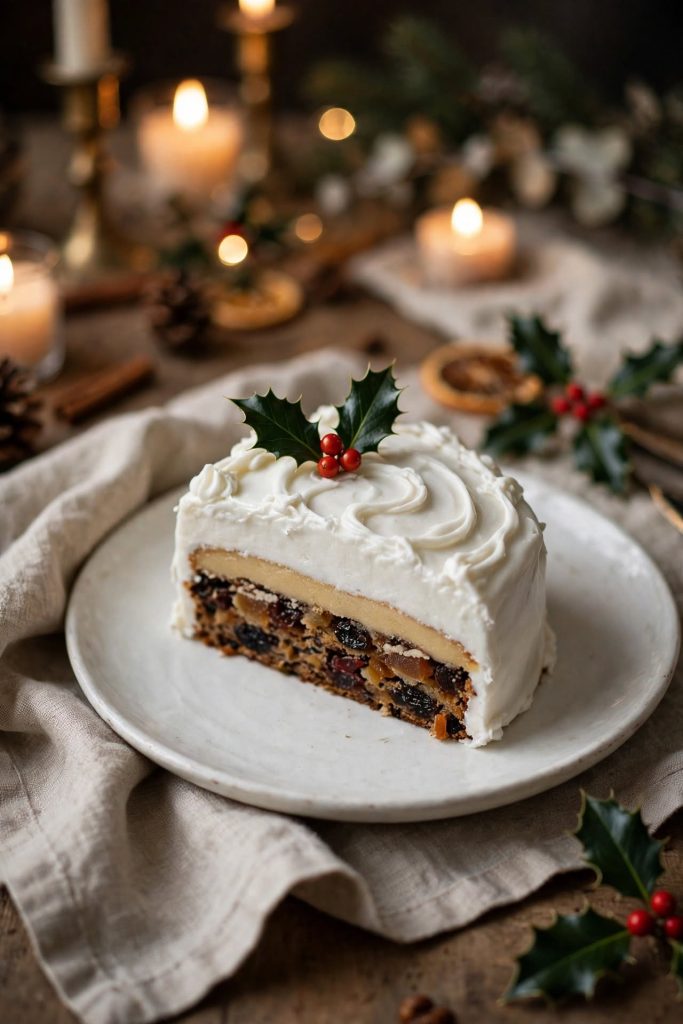
Classic Ways to Serve
- Sliced thin at room temperature, directly from the tin — the dense crumb slices cleanly with a sharp, non-serrated knife
- With a cup of strong black tea or filter coffee — the bitterness cuts the sweetness of the glacé cherries
- Plain, undecorated, as a centrepiece slice alongside cheese — mature cheddar or stilton against a slice of Christmas cake is a traditional British pairing
Upgraded and Occasion-Worthy
- With marzipan and royal icing — the traditional complete finish; brush the surface with warmed apricot jam, apply marzipan, leave 24 hours, then apply royal icing
- For a Christmas Day table — cover with marzipan and a smooth royal icing, mark with a fork in a snow pattern, add a handmade marzipan holly and ribbon
- For gifting — cool individual mini cakes completely, wrap in cellophane, tie with twine, and label with the baking date and feeding instructions for the recipient
Christmas cake pairs well with brandy butter, clotted cream, or a small glass of port. The occasion window is wide: it works from the first week of December through to New Year without losing quality.
Frequently Asked Questions
Can I make Christmas cake without alcohol?
Yes — you can make Christmas cake without alcohol by soaking the fruit in fresh orange juice, cold tea, or apple juice instead of brandy. The fruit absorbs the liquid and stays plump and moist either way. For feeding, brush with orange juice or a diluted black tea every two weeks. The flavour will be lighter and less complex, but the texture remains just as good.
Why did my Christmas cake turn out dry?
The most common cause of a dry Christmas cake is baking at too high a temperature or for too long. Christmas cake needs low, slow heat — 150°C (300°F) for a standard 20cm tin. A second cause is skipping the feeding stage: brushing the finished cake with brandy or juice every two weeks traps moisture inside. Check your oven with a thermometer — many home ovens run 10 to 20 degrees hotter than the dial shows.
How do I know when Christmas cake is done?
Insert a clean skewer into the centre of the cake — it should come out without wet batter clinging to it. The surface will be deep brown and firm to a gentle press. The edges will also begin to pull very slightly from the sides of the tin. Start checking at the 3-hour mark for a standard 20cm cake. A dense cake with a lot of fruit can take up to 4 hours.
Can I make this ahead of time?
Yes — Christmas cake is specifically designed to be made ahead, and it genuinely improves with time. The ideal window is 6 to 12 weeks before serving: bake the cake, let it cool completely, then wrap tightly and feed with brandy or juice every 1 to 2 weeks. A cake made the day before Christmas will taste good, but one made in October will taste noticeably richer. If you enjoy other make-ahead holiday bakes, they work well planned alongside this one.
How long does Christmas cake last?
An undecorated Christmas cake keeps for best quality for up to 3 months at room temperature when wrapped in greaseproof paper and foil and stored in an airtight tin. Once iced with marzipan and royal icing, best quality is up to 4 to 6 weeks. Use your judgment — if it smells off or shows mould, discard it.
Can I freeze Christmas cake?
Yes — Christmas cake freezes well. Wrap the undecorated, unfed cake tightly in cling film, then a layer of foil, and freeze for best quality for up to 3 months. Thaw overnight at room temperature, still wrapped, to prevent condensation. Once thawed, begin the feeding process before decorating. Do not freeze a cake that has already been covered with marzipan or royal icing.
What can I substitute for brandy?
The best non-alcoholic substitutes for brandy are orange juice, cold strong black tea, or apple juice. These keep the fruit moist and add flavour without alcohol. For the feeding stage, warm the juice slightly before brushing so it absorbs faster. Rum, whisky, and amaretto are alcoholic alternatives that each add a distinct flavour note.
Can I double this recipe?
Yes — you can double this Christmas cake recipe. Use two separate 20cm tins rather than one large tin, because a single oversized cake will cook unevenly and the centre may remain underbaked while the edges overbake. Baking time stays roughly the same for standard 20cm tins. If you use a larger 25cm tin, add 30 to 60 minutes to the bake time and check with a skewer.
Why did my Christmas cake sink in the middle?
A sunken centre is almost always caused by opening the oven door before the batter has set — typically in the first 90 minutes of baking. The sudden drop in temperature collapses the structure before it firms up. A second cause is too much raising agent or too much sugar, which causes a rapid early rise that the structure cannot support. Follow the recipe measurements exactly and resist opening the oven before the 2.5-hour mark.
What size tin works best for Christmas cake?
A 20cm (8-inch) round, deep tin is the standard size for this Christmas cake recipe and serves 12 to 16 people. The tin must be at least 7cm (3 inches) deep — a shallow tin causes overflow and uneven baking. If you use a square tin, reduce the size by 2.5cm (1 inch): a 18cm (7-inch) square tin holds the same volume as a 20cm round.
How early can I make Christmas cake?
You can start your Christmas cake as early as 3 months before Christmas — Stir-up Sunday (the last Sunday before Advent) is the traditional baking date in the UK. Earlier is better: each weekly feed of brandy builds layers of flavour. Baking in October and feeding through November gives you a noticeably richer result than a cake baked in December.
Can I add marzipan and royal icing to Christmas cake?
Yes — marzipan and royal icing are the traditional finish for a classic Christmas cake. Apply marzipan first: brush the surface with warmed apricot jam, roll out the marzipan, and press it firmly over the top and sides. Leave to dry for 24 to 48 hours before applying royal icing. This drying step stops the marzipan oils from bleeding through and discolouring the white icing.

Ingredients
Method
- Combine all dried fruit, cherries, and peel in a bowl. Pour over brandy, stir, cover, and soak overnight (minimum 8 hrs; 24–48 hrs preferred).
- Preheat oven to 150°C (130°C fan / 300°F / Gas 2). Line a 20cm deep round tin with a double layer of greaseproof paper, creating a collar 5cm above the rim.
- Beat butter and dark brown sugar for 4–5 minutes until pale and fluffy. Scrape down sides once.
- Add eggs one at a time, beating well after each. Add black treacle with the final egg.
- Sift in flour and spices. Add ground almonds. Fold gently until no flour streaks remain — do not overmix.
- Toss soaked fruit in 1 tbsp flour. Fold fruit and citrus zest into the batter until evenly distributed.
- Spoon into tin, level, create a slight dip in the centre. Bake 3 hrs to 3 hrs 30 mins. Test with a skewer from the 3-hour mark.
- While warm, make holes with a skewer, brush with 2 tbsp brandy. Cool completely in tin. Wrap and feed every 1–2 weeks.
Notes
- Always verify oven temperature with a thermometer — most ovens read inaccurately at 150°C.
- Do not open the oven before the 2.5-hour mark.
- The cake must be completely cold before wrapping — trapping steam causes sogginess.
- Make up to 3 months ahead; feed with 1–2 tbsp brandy every 1–2 weeks.
- Apply marzipan and royal icing within 1 week of serving.
More Holiday Baking Recipes You Will Love
- Mince Pies — buttery shortcrust pastry filled with spiced fruit mincemeat; the recipe that goes alongside your Christmas cake on every festive table.
- Sticky Toffee Pudding — a make-ahead steamed sponge with toffee sauce that reheats perfectly on Christmas Day, giving you one less thing to cook from scratch.
- Yule Log (Bûche de Noël) — a chocolate Swiss roll filled with ganache and decorated as a log; ready in 2 hours and a crowd-pleaser for anyone who does not eat fruit cake.
- Gingerbread Biscuits — crisp, spiced, and endlessly shapeable — the bake to do with children in the week before Christmas.
- Christmas Pudding — the steamed companion to Christmas cake, made with the same soaked fruit base and served with brandy butter on Christmas Day.
Did you make this Christmas cake? Leave a ⭐⭐⭐⭐⭐ rating below and let me know in the comments how it turned out. I read every comment and would love to know what worked for you — and when you started baking yours this year.