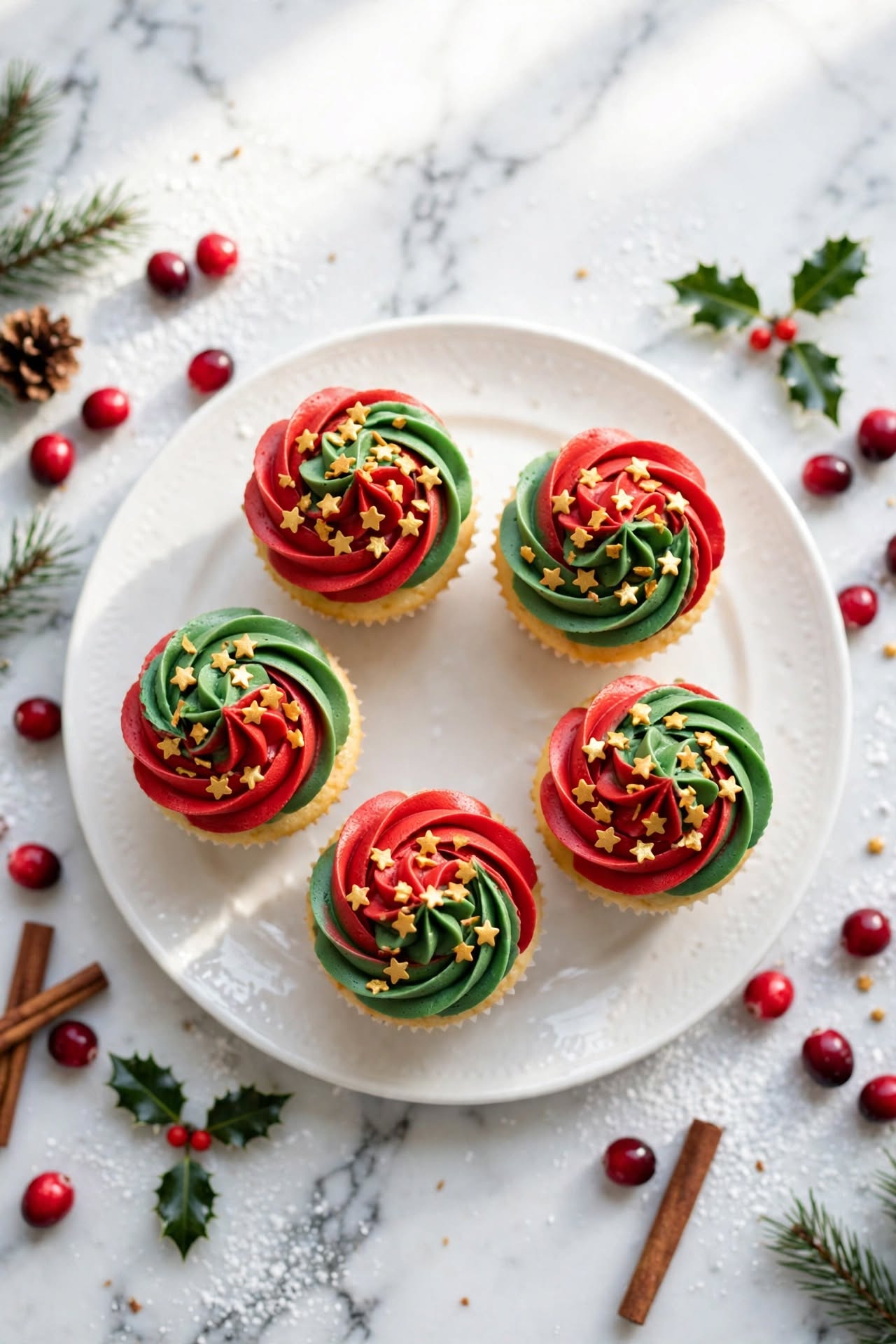
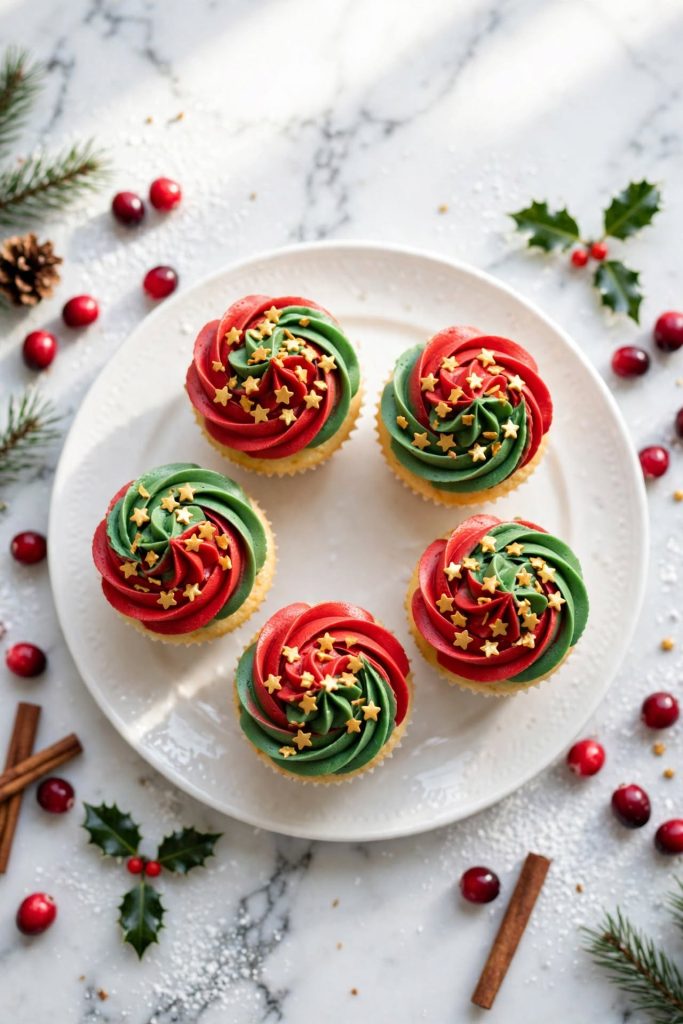
What are Christmas cupcakes? Christmas cupcakes are individual vanilla sponge cakes decorated with festive buttercream frosting and holiday toppings. They use a creamed butter method that produces a tight, even crumb that stays moist for up to three days. Each batch takes roughly 20 minutes of prep and 18 to 22 minutes in the oven. Best for home bakers who want a reliable, crowd-pleasing holiday dessert that decorates easily and travels well.
These Christmas cupcakes deliver a tight, moist crumb with a smooth vanilla buttercream that holds its swirl without collapsing. The recipe takes one bowl for the batter and 20 minutes of prep — no stand mixer required for the base. If your biggest concern is a dry cupcake or a frosting that slides off before guests arrive, the method here addresses both. I tested this recipe multiple times before publishing to confirm the ratios hold across different ovens.
Table of Contents
Why These Christmas Cupcakes Work
Most cupcake recipes online use the same basic formula and produce the same average result. This one is built on six specific choices that change what you pull out of the oven.
- Buttermilk in the batter — the acidity reacts with the baking powder to produce a finer, more even crumb that stays soft for up to three days instead of hardening overnight.
- Cake flour, not all-purpose — lower protein content means less gluten development, which gives you a tender interior that does not pull away from the liner or feel rubbery when you bite in.
- Creamed butter method — beating butter and sugar until pale and fluffy traps tiny air pockets that expand in the oven and lift the dome cleanly, without the sinking centre you get from shortcuts.
- Room-temperature ingredients throughout — cold eggs or cold butter break the emulsion and give you a lumpy, uneven batter; room temperature keeps everything smooth and well-incorporated.
- Double the frosting ratio — this recipe makes enough buttercream to pipe a full swirl on every cupcake without running short on the tenth or eleventh one.
- Baked at 170°C / 340°F — a lower temperature produces a flat, even top that is easier to frost than the domed peak you get at 180°C, with no levelling required.
If you are looking for more Christmas baking ideas, our holiday baking guide is a good place to start. [IL-1 — replace anchor text and URL before publishing]
Ingredients for Christmas Cupcakes
Every ingredient here has a specific job. Here is what each one does — and what to use if you need to make a substitution.
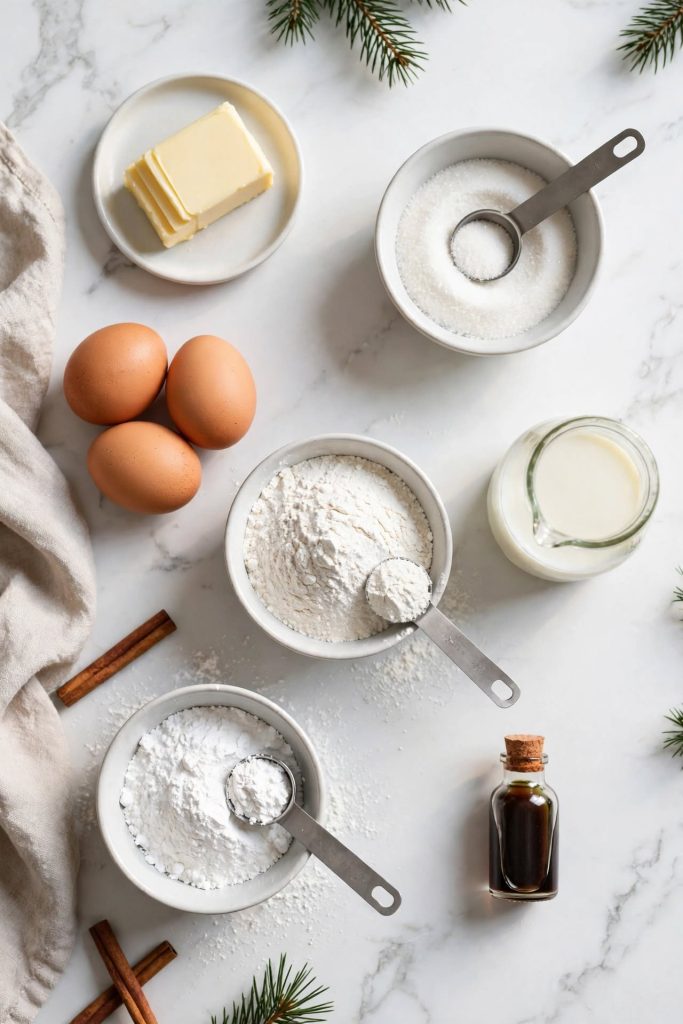
The Cupcake Batter
| Ingredient | Amount | What It Does | Best Substitute + Impact |
|---|---|---|---|
| Unsalted butter, softened | 115g / ½ cup | Provides fat for moisture and a rich base flavour | Salted butter — reduce added salt by ½ tsp; result is slightly saltier |
| Caster sugar | 200g / 1 cup | Sweetens and helps trap air during creaming | White granulated sugar — texture is fractionally coarser but still works |
| Eggs, room temperature | 2 large | Binds the batter and adds structure to the crumb | Flax eggs (1 tbsp flaxmeal + 3 tbsp water each, rested 5 min) — denser crumb |
| Cake flour | 200g / 1½ cups | Lower protein = more tender crumb | All-purpose flour — slightly tougher texture, still bakes correctly |
| Baking powder | 1½ tsp | Lifting agent that creates the dome | No direct substitute — do not skip or reduce |
| Salt | ¼ tsp | Balances sweetness and enhances overall flavour | N/A |
| Buttermilk, room temperature | 120ml / ½ cup | Adds tang, activates lift, keeps crumb moist | Whole milk + 1½ tsp white vinegar, rested 5 minutes — works as 1:1 swap |
| Vanilla extract | 1½ tsp | Primary flavour note in the batter | Vanilla bean paste — same quantity, slightly stronger flavour |
The Vanilla Buttercream Frosting
| Ingredient | Amount | What It Does | Best Substitute + Impact |
|---|---|---|---|
| Unsalted butter, softened | 230g / 1 cup | Fat base that gives the frosting its creaminess and body | Salted butter — reduce icing sugar slightly; flavour is saltier |
| Icing sugar, sifted | 480g / 4 cups | Sweetens and sets the structure so the swirl holds | No substitute — icing sugar is the structural element |
| Heavy cream | 3 to 4 tbsp | Loosens the frosting to a pipeable consistency | Whole milk — slightly less creamy but functional; add ½ tsp at a time |
| Vanilla extract | 2 tsp | Primary flavour of the frosting | N/A — essential |
| Gel food colouring | As needed | Provides festive red and green colour without thinning the frosting | Natural food dye — colour is less vivid and may need more quantity |
Key Ingredient Notes
Butter (batter): It must be soft enough to leave an indent when pressed — not melted, not cold. Cold butter does not cream properly and the batter will be lumpy and dense. If you forgot to pull it out in advance: cut into cubes and microwave at 10% power in 10-second bursts, checking between each.
Eggs: Pull them from the fridge 30 minutes before baking — cold eggs cause the emulsion to split and leave a curdled batter that bakes unevenly.
Buttermilk: Use full-fat where available. The higher fat content adds extra richness. The vinegar substitute works well but the flavour is very slightly more acidic.
Equipment You Need
- Stand mixer or electric hand mixer
- 12-cup standard muffin tin
- Christmas-themed cupcake liners (standard or tulip style)
- Piping bag with a 1M or 2D open star tip
- Wire cooling rack
- Kitchen scales — weight measurements give more consistent results than cup measures
- 60ml / ¼ cup ice cream scoop for even batter portioning (optional but useful)
The Decoration Guide
The frosting colour you choose sets the visual tone of the entire platter — and the technique determines whether the swirl holds for six hours or collapses before guests arrive.
| Decoration Style | What You Need | Best For |
|---|---|---|
| Classic red swirl | Red gel food colouring, 1M tip | Christmas dinner table centrepiece |
| Green Christmas tree | Green gel colouring, leaf tip or round tip | Kids’ parties and school events |
| Two-tone red and green | Two piping bags, one large star tip | Holiday gift platters and party boxes |
| Snowy white with sprinkles | No colouring, white nonpareils or edible glitter | Elegant gatherings and adult events |
| Rustic spread style | Offset spatula, no piping required | Casual family get-togethers |
Visual cue for ideal frosting before piping: run a spatula through the frosting — it should hold a peak that falls over very slightly at the tip. If it holds rigid (too stiff — add ½ tsp cream at a time) or spreads flat immediately (too soft — add 2 tbsp sifted icing sugar and beat 30 seconds before testing again).
The most common reason holiday cupcakes lose their shape at room temperature is gel colouring added too quickly — the added liquid changes the frosting consistency. Add colour one drop at a time and beat fully between each addition.
How to Make Christmas Cupcakes — Step by Step
Preheat your oven before you start mixing — the batter should go in as soon as it is ready.
Step 1: Prepare Your Oven and Muffin Tin
Preheat your oven to 170°C / 340°F (150°C fan). Line a 12-cup standard muffin tin with your Christmas cupcake liners — press each liner firmly to the base so it does not shift when you fill it.
What to look for: the oven light goes off, confirming it has reached temperature before you start mixing.
Step 2: Mix the Dry Ingredients
Whisk the cake flour, baking powder, and salt together in a medium bowl. Set aside — do not sift unless your flour is noticeably lumpy.
What to look for: a pale, uniform mixture with no visible clumps.
Step 3: Cream the Butter and Sugar
Beat the softened butter on medium speed for 2 full minutes before adding the sugar — this pre-beats the butter into a smooth base. Add the caster sugar and continue beating for a full 3 minutes. Stop the mixer and scrape down the bowl with a spatula.
What to look for: the mixture should be noticeably paler — almost cream-coloured rather than yellow — and feel lighter and slightly airy. This creaming stage is what gives Christmas cupcakes their characteristic lift.
Step 4: Add Eggs and Vanilla
⚠️ Critical step: Add eggs one at a time. Beat for 20 seconds after each one before adding the next. Add the vanilla extract with the second egg. If the batter looks curdled after the second egg — this is normal and corrects once the flour goes in.
What to look for: the batter should look smooth and slightly glossy before the flour stage begins.
Step 5: Combine Wet and Dry Ingredients
⚠️ Critical step: Add the flour mixture and buttermilk in three alternating additions — flour, buttermilk, flour, buttermilk, flour. Mix on low speed and stop the moment you no longer see dry streaks. Once you are comfortable with this method, our layered cake guide is worth trying next. [IL-2 — replace before publishing]
What to look for: a smooth, thick batter that falls from the spatula in ribbons rather than dripping in thin streams. No dry patches should remain.
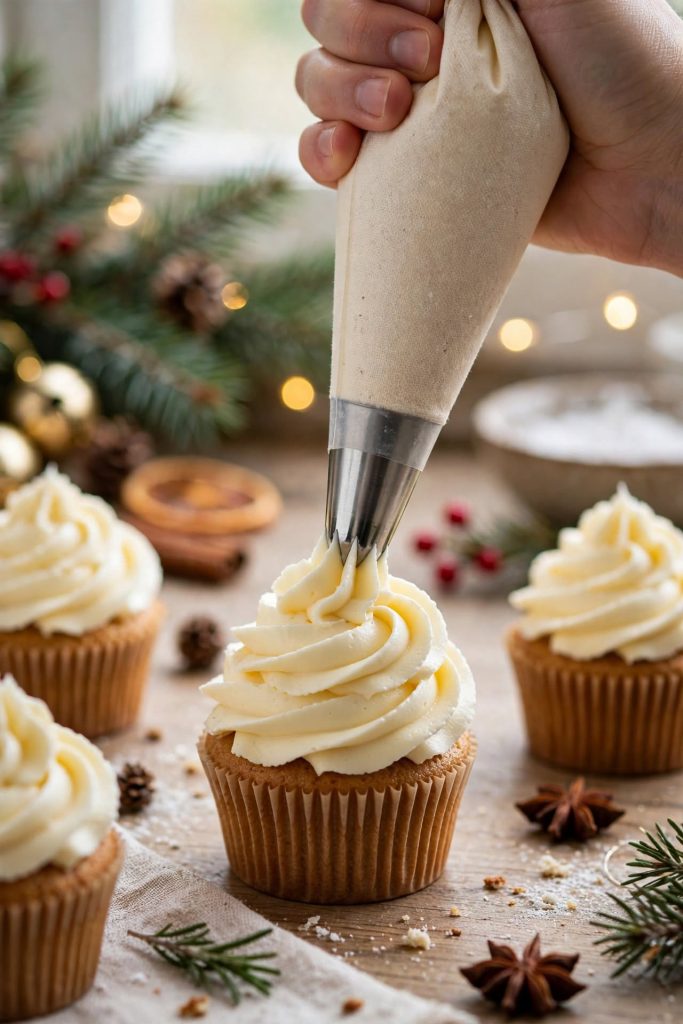
Step 6: Fill and Bake
Divide the batter evenly between the 12 liners — fill each one two-thirds full. A standard 60ml / ¼ cup ice cream scoop gives consistent portions without mess. Each cup should hold roughly 55 to 60g of batter. Bake for 18 to 22 minutes.
What to look for: the tops should be set and not shiny or wet-looking. A toothpick inserted into the centre should come out clean or with one or two moist crumbs — wet batter means another 2 minutes.
Step 7: Cool and Frost
Leave the cupcakes in the tin for 5 minutes, then transfer to a wire rack. Wait until completely cool — at least 45 minutes at room temperature — before frosting. A cupcake that is even slightly warm will melt the buttercream on contact and the swirl will collapse within minutes.
What to look for: the base of each cupcake should feel cool to the touch, not just the top surface.
The Science Behind a Perfect Crumb
Understanding why each step works makes you a more adaptable baker — and lets you fix problems before they ruin an entire batch.
Why Room-Temperature Butter Matters
When butter is cold, it does not cream properly with sugar — you end up with separated, grainy particles instead of a smooth emulsion, and the air pockets you need never form. Room-temperature butter (ideally around 20°C / 68°F) is soft enough to aerate fully during beating, which is what creates the characteristic dome on a well-made cupcake. The visual cue: it should leave an indent when pressed with a fingertip, but hold its shape — not slide or melt.
Why Cake Flour Over All-Purpose Flour
Cake flour has a protein content of around 7 to 9%, compared to 10 to 12% for all-purpose. Lower protein means less gluten development when the flour is mixed with liquid. Less gluten means a more tender, delicate crumb that does not feel rubbery or tight when you bite in. For festive cupcakes — where the texture is half the appeal — that 3% protein difference is noticeable in the final result.
Why Buttermilk Keeps Them Moist
Buttermilk has two functions in this batter. Its acidity reacts with the baking powder to produce carbon dioxide bubbles that expand in the oven heat and help lift the crumb. At the same time, that acidic environment partially breaks down gluten strands as the batter rests, producing a softer and more tender crumb than regular milk would give you. The result: a holiday cupcake that still feels moist on day two — not stale or dry the morning after the party.
Tips for the Best Results
Fill Liners to the Right Level
Two-thirds full is the correct fill level — not three-quarters, not half. More than two-thirds and the batter rises over the edge during baking, producing a dense, mushroom-topped cupcake that is difficult to frost cleanly. Less than half and you get a flat, sunken result with too little crumb to support the weight of the frosting.
Use a Piping Bag for Professional Frosting
A 1M open star tip produces the classic high swirl you see on bakery-style Christmas cupcakes. Start from the outside edge of the cupcake and work inward in a tight spiral, finishing with a short, firm upward pull to create the centre peak. Practice one or two swirls on a piece of baking paper first — you only get one pass on each cupcake and the first two are always your learning curve.
Get the Frosting Consistency Right
Stiff frosting tears the cupcake surface instead of gliding across it. Loose frosting pools instead of holding a peak. The ideal consistency holds a peak that just curls over at the very tip. Add cream one teaspoon at a time if the frosting is too stiff — add sifted icing sugar one tablespoon at a time if it is too loose. Beat for 30 seconds after each small addition and test again before adding more.
Add Food Coloring Without Ruining the Frosting
Always use gel food colouring, not liquid. Liquid dye adds water and shifts the frosting consistency — you lose the stiff peak structure needed for clean piping. Add gel colouring one drop at a time, mixing fully between each addition. Stop two shades before your target colour — the colour deepens as the frosting rests for 5 to 10 minutes.
Decorating With Sprinkles and Toppers
Add sprinkles immediately after piping — the frosting surface begins to set as it dries and sprinkles will not adhere once that happens. Heavier toppers like fondant stars, candy canes, or miniature Christmas trees should be pressed in gently at the base to anchor them. For an edible glitter finish, dust lightly over the swirl using a clean, dry pastry brush after the sprinkles are in place.
Baking Ahead for the Holidays
Bake the cupcake bases up to two days ahead and store them unfrosted in an airtight container at room temperature. Make the buttercream up to three days ahead and refrigerate it in a sealed container. Re-beat the frosting for one full minute before piping — cold frosting is too stiff to pipe cleanly and will tear the cupcake surface. Frost on the day of serving for the best visual result.
Common Mistakes to Avoid
These are the six errors that consistently turn a good batter into a disappointing result.
❌ Overmixing the Batter
Stop mixing the moment you can no longer see dry streaks of flour. Overmixing activates gluten development — every additional second of mixing after the flour is fully incorporated makes the final crumb tighter and tougher. Ten extra folds past the point of incorporation is enough to change the texture noticeably.
❌ Filling Liners Too Full
More than two-thirds full and the batter rises over the edge during baking — you get a muffin-cap shape with a dense, undercooked centre. This is the most common reason festive cupcakes fail to hold their frosting — the mushroomed top surface is not flat enough to pipe on cleanly.
❌ Frosting Warm Cupcakes
The butter in buttercream begins to melt at around 34°C / 93°F. A cupcake that has been out of the oven for only 10 minutes is still above that temperature at its centre. Frosting it at that stage does not just look bad — the buttercream incorporates into the crumb surface and loses all structure.
❌ Using Cold Butter for the Frosting
Cold butter does not beat into a smooth, creamy frosting — it stays lumpy regardless of how long you mix. The ideal butter temperature for frosting is the same as for the batter: soft enough to leave an indent, not melted. If your kitchen is cold, microwave the butter for 5-second bursts at 30% power, checking texture between each.
❌ Overbaking
A clean toothpick does not mean another 5 minutes will improve the result — it means stop immediately. Overbaked cupcakes are noticeably dry within an hour of coming out of the oven. Start checking at 18 minutes, regardless of what your oven’s stated temperature is, as all ovens run differently.
❌ Skipping Room-Temperature Eggs
Cold eggs cause the creamed butter-and-sugar mixture to seize — the butter solidifies around the cold egg and the emulsion breaks. You see this as a curdled, separated batter. While it can bake out, it produces a slightly denser, less uniform crumb than properly emulsified batter.
For more guides like this one, our holiday baking troubleshooting post covers every common issue in the same depth. [IL-3 — replace before publishing]
Variations Worth Trying
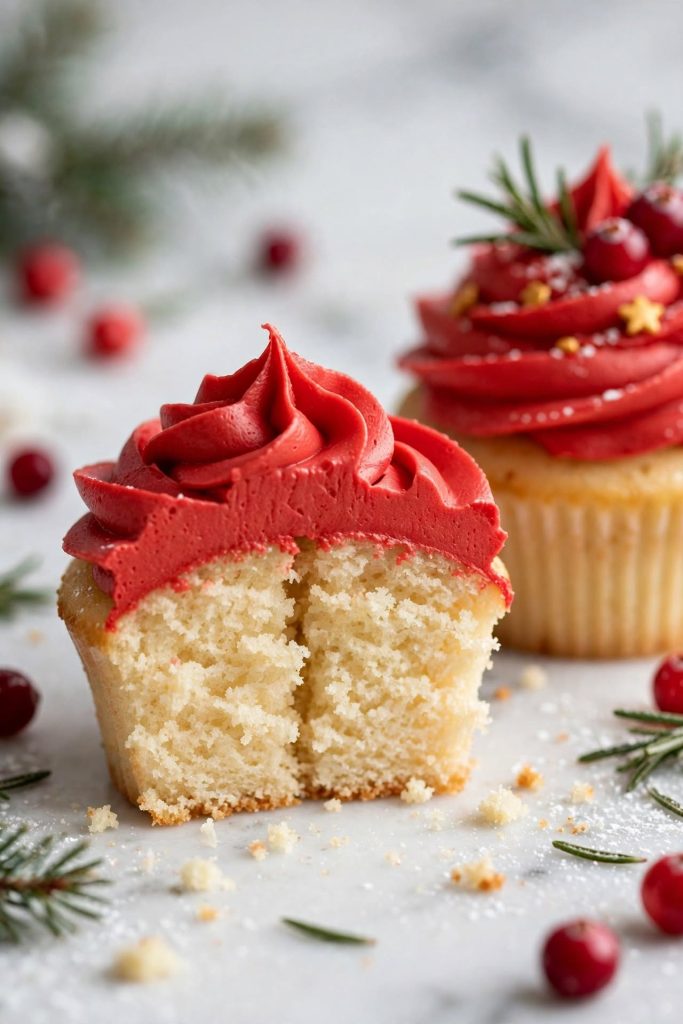
Chocolate Christmas Cupcakes
What changes: Replace 30g of the cake flour with 30g of Dutch-processed cocoa powder. Add 60ml / ¼ cup of hot black coffee to the batter — it deepens the chocolate flavour without adding a coffee taste.
When: At the dry ingredient stage, before combining with wet ingredients.
Result: A richer, darker crumb that pairs well with peppermint buttercream or salted caramel frosting — both festive and visually striking.
Gingerbread Spice Cupcakes
What changes: Add 1½ tsp ground ginger, 1 tsp cinnamon, ¼ tsp cloves, and ¼ tsp nutmeg to the dry ingredients. Replace 50g of the caster sugar with dark brown sugar.
When: At the dry ingredient mixing stage.
Result: A warm-spiced cupcake with a slightly denser crumb and a caramel-molasses undertone — one of the most recognisable Christmas baking flavours and consistently popular at holiday events.
Red Velvet Christmas Cupcakes
What changes: Add 1 tbsp cocoa powder, 1 tsp white vinegar, and 1 tbsp red gel food colouring to the batter. Pair with cream cheese frosting instead of vanilla buttercream.
When: Add the colouring and vinegar with the wet ingredients at Step 4.
Result: The deep red crumb colour makes these the most visually striking option on a holiday dessert platter — and the cream cheese frosting adds a tangy contrast to the sweetness.
Eggless Christmas Cupcakes
What changes: Replace each egg with one flax egg (1 tbsp ground flaxseed + 3 tbsp water, rested 5 minutes until gel forms). Add ½ tsp additional baking powder to compensate for reduced lift.
When: At the egg addition stage in Step 4.
Result: A slightly denser crumb that is still moist and flavourful — suitable for guests with egg allergies or a plant-based preference. The frosting recipe is already egg-free.
Mini Christmas Cupcakes
What changes: Use a 24-cup mini muffin tin with mini Christmas liners. Fill each cup halfway — roughly 25 to 30g of batter per cup.
When: At the fill and bake stage.
Result: Baking time drops to 10 to 13 minutes. One batch of batter produces 24 to 28 mini cupcakes — ideal for party platters, school events, and festive gift boxes where individual wrapping is needed.
How to Store
Room Temperature
Unfrosted cupcakes keep for best quality for up to two days at room temperature in an airtight container. Store in a single layer — stacking compresses the tops and makes frosting harder. Keep away from direct sunlight or heat sources.
Frosted cupcakes keep for best quality for up to one day at room temperature. If your kitchen is above 22°C / 72°F, the buttercream will soften and lose structure — move them to a cool spot or refrigerate.
Refrigerator
Both frosted and unfrosted cupcakes keep for best quality for up to four days in the refrigerator in an airtight container. Refrigerating unfrosted cupcakes can dry them out slightly — wrap them individually in cling film first to slow moisture loss.
To restore texture after refrigeration: bring cupcakes to room temperature for 30 to 40 minutes before serving. Do not microwave frosted cupcakes — the buttercream melts before the crumb warms through evenly.
Freezer — Complete Guide
Can you freeze Christmas cupcakes? Yes — unfrosted cupcakes freeze well. Frosted cupcakes can also be frozen, though the frosting texture changes slightly after thawing.
To freeze unfrosted cupcakes: cool completely on a wire rack, wrap each one individually in cling film, place in a sealed zip-lock bag or airtight container. Best quality for up to two months. Safe beyond that window but flavour and texture begin to decline.
To freeze frosted cupcakes: flash-freeze uncovered on a tray for 1 to 2 hours until the frosting is firm, then wrap individually in cling film and place in a freezer bag. Best quality for up to six weeks.
To thaw: move to the refrigerator overnight, then to room temperature for 30 to 45 minutes before serving — this prevents condensation forming on the frosting surface.
Use your judgment — if they smell off or show any mould, discard them.
If batch baking for Christmas is something you enjoy, our make-ahead holiday baking guide fits perfectly into that approach. [IL-4 — replace before publishing]
How to Serve
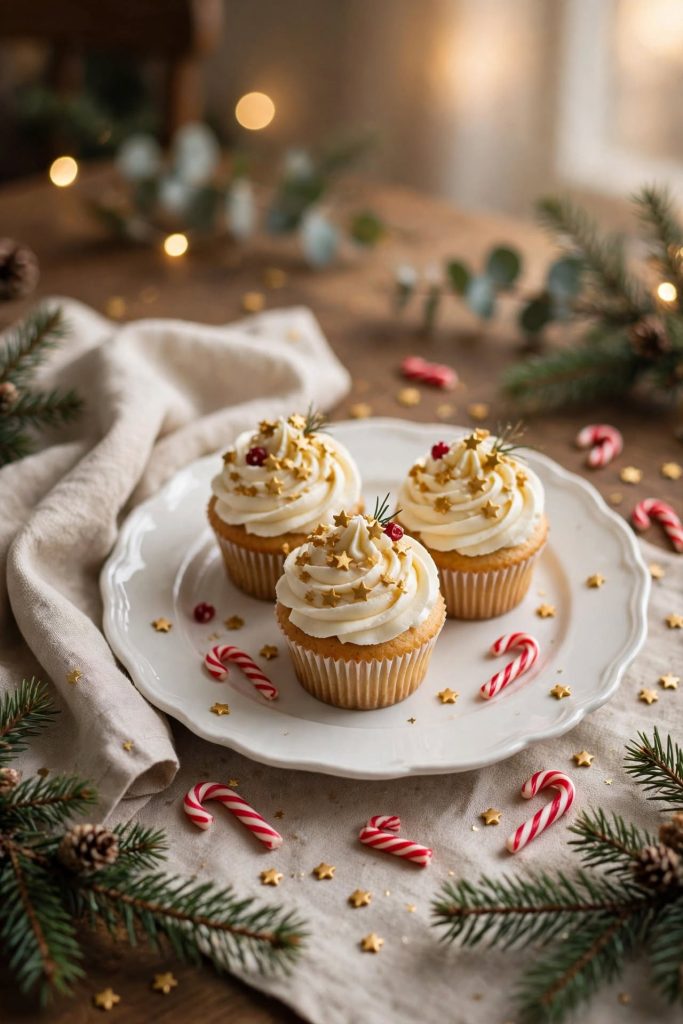
Classic Ways to Serve
- Arranged on a tiered cake stand at room temperature — remove from the fridge 30 minutes before guests arrive
- Placed in individual cupcake boxes for gifting — standard bakery boxes hold 4 or 6 per box
- Set out on a platter alongside mulled wine, hot chocolate, or filter coffee
Upgraded and Occasion-Worthy
- Stack two mini cupcakes as a “tower” on individual dessert plates with a dusting of icing sugar — presents well at sit-down Christmas dinners
- Serve unfrosted with a small pot of warm salted caramel sauce as a dipping option — an interactive dessert course that works well at adult parties
- Arrange 12 cupcakes in a Christmas tree formation on a large wooden board (5 across the base, then 4, 3, 2, 1 working upward) and dust with icing sugar snow — a centrepiece that needs no additional wrapping as a gift
Pairs well with: mulled wine, Irish coffee, peppermint hot chocolate, vanilla ice cream, or warm salted caramel.
Best occasions: Christmas parties, school events, office gift exchanges, holiday gifting, festive afternoon tea.
Frequently Asked Questions
Can I make Christmas cupcakes without eggs?
Yes. Replace each egg with a flax egg: combine 1 tablespoon of ground flaxseed with 3 tablespoons of water and rest for 5 minutes until it forms a gel. The crumb will be slightly denser but still moist and flavourful. Add an extra ½ teaspoon of baking powder to help with lift, and expect a very slightly shorter bake time.
Why did my Christmas cupcakes sink in the middle?
Sinking in the centre is most often caused by under-baking or opening the oven door before the cupcakes have set on top. Check at 18 minutes and insert a toothpick — if it comes back with wet batter, give them 2 more minutes. A second common cause is overfilling the liners: too much batter creates too much weight for the underbaked centre to support as it rises.
How do I know when Christmas cupcakes are done?
Insert a toothpick into the centre — it should come out clean or with one or two moist crumbs attached (not wet batter). The tops should look set and feel lightly springy when pressed. The edges should show very slight separation from the liner. Start checking at 18 minutes regardless of oven temperature, as all ovens vary.
Can I make them ahead of time?
Yes. Bake the cupcake bases up to two days ahead and store unfrosted in an airtight container at room temperature. Make the buttercream up to three days ahead and refrigerate it. Re-beat the frosting for one full minute before piping — cold frosting is too stiff to pipe cleanly. Frost on the day of serving for best presentation.
How long do Christmas cupcakes last?
Unfrosted cupcakes keep for best quality for up to two days at room temperature or up to four days refrigerated. Frosted cupcakes are at their best within one day at room temperature. Refrigerated frosted cupcakes should be brought to room temperature for 30 minutes before serving. If you enjoyed this recipe, our Christmas gingerbread recipe is the next one worth making. [IL-5 — replace before publishing]
Can I freeze Christmas cupcakes?
Yes. Unfrosted cupcakes freeze for best quality for up to two months when wrapped individually in cling film and stored in an airtight container. Frosted cupcakes can also be frozen — flash-freeze them first until the frosting is solid, then wrap and bag them. Thaw overnight in the refrigerator, then bring to room temperature before serving.
What can I substitute for buttermilk?
Combine 120ml (½ cup) of whole milk with 1½ teaspoons of white vinegar or fresh lemon juice. Stir and let it sit for 5 minutes — the milk will thicken and curdle slightly. This creates the same acidity as buttermilk and works as a direct 1:1 replacement in this batter.
Can I double this recipe?
Yes. Double every ingredient and use two standard muffin tins. Bake both tins on the same oven rack if your oven is wide enough, or bake one tin at a time on the centre rack. Doubling does not change the baking time — check both tins individually at 18 minutes.
Why did my frosting turn out too runny?
Runny buttercream is typically caused by butter that was too warm (above 23°C / 73°F), too much cream added at once, or gel colouring used in excess. Refrigerate the frosting for 10 to 15 minutes, then re-beat. If it is still too soft, beat in sifted icing sugar one tablespoon at a time until it holds a peak.
What size liners work best?
Standard-size liners (approximately 6cm / 2.4 inches across the base) are correct for a 12-cup standard muffin tin. Avoid plain foil liners without a paper layer — the batter can cling to them. Tall tulip-style liners also work well and produce a bakery-height presentation, but fill them to only half capacity rather than two-thirds.
Can I use store-bought frosting?
You can, but store-bought frosting is significantly softer than homemade buttercream and will not hold a piped swirl at room temperature. If you use it, spread it with an offset spatula instead of piping. For Christmas cupcakes where presentation is part of the appeal, homemade buttercream consistently performs better and gives you full control over the colour and consistency.
How do I get bright red and green frosting?
Always use gel food colouring, not liquid. For a true Christmas red, use a “Christmas red” or “super red” gel colour from a baking supply shop — standard red gel often produces a coral-pink tone unless used in large amounts. Add colouring one drop at a time and mix fully between each addition. Colour the frosting, then rest it for 10 minutes — the colour deepens as it sits.

Christmas Cupcakes
Ingredients
Method
- Preheat oven to 170°C / 340°F (150°C fan). Line a 12-cup muffin tin with cupcake liners.
- Whisk the cake flour, baking powder, and salt together in a medium bowl. Set aside.
- Beat softened butter on medium speed for 2 minutes. Add caster sugar and continue beating for a full 3 minutes until the mixture is pale and noticeably lighter in texture.
- Add eggs one at a time, beating 20 seconds after each. Add vanilla extract with the second egg.
- Add flour and buttermilk in three alternating additions (flour, buttermilk, flour, buttermilk, flour), mixing on low speed. Stop the moment you no longer see dry flour streaks.
- Divide batter evenly between the 12 liners, filling each two-thirds full (approximately 55 to 60g per cup). Bake for 18 to 22 minutes until a toothpick comes out clean.
- Cool in the tin for 5 minutes, then transfer to a wire rack. Cool completely — at least 45 minutes — before frosting.
- Beat softened butter for 3 minutes until pale. Add sifted icing sugar in two additions, beating well between each. Add cream one tablespoon at a time until the frosting reaches piping consistency. Beat in vanilla.
- Divide frosting and tint with gel food colouring as desired. Pipe onto cooled cupcakes using a star tip. Decorate immediately with sprinkles and holiday toppers.
Notes
- Cake flour substitute: Use all-purpose flour — expect a slightly firmer crumb.
- Buttermilk substitute: 120ml whole milk + 1½ tsp white vinegar, rested 5 minutes.
- Frosting too stiff? Add cream ½ tsp at a time. Too loose? Add 1 tbsp sifted icing sugar and beat 30 seconds.
- Make ahead: Bake bases up to 2 days ahead; frost on the day of serving.
- Gel colouring: Use “Christmas red” or “super red” for a vivid red — standard red gel can turn coral-pink.
Estimated Nutrition Per Serving
Approximate values including full frosting. Use a nutrition calculator for precise figures before publishing.More Holiday Baking Recipes You Will Love
- Christmas Gingerbread Cookies — the classic spiced biscuit that holds its shape perfectly for icing and decorating; ideal for making with kids or filling gift boxes.
- Cinnamon Christmas Rolls — a pull-apart breakfast treat that goes from oven to table on Christmas morning in under an hour, with a sticky glaze that sets as it cools.
- Christmas Fruit Cake — a rich, dark fruit cake made with soaked dried fruit and brandy; it improves with every day it rests before serving and keeps for weeks.
- Yule Log Cake — a chocolate Swiss roll decorated to resemble a woodland log; the most visually impressive dessert on any Christmas table and easier to make than it looks.
Did you make these Christmas cupcakes? Leave a ⭐⭐⭐⭐⭐ rating below and let me know in the comments how they turned out. I read every comment and would love to know what worked for you.