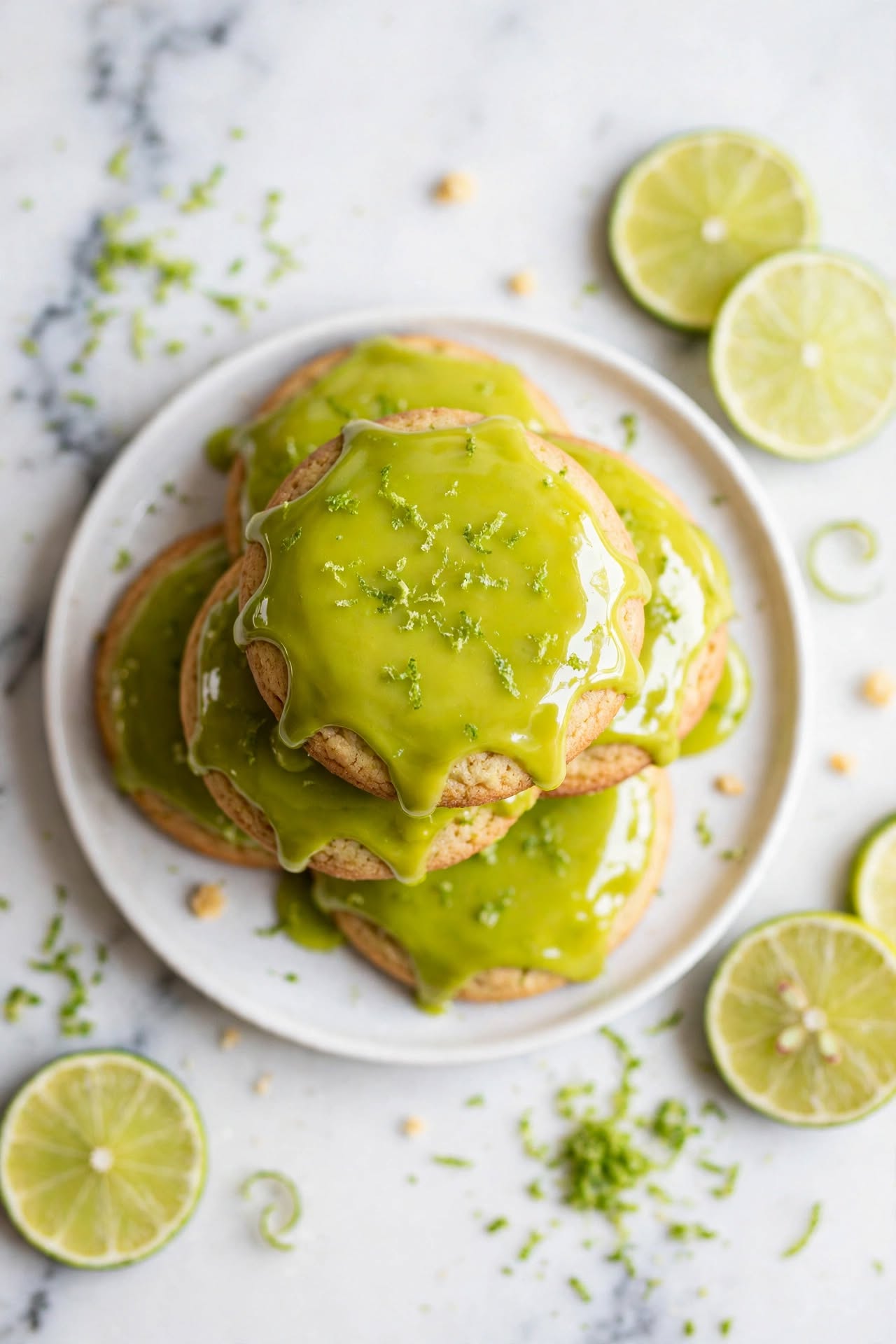
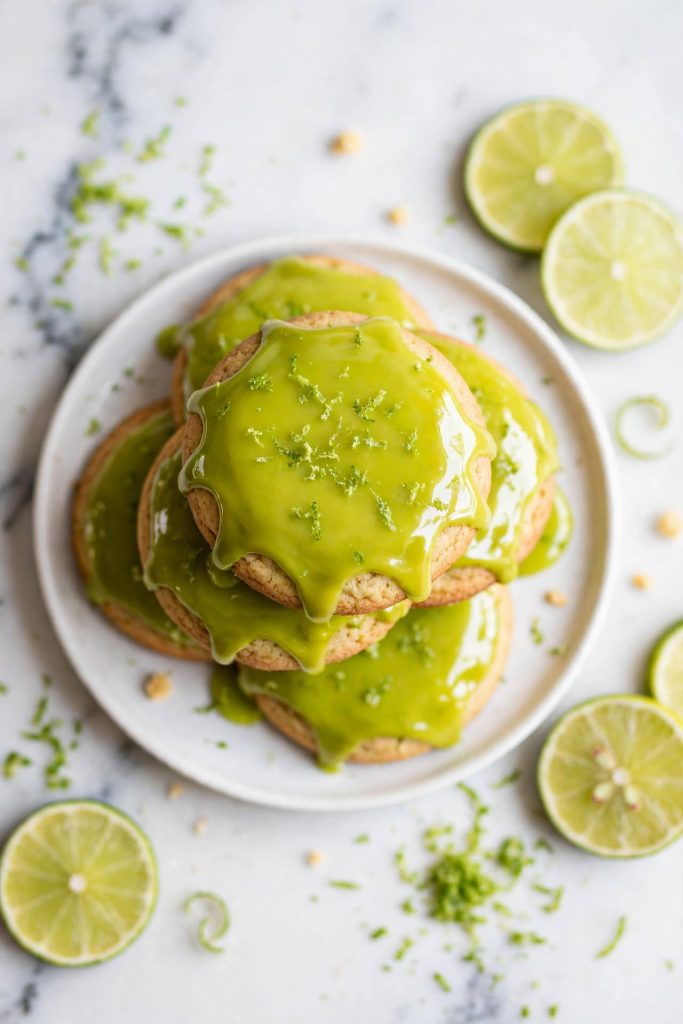
Key lime cookies are soft, thick drop cookies made from butter, cream cheese, fresh key lime zest, lime juice, and flour that bake in under 12 minutes per batch. They use zest as the primary flavor source — not juice — because the oils in the peel survive oven heat better than the juice does. A two-ingredient key lime glaze goes on after baking to deliver a sharp citrus punch that the dough alone cannot match. Total active time is about 20 minutes, with 1 hour of dough chilling.
This key lime cookies recipe solves the most common problem with citrus baked goods: the lime flavor bakes out before the cookies finish cooking. The fix is in the ratio — more zest than juice in the dough, plus a fresh key lime glaze that never sees the inside of an oven. The result is a cookie that genuinely tastes like key lime, not just a pale suggestion of it. I tested this recipe eight times before publishing, adjusting the zest quantity and glaze concentration until every bite delivered the tart, aromatic punch that makes a key lime dessert worth eating.
Why These Key Lime Cookies Work
Most citrus cookie recipes rely too heavily on juice and not enough on zest — and the juice flavor largely bakes out at oven temperatures. This recipe builds flavor on both sides of the oven: inside the dough where zest survives the heat, and on top via a glaze that never gets cooked at all.
- Zest-forward formula — this recipe uses 2 tablespoons of zest and only 2 tablespoons of juice in the dough. The essential oils in the peel are far more concentrated and heat-stable than the juice compounds, so more zest means more lime flavor that actually survives baking.
- Cream cheese in the dough — full-fat cream cheese traps moisture and limits gluten development, giving you a soft, dense crumb that holds its tenderness for days. Citrus acidity and cream cheese tang work together here rather than competing.
- Cornstarch for a tender bite — two tablespoons of cornstarch dilute the gluten-forming proteins in the flour without adding liquid. The result is a crumb that stays soft without making the dough too loose to scoop cleanly.
- A mandatory chill — cold dough holds its height in the oven. The small amount of lime juice in the dough softens the fat slightly more than a non-citrus recipe, making the chill more important here than in other cookie recipes.
- The two-ingredient glaze — powdered sugar and fresh key lime juice, applied after baking. This is where the sharpest, most recognizable key lime flavor lives because it never enters the oven. It also seals the surface and keeps the crumb soft longer.
- Works as both drop cookies and cut-outs — the same chilled dough scoops cleanly for weeknight drop cookies or rolls out for cut shapes when the occasion calls for it.
If you want to understand more about how citrus behaves in baked goods, our guide to baking with citrus zest and juice covers the full chemistry.
Ingredients for Key Lime Cookies
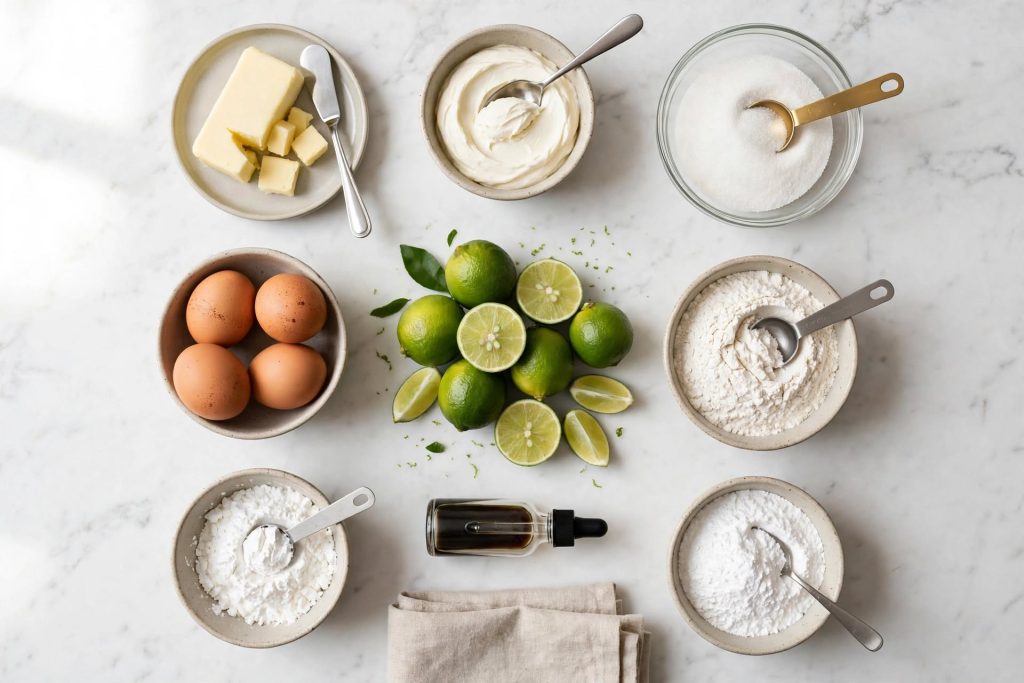
Every ingredient here has a specific job. Here is what each one does — and what to use if you need to make a substitution.
The Cookie Dough
| Ingredient | Amount | What It Does | Best Substitute + Impact |
|---|---|---|---|
| Unsalted butter, room temp | 225g (1 cup) | Fat base, richness, structure | Salted butter — reduce added salt to ¼ tsp |
| Full-fat cream cheese, room temp | 115g (4 oz) | Softness, moisture retention, tang | Full-fat sour cream — slightly more cakey |
| Granulated sugar | 300g (1½ cups) | Sweetness, structure, slight crisp edge | Caster sugar — finer grain, same result |
| Large eggs | 2 | Structure, binding, moisture | 2 flax eggs — denser, less lift |
| Fresh key lime juice | 2 tbsp | Tartness, citrus depth | Fresh regular lime juice — less floral |
| Key lime zest | 2 tbsp | Primary lime flavor carrier | Regular lime zest — same quantity |
| Pure vanilla extract | 1 tsp | Flavor base, rounds out citrus | Vanilla bean paste — stronger |
| All-purpose flour | 360g (3 cups) | Structure, body | 1:1 GF flour blend — same weight |
| Cornstarch | 2 tbsp | Tender crumb, prevents spread | Arrowroot powder — same ratio |
| Baking powder | 1 tsp | Slight lift, keeps cookies thick | None — do not skip |
| Fine sea salt | ½ tsp | Flavor balance, sharpens lime | Kosher salt — use ¾ tsp |
The Key Lime Glaze
| Ingredient | Amount | What It Does | Notes |
|---|---|---|---|
| Powdered sugar, sifted | 180g (1½ cups) | Sweet glaze base, sets firm | Sift to avoid lumps — lumpy glaze will not flow |
| Fresh key lime juice | 3–4 tbsp | Tartness, thins the glaze | Start with 3 tbsp and add more to reach drizzle consistency |
| Key lime zest | 1 tbsp | Aromatic flavor boost on the surface | Press into glaze immediately after applying so it adheres |
Key Ingredient Notes
Key limes vs regular limes: Key limes are smaller, more aromatic, and more tart than Persian limes (the regular kind). You will need about 10 to 12 key limes to get 2 tablespoons each of zest and juice. If key limes are not available, 4 to 5 regular limes give you the same volume with a slightly mellower flavor — the cookies will still be excellent. Do not use bottled key lime juice in the dough — it tastes flat after baking and often has added preservatives that affect flavor.
Zest first, always: Zest before you juice — it is nearly impossible to zest a lime that has already been squeezed. A microplane grater gives you the finest, most fragrant zest. Zest only the outer green layer — the white pith underneath is bitter and will make the dough taste sharp in an unpleasant way.
Cream cheese temperature: Use full-fat block cream cheese, not the spreadable tub version. Both the butter and cream cheese must be at room temperature — the same temperature — before creaming. Cold cream cheese will not blend smoothly and will leave visible chunks in the dough.
Equipment You Need
- Microplane or fine zester (essential — a box grater will not give fine enough zest)
- Stand mixer or hand mixer
- Large mixing bowl
- 2-tablespoon cookie scoop
- Baking sheets — light-colored, not dark
- Parchment paper
- Small whisk or fork (for glaze)
The Key Lime Flavor Guide
Not all lime flavor is equal in a baked cookie. Here is how the different sources behave in and out of the oven — and which ones actually deliver the result you want.
| Flavor Source | Flavor Strength | Survives Baking? | Best Use in This Recipe |
|---|---|---|---|
| Key lime zest (fresh) | ⭐⭐⭐⭐⭐ Strongest | ✓ Mostly — peel oils are heat-stable | In the dough — primary flavor source |
| Key lime juice (fresh) | ⭐⭐⭐ Moderate | ⚠️ Partially — tartness survives, aroma fades | Small amount in the dough; larger amount in the glaze |
| Key lime juice (bottled) | ⭐⭐ Weak | ❌ Poor — flat taste after heat | Last resort for glaze only — not dough |
| Lime extract | ⭐⭐⭐ Variable | ⚠️ Partially — can taste artificial after baking | Small addition alongside zest only |
| Key lime glaze (no heat) | ⭐⭐⭐⭐⭐ Strongest | ✓ Fully — never baked | Applied after baking — sharpest lime hit |
The takeaway: use zest as your primary in-dough flavor source, fresh juice in the glaze where no heat touches it, and never rely on juice alone in the dough if you want a genuine key lime result after baking.
How to Make Key Lime Cookies — Step by Step
Follow these steps in order. The zest prep in Step 1 is the most important step in the whole recipe — do not skip or rush it.
Step 1 — Zest and Juice the Limes
Using a microplane, zest all limes before juicing — you cannot zest a squeezed lime. Measure 2 tablespoons of zest and 2 tablespoons of juice for the dough, and set aside an additional 1 tablespoon of zest and 3 to 4 tablespoons of juice for the glaze. Use the zest immediately — the aromatic oils begin to dissipate within minutes of zesting.
What to look for: The zest should look bright green and feel slightly damp with oil when you rub it between your fingers. If it looks dry or pale, you are not getting deep enough — press harder on the microplane.
⚠️ Zest only the outer green layer. The white pith directly beneath it is bitter and will make your key lime cookies taste unpleasantly sharp rather than tart.
Step 2 — Cream the Butter, Cream Cheese, and Sugar
Beat room-temperature butter and cream cheese together on medium speed for 1 minute until combined. Add the sugar and beat on medium-high for 3 to 4 minutes until the mixture is pale, light, and fluffy — it should nearly double in volume.
What to look for: The mixture should look visibly lighter in color, feel airy when you scrape it with a spatula, and cling cleanly to the sides of the bowl without any visible lumps of cream cheese.
Step 3 — Add Eggs, Lime Juice, Lime Zest, and Vanilla
Add eggs one at a time, beating 30 seconds after each addition. Add the lime juice, lime zest, and vanilla extract and mix on low until just combined — about 15 seconds.
What to look for: The mixture will look slightly curdled after the lime juice goes in — this is normal. Keep mixing for 15 seconds more and it will come back together into a smooth, fragrant batter.
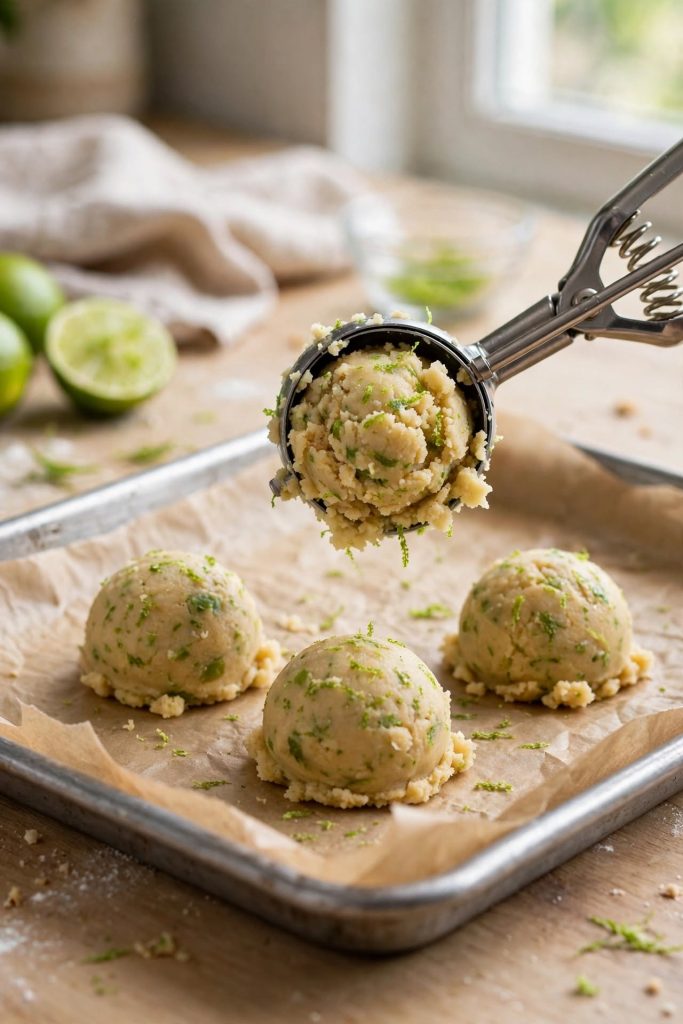
Step 4 — Fold in the Dry Ingredients
In a separate bowl, whisk together the flour, cornstarch, baking powder, and salt. Add to the butter mixture in two additions, folding on low speed just until no flour streaks remain after each addition. Stop immediately.
What to look for: A soft, cohesive dough with visible flecks of lime zest throughout. The dough will be slightly softer than a standard sugar cookie dough due to the lime juice — this is correct.
⚠️ Do not overmix after the flour goes in. Extra gluten development makes the crumb tough and masks the delicate citrus flavor with a bready, heavy texture.
Once you are comfortable with this folding method, our complete guide to mixing citrus cookie dough goes further into the technique.
Step 5 — Chill the Dough
Using a 2-tablespoon scoop, portion the dough into balls and place on a plate or tray. Cover tightly with plastic wrap and refrigerate for 1 hour minimum — up to 3 days is fine and deepens the lime flavor as the zest infuses further into the dough.
What to look for: The dough balls should feel firm and hold their shape when pressed lightly. If they flatten easily, they need another 30 minutes of chilling before going into the oven.
Step 6 — Scoop, Bake, and Glaze
Preheat your oven to 175°C / 350°F. Place chilled dough balls on parchment-lined baking sheets 5cm apart. Bake for 10 to 11 minutes. While cookies cool, whisk together the sifted powdered sugar, key lime juice, and zest until smooth and pourable. Once cookies are fully cool — at least 30 minutes — spoon or drizzle glaze over each one. Allow the glaze to set for 20 minutes before stacking.
What to look for: Edges just set and opaque; centers still slightly soft and shiny. The glaze should be thick enough to coat the back of a spoon but thin enough to drizzle — add juice one teaspoon at a time to reach the right consistency.
The Science Behind Key Lime Flavor in Cookies
Understanding why citrus flavor disappears in baked goods — and how to stop it — is what separates a key lime cookie that delivers from one that disappoints.
Why Key Lime Zest Carries More Flavor Than Juice
The intense aromatic flavor of key lime comes primarily from volatile essential oils concentrated in the outer peel — compounds like limonene, linalool, and citral. These oils are more heat-stable than the acid compounds in juice, meaning they partially survive oven temperatures. Key lime juice, by contrast, contains citric acid which contributes tartness, plus smaller amounts of those aromatic volatiles which largely evaporate during baking. Using more zest than juice in the dough ensures that flavor survives the heat. This is the most important formula change in this recipe compared to most key lime cookie recipes you will find elsewhere.
Why Cream Cheese Keeps Citrus Cookies Soft
The slight acidity in cream cheese interacts with the lime juice and zest in the dough in a useful way: both weaken gluten development from different directions, and the result is a crumb that stays more tender than a butter-only dough would produce. Citrus juice alone can sometimes make baked goods tougher by tightening the gluten network — the fat and protein in cream cheese counterbalances that effect. The cream cheese also acts as an emulsifier, helping the lime juice incorporate fully into the fat-based dough rather than sitting as separate droplets.
Why the Glaze Is Not Optional
The key lime glaze on top of these cookies serves a function beyond flavor — though the flavor it adds is significant. Because the glaze is never exposed to heat, every aromatic compound in the fresh juice and zest remains fully intact. The first thing your palate registers when you bite into a glazed key lime cookie is the sharp, bright hit of uncooked lime from the surface. The dough beneath provides a softer, baked citrus note in contrast. Without the glaze, that sharp surface flavor is absent and the cookie reads as a mild, pleasant citrus cookie rather than a genuinely key lime one. The glaze is also what makes the cookie visually distinctive — the glossy, pale green surface is what people photograph and share.
Tips for the Best Result
These are the details that separate a good key lime cookie from one that people identify immediately as key lime — and then ask where they can get more.
- Zest all your limes at once — zesting is tedious with key limes due to their small size. Zest every lime at the start, measure what you need for the dough and glaze, and have everything ready before you begin mixing. The whole recipe moves faster with the prep done first.
- Chill already-scooped balls, not the whole bowl — scooping chilled dough is much harder than scooping room-temperature dough. Portion the dough first, then refrigerate the tray of balls. This also means they go straight from fridge to oven with no handling.
- Use a microplane, not a box grater — a microplane produces fine, fluffy zest full of essential oils. A box grater produces wet, chunky zest that releases less flavor and distributes unevenly through the dough.
- Taste the glaze before applying — the glaze should taste noticeably tart and bright on its own. If it tastes only sweet, add more lime juice one teaspoon at a time. The glaze needs to be assertive because it will be diluted by the sweetness of the cookie beneath it.
- Add zest on top of the wet glaze — press extra lime zest into the surface of the glaze while it is still wet. It will hold in place as the glaze sets and adds both flavor and visual appeal to the finished cookie.
- Pull at 10 minutes, not 11 — err on the side of underbaking. The residual heat from the pan finishes cooking the center over the following 5 minutes. A 10-minute pull gives you the best soft center; 12 minutes gives you a cookie that will be firm by tomorrow.
- Use light-colored baking sheets — dark pans absorb more radiant heat and over-brown the bottom of your cookies before the center has finished cooking, which also speeds up flavor loss.
Common Mistakes to Avoid
❌ Using Bottled Lime Juice Instead of Fresh
Result: The cookie flavor is flat and vaguely artificial — bottled juice loses most of its volatile aromatic compounds during pasteurization and storage. The glaze made with bottled juice tastes noticeably less bright than one made with fresh.
Fix: Always use fresh key lime juice or fresh regular lime juice. If key limes are unavailable, Persian limes work well — the flavor is slightly less intense but still vibrant. Bottled juice is a last resort only.
❌ Skipping the Dough Chill
Result: Key lime cookies made with unchilled dough spread very flat — the lime juice adds extra liquid that softens the fat, so unchilled dough spreads faster than standard cookie dough would.
Fix: Chill for at minimum 1 hour. If your kitchen is warm or the dough feels particularly soft after mixing, extend to 90 minutes or refrigerate overnight. The chill also allows the lime zest to infuse the dough more deeply.
❌ Not Enough Zest in the Dough
Result: Cookies taste bland or vaguely citrusy but not clearly key lime — the juice alone does not carry enough flavor through the baking process.
Fix: Use the full 2 tablespoons of zest in the dough as written. For an even bolder result, increase to 3 tablespoons. Zest is the primary flavor source — it should feel like a generous amount when you measure it out.
❌ Overbaking Even by One Minute
Result: The crumb dries out and the delicate lime flavor — already partially diminished by heat — becomes even harder to detect against the dominant baked-dough taste of an overdone cookie.
Fix: Set your timer for 10 minutes and check. Pull the tray when the edges are just set and the centers look slightly underdone. The glaze on top will also taste sharper and more vibrant on a correctly baked soft cookie than on an overbaked dry one.
❌ Glazing While Cookies Are Still Warm
Result: The glaze melts off warm cookies, pools around the base, and dries with a streaky, uneven finish. The heat also partially cooks the glaze and diminishes its bright citrus character.
Fix: Cool cookies on a wire rack for at minimum 30 minutes. The bottom of each cookie must feel completely room-temperature before glazing. Make the glaze while the cookies cool so it is ready the moment they are.
❌ Using Only Lime Juice and No Zest
Result: A cookie that smells faintly of lime when it goes into the oven but tastes like a plain sugar cookie when it comes out — all the aromatic juice compounds evaporate at baking temperature.
Fix: Zest is non-negotiable. You can reduce the juice if needed (use 1 tablespoon if you want to play it safe with spread), but do not reduce the zest — it is what survives the oven.
For more guides at this level of detail, our citrus dessert troubleshooting guide covers lime, lemon, and orange baked goods from the same angle.
Variations Worth Trying
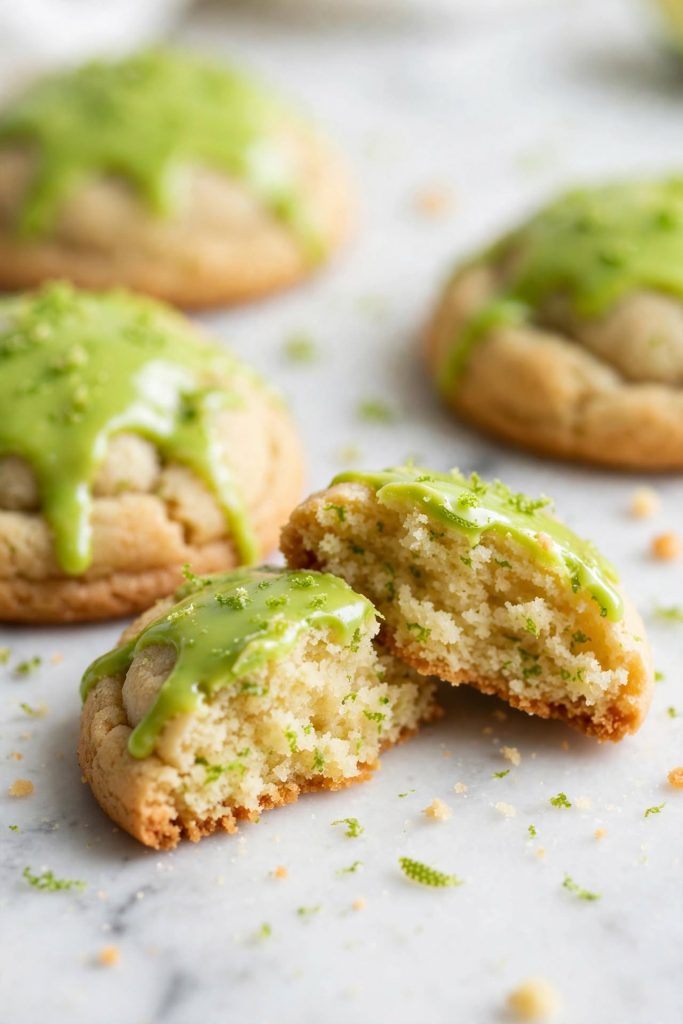
Key Lime Pie Cookies
What changes: Press a graham cracker crumb crust (60g crushed graham crackers + 2 tbsp melted butter) into the base of a muffin tin, top with one dough ball, and bake for 12 to 13 minutes. Finish with a white chocolate drizzle alongside the lime glaze.
Result: A cookie that delivers all three elements of a key lime pie — buttery crust, tangy filling, and sweet topping — in a single hand-held bite. These are the most impressive variation and the one most likely to get photographed.
Key Lime Coconut Cookies
What changes: Add 60g (¾ cup) of toasted unsweetened shredded coconut to the dough at Step 4. Roll the dough balls in additional toasted coconut before chilling.
When: Fold the coconut in with the last few strokes after the flour is incorporated.
Result: A tropical pairing that softens the sharp edge of the lime and adds a chewy texture contrast. The toasted coconut coating adds crunch and visual texture that shows up well in photos.
Key Lime Thumbprint Cookies
What changes: After scooping chilled dough balls onto the baking sheet, press a deep indent into the center of each ball with your thumb or the back of a spoon. Bake 9 to 10 minutes. Fill each cooled indent with a small spoonful of key lime curd instead of the drizzle glaze.
Result: A more elegant presentation with a jammy, concentrated lime center. Key lime curd can be made ahead and stored in the fridge for up to two weeks — it takes the recipe to a different level for gift giving or events.
Key Lime Cream Cheese Frosted Version
What changes: Instead of the thin glaze, make a cream cheese frosting: beat 115g (4 oz) room-temperature cream cheese with 180g (1½ cups) powdered sugar, 1 tablespoon key lime juice, and 1 teaspoon lime zest until smooth. Pipe or spread onto fully cooled cookies.
Result: Thicker, richer, and more substantial than the glaze version — closer to a frosted sugar cookie. The cream cheese in the frosting doubles down on the cream cheese in the dough for a very rich result. Best for parties or events where you want a more decorative finish.
Gluten-Free Version
What changes: Replace the all-purpose flour with a 1:1 gluten-free flour blend containing xanthan gum (same weight: 360g).
When: Use at Step 4 exactly as written.
Result: Slightly denser texture with a touch more crumble at the edges. Extend the dough chill to 90 minutes — gluten-free dough needs more time to hydrate and firm. The glaze is naturally gluten-free and requires no changes.
How to Store
Room Temperature
Store glazed key lime cookies in a single layer in an airtight container at room temperature. They stay at their best quality for up to 4 days. The glaze forms a thin seal over the surface that actually slows moisture loss from the crumb — glazed cookies stay softer longer than unglazed ones. If you need to stack them, place a sheet of parchment paper between layers — glazed surfaces will stick together without it. Avoid storing in warm environments; heat softens the glaze and makes it tacky.
Refrigerator
Key lime cookies can be refrigerated in an airtight container for up to 5 days. The cold air firms the glaze and slightly tightens the crumb, but a 10-minute rest at room temperature before eating restores most of the soft texture. The lime flavor actually deepens slightly after a day in the refrigerator as the zest continues to infuse. If your frosting contains cream cheese rather than a plain glaze, refrigeration is recommended and extends the life to 5 to 6 days.
Freezer — Complete Guide
For baked unglazed cookies: cool completely, layer in an airtight container with parchment between layers, and freeze for up to 2 months. Thaw at room temperature for 20 to 30 minutes, then make fresh glaze and apply. The fresh glaze on a thawed cookie restores the bright lime flavor completely — this method works better than freezing already-glazed cookies.
Do not freeze already-glazed cookies: the glaze becomes sticky as it thaws, weeps moisture, and loses its clean appearance. Bake and freeze without glazing — always glaze fresh.
For unbaked dough balls: freeze scooped balls on a flat tray for 1 hour until solid, then transfer to a freezer bag. Freeze for up to 2 months. Bake from frozen at 175°C / 350°F and add 2 minutes to the bake time. This is the most convenient method — you can bake a small number of fresh cookies at any time.
If batch baking for events is part of your routine, our guide to freezer-friendly cookies gives you the full workflow for planning ahead.
How to Serve
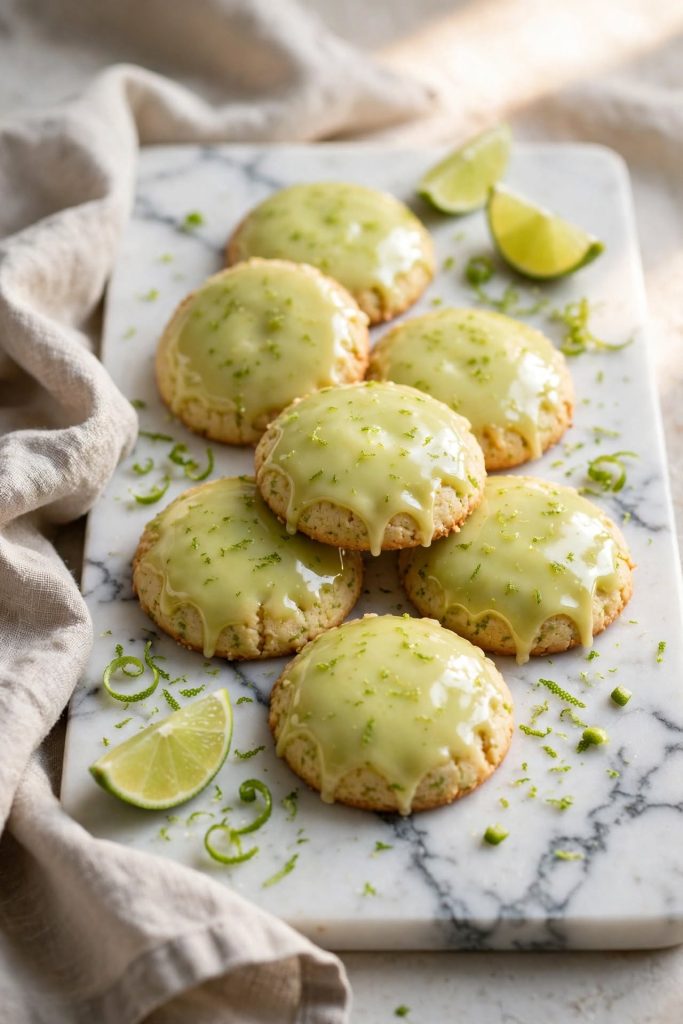
Classic Ways to Serve
- Arranged on a white plate with a scattering of extra lime zest on top — the green against white photographs well and makes even a simple presentation look intentional
- With a glass of cold water or sparkling water — the clean, neutral drink does not compete with the tart lime flavor the way a sweet drink would
- Stacked in cellophane bags tied with green ribbon — these travel well and make a distinctive homemade gift because the lime glaze shows through the clear packaging
Upgraded and Occasion-Worthy
- Served alongside a scoop of vanilla ice cream or coconut sorbet for a simple plated dessert — the tart cookie against the cold, creamy contrast is genuinely excellent
- On a summer dessert table next to lemon bars and strawberry shortcake — key lime cookies anchor the citrus end of a dessert spread and give guests a format that is easier to eat standing up than a slice of pie
- Packaged in a kraft box with the Key Lime Coconut variation and the Key Lime Pie Cookie variation as a three-type assortment — this is the gift version that impresses most because of the variety
- On a beach, patio, or outdoor event where a tart, refreshing dessert is more welcome than something heavy — key lime cookies are one of the few cookie types that actually feel appropriate in summer heat
These cookies pair well with sparkling water, iced tea, cold milk, or a coconut rum cocktail if the occasion calls for it. They are the right bake for summer parties, tropical-themed events, care packages, and any situation where you want something that surprises people with how strongly it tastes like the thing it claims to be.
Frequently Asked Questions
Can I use regular limes instead of key limes?
Yes — regular Persian limes work well and are much easier to find and juice. You will need about 4 to 5 regular limes for the same amount of zest and juice this recipe calls for. The flavor is slightly less floral and a touch less tart than true key limes, but most people cannot tell the difference in a baked cookie. Bottled key lime juice is a last resort — it lacks the brightness of fresh and often tastes flat after baking.
Why did my key lime cookies spread too flat?
The two most common causes are butter or cream cheese that was too warm before mixing, or skipping the dough chill. The lime juice also adds a small amount of liquid that softens the dough slightly more than a non-citrus recipe — if your kitchen is warm, extend the chill to 90 minutes. Measure the lime juice accurately; too much extra liquid weakens the dough structure significantly.
How do I get more lime flavor in my key lime cookies?
Increase the zest in the dough to 3 tablespoons — zest is where the concentrated aromatic oils live, not the juice. Always zest immediately before using; the volatile oils begin to dissipate within minutes of zesting. A more generous glaze with extra zest pressed into the wet surface adds the most flavor impact since it never enters the oven and loses nothing to heat.
Can I make the dough ahead of time?
Yes — the dough keeps in the refrigerator for up to 3 days, tightly covered. The lime flavor deepens as the zest continues to infuse the dough during the extended chill. For longer storage, scoop into balls and freeze for up to 2 months. Bake from frozen at 175°C / 350°F with 2 extra minutes added. Always make the glaze fresh on the day you serve.
How long do key lime cookies last?
Glazed key lime cookies stay at their best quality for up to 4 days in an airtight container at room temperature. The glaze seals in moisture and keeps the crumb softer for longer than unglazed cookies. Store in a single layer or with parchment paper between layers — the glaze surface will stick if cookies are stacked directly.
Can I freeze key lime cookies?
Yes — bake without glazing, cool completely, and freeze in a container with parchment between layers for up to 2 months. Thaw at room temperature for 30 minutes, then apply fresh glaze. Do not freeze already-glazed cookies — the glaze becomes sticky and loses its clean appearance as it thaws. If you enjoyed these, our lemon sugar cookies are the next citrus recipe worth making.
What can I substitute for cream cheese?
Full-fat sour cream works at the same weight (115g) — the texture will be slightly more cakey and less rich. Full-fat Greek yogurt also works but produces a softer, less structured result. Use full-fat versions of any substitute — low-fat products contain more water, which softens the dough too much and increases spread during baking.
Can I double this recipe?
Yes — double every ingredient exactly, including the lime zest and juice. Do not reduce the citrus quantities when doubling. Make the glaze in two smaller batches rather than one large one — powdered sugar glaze thickens quickly as you work and is easier to control in smaller quantities. Bake one sheet at a time on the center rack for even results.
Why did my cookies lose their lime flavor after baking?
This is the most common complaint with citrus cookies. The aromatic volatile compounds in lime juice evaporate at oven temperatures — that is why the glaze is so important. If your baked cookies taste bland, the most likely cause is too much juice and not enough zest in the dough, or a thin glaze that did not deliver enough fresh lime flavor on the surface. Increase the zest and make a more generous glaze next time.
Do I need the glaze?
Strongly recommended — the glaze is the sharpest delivery of key lime flavor in the entire recipe because it never gets baked. Without it, the cookies are pleasant but mild. If you cannot use the glaze, roll dough balls in a mixture of granulated sugar and lime zest (2 tablespoons sugar + 1 teaspoon zest) before baking for a partial surface flavor boost.
Can I use lime extract instead of fresh lime?
Use fresh lime wherever possible — extract alone reads as artificial in baked goods to most people. If you use extract, add ½ teaspoon in addition to — not instead of — the fresh zest. Never use extract in the glaze; the glaze relies on fresh juice for both its flavor character and its correct liquid consistency. Imitation lime flavoring should not be used in this recipe at all.

Key Lime Cookies
Ingredients
Method
- Zest and juice all limes before starting. Measure 2 tbsp zest + 2 tbsp juice for the dough; 1 tbsp zest + 3–4 tbsp juice for the glaze. Set aside.
- Beat butter and cream cheese on medium for 1 minute. Add sugar and beat on medium-high for 3 to 4 minutes until pale and fluffy.
- Add eggs one at a time, beating 30 seconds after each. Add lime juice, lime zest, and vanilla; mix until just combined. The mixture may look briefly curdled — keep mixing and it will smooth out.
- Whisk flour, cornstarch, baking powder, and salt in a separate bowl. Add to butter mixture in two additions, folding on low just until no flour streaks remain.
- Scoop into 2-tablespoon balls, place on a tray, cover, and refrigerate for 1 hour minimum.
- Preheat oven to 175°C / 350°F. Place chilled balls on parchment-lined baking sheets 5cm apart. Bake 10 to 11 minutes — edges just set, centers slightly underdone. Cool on the pan 5 minutes, then transfer to a wire rack.
- While cookies cool, whisk sifted powdered sugar, key lime juice, and zest until smooth and pourable. Once cookies are fully cool (30 minutes minimum), spoon glaze over each. Press extra zest into the wet glaze. Allow to set 20 minutes before stacking.
Notes
More Dessert Recipes You Will Love
- Lemon Sugar Cookies — the same soft, cream-cheese-enriched base as this recipe but built around fresh lemon zest and a lemon glaze. Slightly sweeter and less tart than the key lime version — a good second bake if this recipe is a hit.
- Key Lime Bars — all the key lime flavor of these cookies in a bar format with a graham cracker crust, a tangy lime curd filling, and a dusting of powdered sugar. Makes 16 to 20 bars from a 9×13 pan.
- Coconut Lime Shortbread — a crumbly, buttery shortbread with toasted coconut and lime zest throughout. Three ingredients plus citrus, no eggs, no chilling required.
- Frosted Lemon Cookies — pillowy cookies with lemon zest in the dough and a thick cream cheese lemon frosting that holds its shape beautifully for gifting or events.
- Lime Cheesecake Bars — a no-bake cheesecake layer over a graham cracker base, set with a small amount of gelatin and finished with a fresh lime glaze. The refrigerator does all the work.
Did you make these key lime cookies? Leave a ⭐⭐⭐⭐⭐ rating below and let me know in the comments how they turned out — and whether you used key limes or regular limes. I read every comment and would love to know what worked for you.