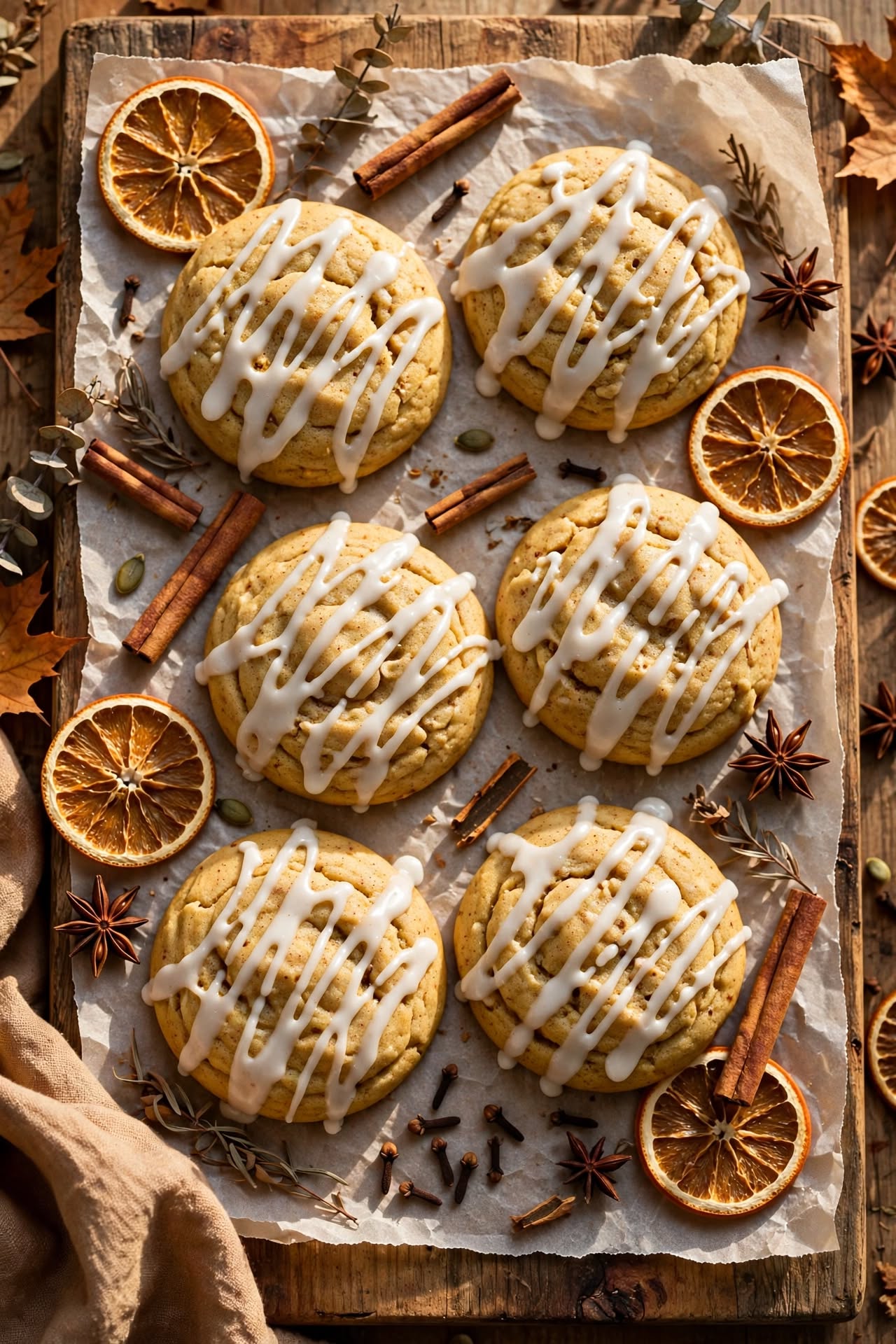
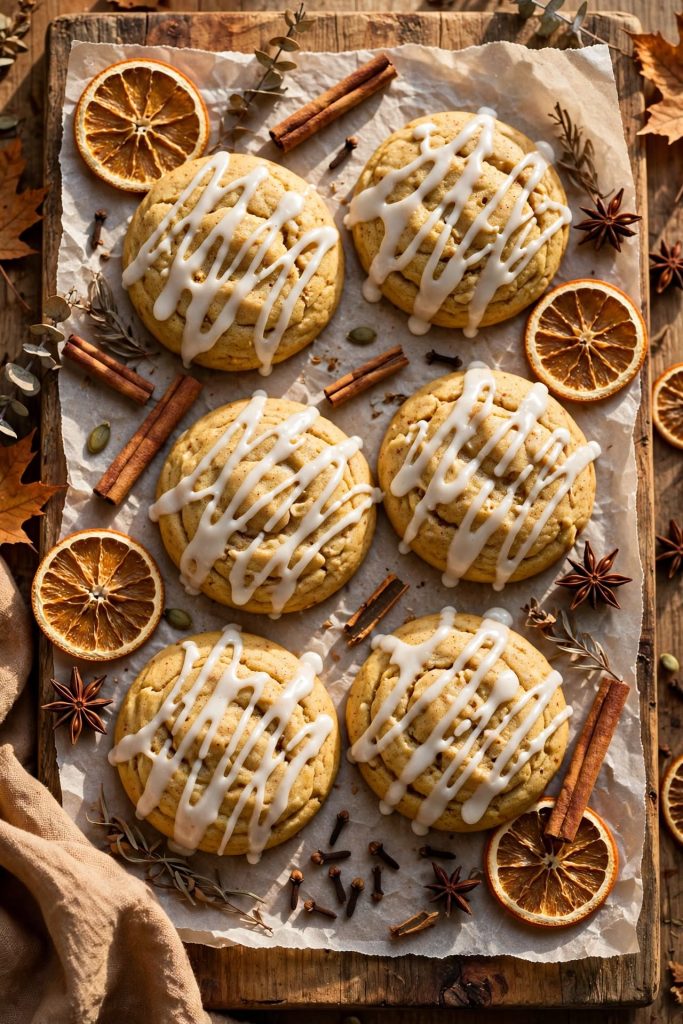
Thanksgiving cookies are soft, warmly spiced cookies designed for the holiday season. This version is a soft pumpkin spice cookie made with browned butter and finished with a brown butter maple glaze. The dough uses a single egg yolk instead of a whole egg, which keeps the cookies soft without turning cakey — a common problem with pumpkin-based cookies. They bake in 11 to 13 minutes and can be made up to 4 days ahead.
Thanksgiving cookies need to do more than taste good — they need to travel to someone else’s table, stay soft for days, and look like you put in serious effort even when the rest of the meal already took everything you had. These soft pumpkin spice cookies with a brown butter maple glaze check every box. The browned butter adds a nutty caramel depth that plain butter cannot replicate, the spice blend is calibrated to taste like Thanksgiving rather than just cinnamon, and the maple glaze sets firm enough to stack. I tested this recipe 4 times to solve the biggest problem with pumpkin cookies — that cakey, dry texture — before publishing.
Why This Recipe Works
Pumpkin cookies have one persistent problem: the moisture in the pumpkin puree makes them cakey and dry within a day. This recipe solves that with three specific decisions.
- One egg yolk only, no white — egg whites add moisture and protein that puff the cookie upward and produce a cakey crumb. The yolk alone provides richness and binding without the added water content of the white. This single change keeps the cookie soft and dense rather than airy and dry.
- Browned butter, not regular butter — the milk solids turn golden and nutty when browned, developing complex flavor compounds that plain melted butter does not have. In a Thanksgiving cookie, that caramel-nut note layers with the spices in a way that makes the whole cookie taste more complex and intentional.
- Brown sugar majority — using more brown sugar than white adds the hygroscopic properties of molasses, which draw and hold moisture even as the cookies sit. These Thanksgiving cookies stay soft for 4 days at room temperature because the molasses fights the drying effect of the pumpkin.
- Mandatory dough chill — pumpkin cookie dough is particularly soft from the puree moisture. Chilling solidifies the fat and lets the flour hydrate fully, which means the cookies spread less, hold their height, and develop a deeper flavor in the resting time.
- Brown butter maple glaze instead of frosting — a thin drizzle glaze sets firm enough to stack the cookies without sticking and transport them without smearing. It adds sweetness and maple flavor without the thickness or sugar-density of full frosting.
- Individual spices, not pie spice blend — building the spice blend from scratch lets you calibrate each note independently. This recipe leans heavier on cinnamon and ginger, lighter on clove, because clove overpowers everything else at higher quantities.
For the full rundown on fall baking staples, our fall cookie guide covers the same seasonal approach for every October through December recipe. [IL-1 — replace with your URL]
Ingredients for Thanksgiving Cookies
Every ingredient here has a specific job. Here is what each one does — and what to use if you need to make a substitution.
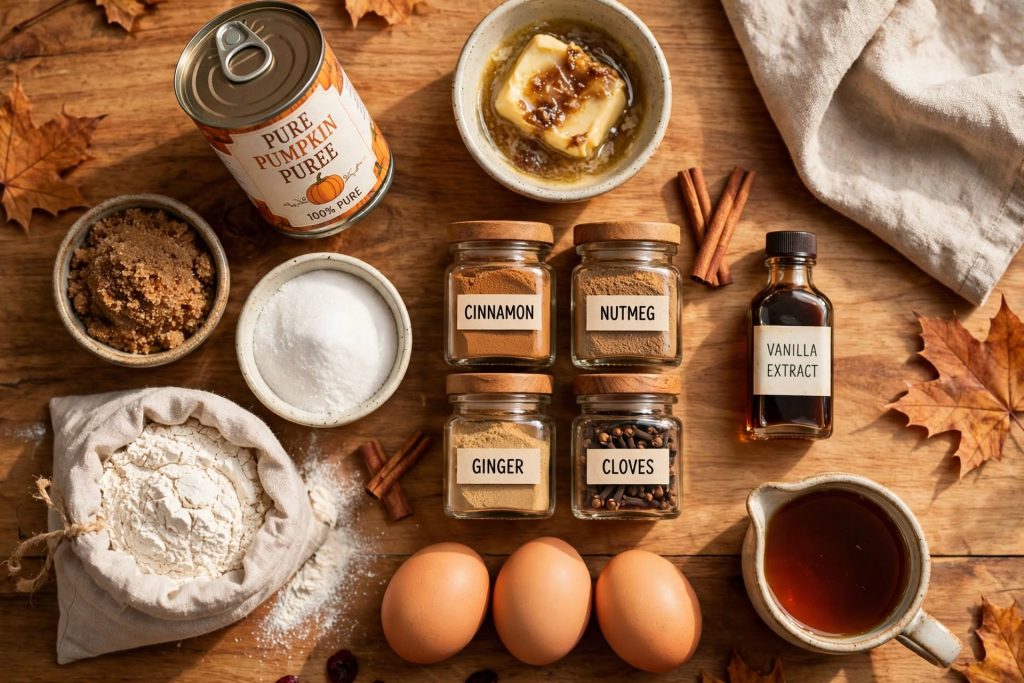
The Cookie Dough
| Ingredient | Amount | What It Does | Best Substitute + Impact |
|---|---|---|---|
| All-purpose flour | 280g / 2¼ cups | Structure; keeps cookies from spreading flat | Cake flour — more tender crumb; do not use self-rising |
| Baking soda | 1 tsp | Lift and spread control | Do not swap for baking powder — cookies will be too puffy |
| Baking powder | ½ tsp | Backup lift; insurance for height | Do not skip |
| Salt | ½ tsp | Amplifies all spice flavors | Do not skip |
| Ground cinnamon | 1½ tsp | Warm backbone spice | Do not reduce — it is the dominant flavor note |
| Ground nutmeg | ½ tsp | Warmth and depth | Freshly grated nutmeg — stronger; use ¼ tsp |
| Ground ginger | ¼ tsp | Bright, sharp warmth | Omit — slight flavor loss; or use ½ tsp for more ginger |
| Ground cloves | ¼ tsp | Depth and complexity | Do not increase — clove overpowers easily at higher amounts |
| Unsalted butter (for browning) | 170g / ¾ cup | Base fat; browning creates complex nutty flavor | Salted butter — reduce added salt; cannot skip the browning step |
| Brown sugar, packed | 200g / 1 cup | Moisture retention, caramel flavor, chew | All brown sugar — cookies will be chewier and darker |
| Granulated sugar | 100g / ½ cup | Slight crispness at the edges | All brown sugar if you prefer fully soft cookies |
| Pure pumpkin puree | 120g / ½ cup | Flavor, color, and soft texture | Butternut squash puree — milder; do not use pie filling |
| Egg yolk (1 large) | 1 yolk only | Binding and richness without cakey lift | No direct substitute — whole egg makes these cakey |
| Vanilla extract | 1 tsp | Rounds out the spice blend | Omit — minor flavor loss |
The Brown Butter Maple Glaze
| Ingredient | Amount | What It Does | Best Substitute + Impact |
|---|---|---|---|
| Powdered sugar, sifted | 180g / 1½ cups | Base sweetness and body | Do not use granulated — will not dissolve |
| Pure maple syrup | 2 tbsp | Maple flavor and slight golden color | Artificial maple syrup — weaker flavor; honey — different but works |
| Whole milk or heavy cream | 2 to 3 tbsp | Thins glaze to drizzling consistency | Any milk — thinner glaze; use less for thicker coverage |
| Vanilla extract | ¼ tsp | Flavor background | Omit |
| Salt | Pinch | Cuts sweetness and sharpens maple note | Do not skip |
Key Ingredient Notes
Pumpkin puree: Use 100% pure canned pumpkin — not pumpkin pie filling. The label should say only “pumpkin” or “100% pure pumpkin.” Pie filling contains added sugar, spices, and thickeners that throw off every ratio in this recipe.
Brown butter: The butter must be cooked until the milk solids turn golden-brown and the liquid smells nutty — not just melted, not just foamy. See the Brown Butter Guide section for the full visual cue breakdown.
Egg yolk only: Separate the egg cold (cold eggs separate more cleanly), then let the yolk come to room temperature before adding. Save the white for meringues, an egg wash, or scrambled eggs.
Equipment You Need
- Light-colored saucepan (for browning butter — so you can see the color change)
- Stand mixer or electric hand mixer
- Two large baking sheets
- Parchment paper or silicone baking mats
- 2-tablespoon cookie scoop (#30 scoop)
- Wire cooling racks
- Small whisk (for the glaze)
- Piping bag or zip-lock bag with corner snipped (for drizzling glaze)
The Brown Butter Guide
Brown butter is the ingredient that lifts these Thanksgiving cookies above any standard pumpkin cookie recipe. Here is what to look for at each stage.
| Stage | Appearance | Sound | Smell | Action |
|---|---|---|---|---|
| 1 — Melting | Pale yellow, opaque | Quiet sizzle | Butter smell | Stir gently; keep heat at medium |
| 2 — Foaming | White foam on surface | Louder, active sizzle | Butter smell intensifying | Stir continuously; foam hides the color change below |
| 3 — Subsiding foam | Foam reduces; liquid below is golden | Sizzle quietens | Toasty, nutty note emerging | Watch closely — color changes fast here |
| 4 — Brown butter (target ✅) | Milk solids at bottom are golden-amber; liquid is deep gold | Very quiet | Strongly nutty, hazelnut, caramel | Remove from heat immediately; pour into bowl |
| 5 — Overbrowned ❌ | Milk solids are dark brown to black | Quiet or silent | Acrid, bitter | Discard and start again |
Total time: 5 to 7 minutes over medium heat. Never walk away from the pan during stage 3 onward — the transition from golden to overbrowned takes less than 30 seconds.
After browning: pour immediately into a heat-safe bowl, scraping all the browned bits from the bottom. Those dark specks are the flavor. Refrigerate until re-solidified to softened-butter consistency — about 45 minutes in the refrigerator or 15 minutes in the freezer.
How to Make Thanksgiving Cookies — Step by Step
Follow these steps in order. The most important rules: the brown butter must be fully re-solidified before beating, and the dough must chill before baking.
Step 1
Brown the Butter and Cool It
Place the butter in a light-colored saucepan over medium heat. Stir continuously as it melts, foams, then subsides. Watch for the milk solids at the bottom to turn golden-amber and for the smell to shift from buttery to deeply nutty — about 5 to 7 minutes. Remove from heat immediately and pour into a large heat-safe bowl, scraping every dark bit from the pan. Refrigerate the bowl for 45 minutes (or freeze for 15 minutes) until the butter has re-solidified to the texture of softened butter.
⚠️ Critical step: Do not try to speed-cool brown butter by adding ice or cold water — it will seize and separate. Refrigerate or freeze in a shallow bowl for the fastest even cooling.
What to look for: Solidified brown butter should look like golden-tan regular butter and smell nutty even when cold. If it smells burnt or acrid, it went too far — start again.
Step 2
Make the Cookie Dough
Beat the re-solidified brown butter with both sugars on medium speed for 2 to 3 minutes until light and fluffy. Add the pumpkin puree and beat 1 minute more. Add the egg yolk and vanilla and beat 30 seconds until incorporated. In a separate bowl, whisk together the flour, baking soda, baking powder, salt, cinnamon, nutmeg, ginger, and cloves. Add the dry ingredients to the wet in one addition and fold with a rubber spatula just until no flour streaks remain. Do not overmix.
What to look for: Dough is soft, slightly sticky, and a warm orange-brown color from the pumpkin and spices. It will be too soft to scoop directly — this is expected. Chilling firms it up.
Step 3
Chill the Dough
Cover the bowl with plastic wrap pressed directly onto the dough surface and refrigerate for a minimum of 1 hour. Overnight produces noticeably better flavor — the spices bloom further and the dough firms to the ideal scooping consistency. Do not skip or shorten this step. Pumpkin cookie dough baked warm will spread flat and lose its height entirely.
What to look for: After chilling, the dough should hold its shape when scooped and not immediately slump. It will feel noticeably firmer than when you put it in.
For more make-ahead cookie strategies, our holiday cookie prep guide covers how to batch and chill for Thanksgiving week. [IL-2 — replace with your URL]
Step 4
Bake the Cookies
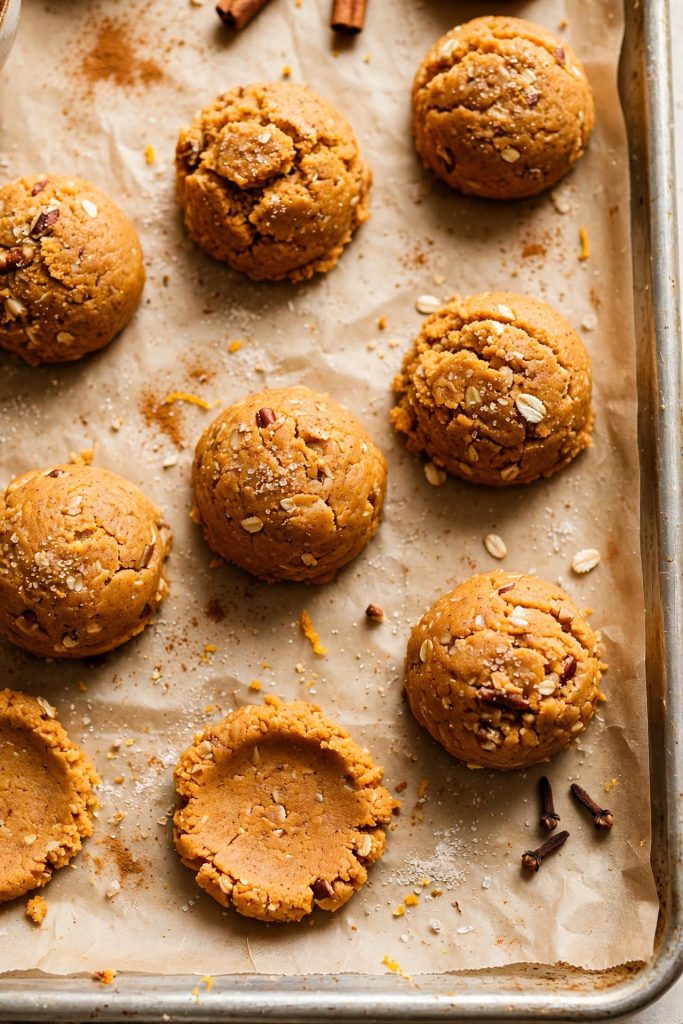
Preheat your oven to 375°F (190°C). Line two baking sheets with parchment paper. Use a 2-tablespoon cookie scoop to portion the chilled dough and roll each portion briefly between your palms into a smooth ball. Place 2 inches apart on the prepared sheets. Press each ball slightly with your fingers to flatten to about ¾-inch thickness — pumpkin cookies do not spread as much as butter cookies and need this gentle press to bake to the right proportions. Bake one sheet at a time on the center rack for 11 to 13 minutes.
⚠️ Critical step: Pull the cookies when the edges look set and the centers still look slightly underdone and glossy. They continue cooking on the hot pan for 5 minutes after coming out. Waiting until the centers look fully set means overbaked, dry cookies by the time they cool.
What to look for: Set, matte edges. Centers that look barely done — slightly puffed and glossy. Bottoms should be pale golden, not brown. Cool on the pan 5 minutes before transferring to a wire rack.
Step 5
Make the Glaze and Finish
Whisk together the sifted powdered sugar, maple syrup, 2 tablespoons of milk, vanilla, and salt until completely smooth. The glaze should flow off the whisk in a slow, thick ribbon. If it is too thick, add milk 1 teaspoon at a time. If too thin, add powdered sugar 1 tablespoon at a time. Transfer to a piping bag or zip-lock bag with the corner snipped. Drizzle back and forth across each fully cooled cookie in a zigzag pattern, or dip the top third directly into the glaze for a thicker coating. Let the glaze set completely — 20 to 30 minutes at room temperature — before stacking or storing.
What to look for: The glaze should look slightly translucent when first applied and turn opaque white as it sets. Press a fingertip lightly against a glazed cookie after 20 minutes — it should feel dry and not tacky.
The Science Behind a Perfect Thanksgiving Cookie
Why Brown Butter Changes the Flavor
When butter is heated past the point of melting, the water evaporates and the milk solids undergo the Maillard reaction and caramelization simultaneously. These reactions produce hundreds of new flavor compounds including diacetyl (buttery, caramel notes), furanones (sweet, toasty), and pyrazines (nutty, roasted). The result is a fat with a dramatically more complex flavor profile than uncooked butter. In Thanksgiving cookies, these nutty caramel notes layer with the cinnamon, ginger, and maple glaze to create a flavor that reads as autumn rather than simply sweet — it is why people ask what makes these different from other pumpkin cookies.
Why Chilling the Dough Matters for Thickness and Texture
Pumpkin puree adds significant moisture to cookie dough. That moisture, when warm, keeps the fat in a semi-liquid state that causes the dough to spread quickly in the oven — the cookies flatten before the structure sets. Chilling re-solidifies the browned butter fat and also allows the flour proteins to fully hydrate, creating stronger gluten networks that resist spreading. The result is a cookie that holds its height through the bake rather than spreading thin. The extra resting time also allows the spices to bloom into the wet ingredients, which deepens the flavor measurably — particularly the cinnamon and ginger, which become rounder and more integrated after 8 to 12 hours.
Why Pumpkin Puree Produces a Soft, Cakey Cookie (and How to Fix It)
Pumpkin puree is approximately 90 percent water and contains significant pectin — the same fiber that makes jam set. In a cookie, that water converts to steam during baking and pushes the cookie upward, and the pectin creates a texture more like cake than cookie. The fix in this recipe is threefold: using only the egg yolk (which has fat but no additional water from the white), using a higher ratio of brown sugar (whose molasses fights moisture loss during storage), and chilling the dough so the fat is solid enough to slow the spreading before the structure sets. Together, these three decisions produce a cookie that is distinctly soft without being cakey — it has a slight chew at the center and a defined edge rather than the uniform, spongy texture of most pumpkin cookies.
Tips for the Best Result
These are the details that make these Thanksgiving cookies the ones people ask you to bring every year.
- Make a test cookie before baking the full batch — after the dough chill, bake one cookie alone. Check the spread, bake time, and edge color. Your oven may need 1 minute more or less than the recipe states. Mark it and use that time for the rest.
- Use parchment, not greased pans — extra grease increases spreading. Parchment provides just enough non-stick surface without adding fat to the bottom of the cookie.
- Bake one sheet at a time — pumpkin cookies are sensitive to heat distribution. A single sheet on the center rack bakes more evenly than two sheets on two racks.
- Roll the dough balls before chilling if making ahead — pre-rolled balls can be refrigerated for up to 3 days or frozen on a sheet then transferred to a bag. This means you can scoop and bake in 20 minutes on Thanksgiving day rather than dealing with the full prep.
- Add flaky salt to the top of each cookie before baking — a single pinch pressed lightly into each dough ball creates a sweet-salty contrast that makes every other flavor in the cookie come forward more clearly.
- Glaze when fully cool, not just warm — even slightly warm cookies melt the glaze, which runs off the sides and pools on the rack rather than setting on the surface. A full 30-minute cool is the minimum.
- Double the glaze if dipping rather than drizzling — the drizzle method uses about half as much glaze as the dip method. Make the full glaze recipe if dipping — you will use most of it.
Common Mistakes to Avoid
Using Warm Brown Butter Before It Has Re-Solidified
Result: The warm liquid butter coats the sugar crystals without incorporating air, producing a flat, greasy dough that bakes into thin, spread-out cookies with very little height.
Fix: The brown butter must re-solidify to softened-butter consistency before beating with the sugar. Test it with a finger: it should leave a dent but not be squishy or liquid. If in doubt, give it another 10 minutes in the refrigerator.
Skipping the Dough Chill
Result: The cookies spread flat in the oven before the structure sets. Thin, lacy, almost crispy cookies instead of soft, domed ones. The centers will also taste underdeveloped because the spices have not had time to bloom.
Fix: 1 hour minimum; overnight for both texture and flavor. If genuinely short on time, chill the portioned dough balls in the freezer for 20 minutes — not as good as a full chill, but better than none.
Using Pumpkin Pie Filling Instead of Pure Pumpkin Puree
Result: The cookies are overly sweet, the spice balance is off (because the filling has its own pre-added spices), and the texture can be gummy because pie filling contains thickeners not accounted for in the recipe.
Fix: Check the label before opening the can. It should say “100% pure pumpkin” with no other ingredients. Pumpkin pie filling lists sugar, spices, and thickeners.
Overbaking — Pulling When They Look Underdone
Result: Dry, crumbly cookies that lose the soft center within hours. Pumpkin cookies look underdone when they are actually done — the centers will look glossy and not fully set at the correct bake time.
Fix: Pull at 11 minutes and check the edges — they should look set and matte while the centers still look slightly soft and glossy. The cookies finish cooking on the hot pan in the next 5 minutes. This is the most important timing call in the recipe.
Applying the Glaze Before the Cookies Are Fully Cool
Result: The glaze melts, thins, and runs off the surface. The cookies stick together if stacked and the glaze pools on the rack instead of setting on the cookie surface.
Fix: Wait until the cookies are genuinely room temperature — the bottoms should feel cool to the touch. 30 minutes on a wire rack after removing from the pan.
Using a Cookie Scoop That Is Too Small
Result: Small cookies bake through too quickly, losing the soft center entirely. They also require more batches when making a crowd-sized quantity of Thanksgiving cookies.
Fix: Use a 2-tablespoon scoop (#30). This size produces a cookie about 2.5 inches in diameter after baking — thick enough to have a soft center and big enough to hold the maple glaze drizzle visually.
For more Thanksgiving baking timelines and batch strategies, our Thanksgiving dessert prep guide is worth reading before the holiday week. [IL-3 — replace with your URL]
Variations Worth Trying
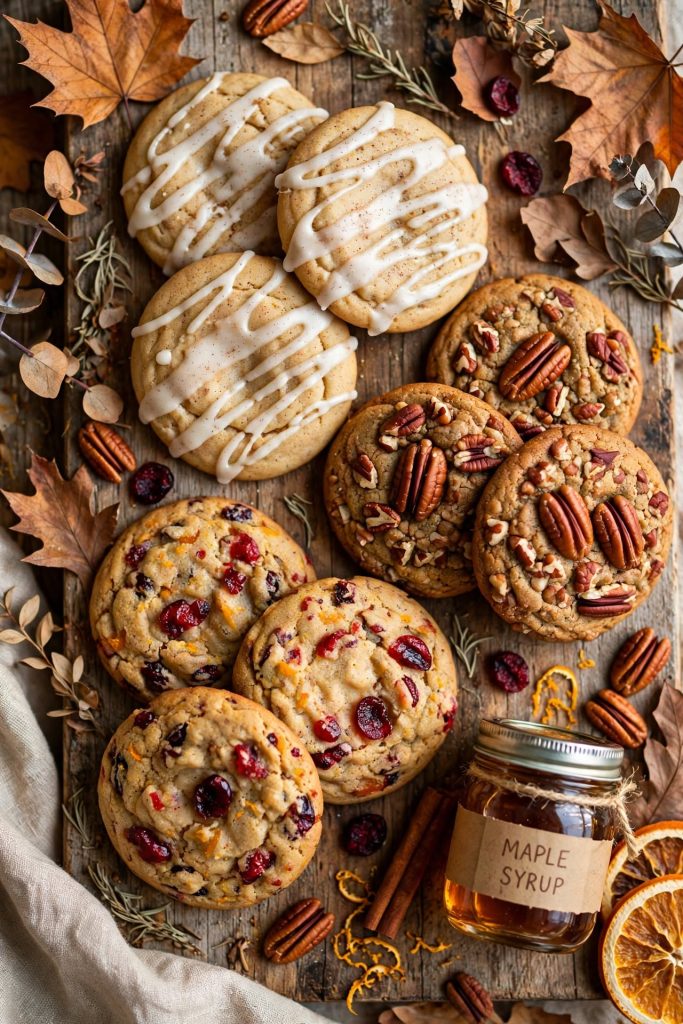
Thanksgiving Sugar Cookies (Decorated)
What changes: Use a standard roll-out sugar cookie dough. Cut into Thanksgiving shapes — leaves, turkeys, pumpkins, acorns — using seasonal cookie cutters. Decorate with royal icing in autumn colors: burnt orange, deep red, golden yellow, and warm brown.
When: Royal icing requires 4 to 6 hours to set fully between flood and detail layers. Plan for 2-day assembly: bake day one, decorate day two.
Result: Visually striking Thanksgiving cookies that are the centerpiece of any dessert table. These are the cookies to make if presentation is the priority and time is available for the decoration step.
Brown Butter Pecan Cookies
What changes: Remove the pumpkin puree and spices. Use 1 whole egg instead of just the yolk. Fold in 150g of toasted, roughly chopped pecans. Add 1 tablespoon of bourbon or 1 teaspoon of maple extract if desired.
When: All substitutions at Step 2. No dough chill required — bake immediately or chill 30 minutes for slightly thicker cookies.
Result: A simple, deeply nutty cookie with browned butter richness and crunchy pecan pieces. No glaze needed — sprinkle with flaky salt before baking. These keep longer than the pumpkin version (up to 5 days) because there is no pumpkin moisture to manage.
Cranberry Orange Cookies
What changes: Replace pumpkin puree with 2 tablespoons of fresh orange zest and 1 tablespoon of fresh orange juice. Use 1 whole egg instead of just the yolk. Fold in 120g of dried cranberries. Replace the spice blend with ½ teaspoon of cinnamon only.
When: All substitutions at Step 2.
Result: A bright, tart-sweet cookie with a clean citrus and cranberry profile — a refreshing counterpoint to the richness of the Thanksgiving spread. Drizzle with an orange glaze (powdered sugar, orange juice, zest) instead of the maple version.
Apple Cider Snickerdoodles
What changes: Reduce the butter to 115g. Add 60ml (¼ cup) of reduced apple cider to the dough (simmer 240ml of fresh apple cider down to 60ml, then cool). Roll the dough balls in a cinnamon-sugar-cardamom mixture (2 tbsp sugar, 1 tsp cinnamon, ¼ tsp cardamom) before baking.
When: All substitutions at Step 2. Skip the glaze — the cinnamon-sugar coating provides sweetness and texture.
Result: A soft, warmly spiced cookie with a concentrated apple cider flavor that tastes more complex than the ingredient list suggests. The cardamom in the rolling sugar adds a floral warmth that makes these feel elevated.
Maple Gingersnaps
What changes: Remove the pumpkin puree. Use 1 whole egg. Replace granulated sugar with an equal amount of brown sugar (all brown sugar). Add 1 tablespoon of molasses with the wet ingredients. Increase ground ginger to 1½ teaspoons. Reduce cinnamon to 1 teaspoon.
When: All substitutions at Step 2. Chill 30 minutes minimum — longer produces a crispier edge.
Result: A thin, crispy-edged cookie with a pronounced ginger-molasses flavor and the same maple glaze as the hero recipe. Closer to a classic gingersnap than the soft pumpkin cookie — for people who prefer a snap to a chew.
How to Store
Room Temperature
Glazed Thanksgiving cookies store at room temperature in an airtight container for up to 4 days. Place a sheet of parchment between each layer to prevent the glaze from sticking. The glaze acts as a partial moisture barrier that helps keep the cookies soft longer than unglazed pumpkin cookies. The spice flavor deepens on day two and three — these are often better the day after baking. Use your judgment on appearance and smell; discard if anything looks or smells off.
Refrigerator
Refrigerated Thanksgiving cookies last for best quality for up to 7 days in an airtight container. The cold firms the cookie and the glaze, making them feel denser than at room temperature. Remove them 15 to 20 minutes before serving to allow the texture to return to soft. The pumpkin and spice flavor is more pronounced when the cookies are cold — a useful thing to know if you want to serve them straight from the refrigerator alongside warm Thanksgiving desserts.
Freezer — Complete Guide
Thanksgiving cookies freeze well in two forms. Unbaked dough balls: freeze portioned balls on a parchment-lined sheet for 1 hour until solid, then transfer to a zip-lock freezer bag and freeze for up to 2 months. Bake from frozen at 375°F, adding 2 to 3 minutes to the bake time. Glaze after baking as normal. Baked, unglazed cookies: cool completely, wrap individually in plastic wrap, and freeze in a zip-lock bag for up to 2 months. Thaw at room temperature for 1 hour, then glaze just before serving. Avoid freezing glazed cookies — the glaze softens and weeps when it thaws.
For a complete Thanksgiving baking timeline that maps out what to make when, our Thanksgiving baking schedule guide is worth bookmarking before November. [IL-4 — replace with your URL]
How to Serve
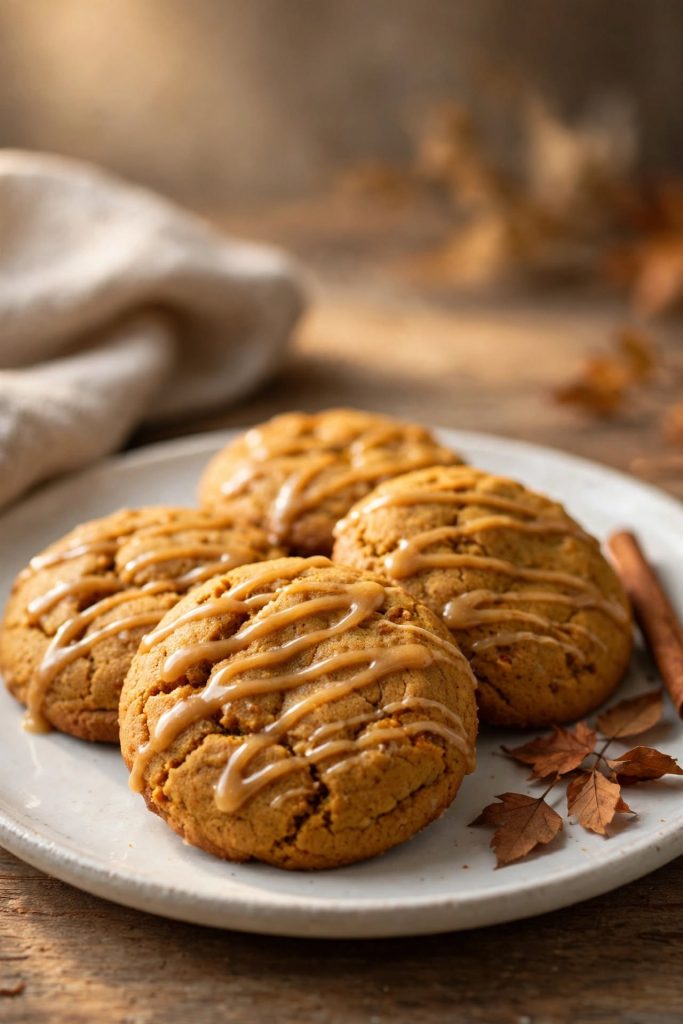
Classic Ways to Serve
- Arrange on a wooden board or slate with other Thanksgiving desserts — the warm orange-brown color photographs beautifully in autumn table settings
- Serve at room temperature with the glaze fully set — they should not be served warm unless you skip the glaze
- Stack in groups of three or four on the dessert table — the drizzled glaze is visible from the side when stacked and makes the display more interesting than a flat arrangement
Upgraded and Occasion-Worthy
- Pair each cookie with a small cup of spiced apple cider or hot chai — the warm spiced drink amplifies the cinnamon and ginger in the cookie
- Build a Thanksgiving cookie box: layer pumpkin spice cookies with brown butter pecan cookies and cranberry orange cookies in a white box with a ribbon — a host gift more personal than a bottle of wine
- Set out a glaze-and-decorate station at Thanksgiving with the baked unglazed cookies, the maple glaze, and small bowls of fall sprinkles, chopped pecans, and dried cranberries — guests of all ages can finish their own
Best pairings: spiced apple cider, chai tea, black coffee, or vanilla ice cream. Best occasions: Thanksgiving dessert table, Friendsgiving, cookie exchanges, holiday gifting, or as a make-ahead after-school treat for the week of Thanksgiving.
Frequently Asked Questions
Can I make Thanksgiving cookies ahead of time?
Yes — and this recipe is built for it. The dough can be made up to 3 days ahead and kept refrigerated, or portioned into balls and frozen for up to 2 months. Baked unglazed cookies keep at room temperature for up to 4 days or frozen for 2 months. The glaze should be made fresh on the day of serving for the cleanest set. Practical schedule: make dough Tuesday, bake Wednesday, glaze Wednesday afternoon, serve Thursday.
How many cookies does this recipe make?
Using a 2-tablespoon (#30) cookie scoop, this recipe makes approximately 24 cookies. The recipe doubles cleanly for a larger crowd — see the doubling FAQ below. For a smaller household or as part of a multi-dessert spread, the recipe halves well with no adjustments needed.
Can I make Thanksgiving cookies without pumpkin?
Yes — see the Variations section for Brown Butter Pecan Cookies (no pumpkin, deeply nutty), Apple Cider Snickerdoodles (apple flavor, no pumpkin), and Maple Gingersnaps (no pumpkin, crispy-edged). All three are Thanksgiving-appropriate cookies that do not use pumpkin and use the same brown butter base from this recipe.
How do I ship or transport Thanksgiving cookies?
Glazed Thanksgiving cookies transport well once the glaze is fully set (20 to 30 minutes). Stack with parchment between layers in a rigid container — a tin or box rather than a flexible bag. For shipping, freeze them first: wrap individually in plastic wrap, freeze overnight, then pack tightly in a box with crumpled parchment between layers. They will thaw in transit and arrive at the right texture. Ship with 2-day delivery maximum.
How long do Thanksgiving cookies last?
Room temperature in an airtight container: best quality for up to 4 days. Refrigerated: best quality for up to 7 days. Baked and frozen (unglazed): best quality for up to 2 months. Unbaked dough balls frozen: best quality for up to 2 months. The spice flavor is best on day two and three; by day four the fresh-baked quality has faded.
Can I freeze Thanksgiving cookies?
Yes — freeze baked cookies unglazed for the best result. Wrap each cookie individually in plastic wrap and place in a zip-lock freezer bag for up to 2 months. Thaw at room temperature for 1 hour, then glaze just before serving. Alternatively, freeze raw portioned dough balls on a sheet, then bag and freeze for up to 2 months — bake from frozen adding 2 to 3 minutes. Avoid freezing already-glazed cookies; the glaze softens and weeps when thawed.
Can I use pumpkin pie spice instead of individual spices?
Yes — replace the cinnamon, nutmeg, ginger, and cloves with 2 teaspoons of pumpkin pie spice. This is a direct swap by volume. The flavor will be very close to the individual spice blend. Some blends include allspice, which adds a subtle complexity. Taste the dough before chilling and add an extra ¼ teaspoon of cinnamon if it tastes flat.
Can I double this recipe for a crowd?
Yes — double all ingredients exactly. Brown the butter in two batches rather than one; a single pan with too much butter can burn unevenly. Use a stand mixer bowl if possible for the large dough volume. Bake in batches, one sheet at a time. Doubled recipe makes approximately 48 Thanksgiving cookies. If you enjoyed these, our pumpkin spice dessert collection has the complete Thanksgiving pumpkin baking lineup. [IL-5 — replace with your URL]
Why did my cookies spread too much?
Three main causes: dough was not cold enough when it went into the oven (always bake straight from the refrigerator), butter was still too warm when beaten with the sugar (it must be re-solidified, not just slightly firm), or too much pumpkin puree was used (measure precisely — 120g / ½ cup). The dough chill is the single most effective fix for spreading.
What size cookie scoop gives the best result?
A 2-tablespoon scoop (labeled #30) is ideal — it produces a cookie about 2.5 inches in diameter after baking. A 1-tablespoon scoop produces cookies that are too thin and bake through too quickly. A 3-tablespoon scoop produces cookies that need 14 to 15 minutes and have a narrower window between underbaked and overbaked.
Can I decorate these cookies for Thanksgiving?
Yes — the maple glaze can be colored with gel food coloring: orange, golden yellow, and warm brown all work well for a fall Thanksgiving palette. Add the food coloring to the glaze before drizzling. For more elaborate decoration, use royal icing instead of the maple glaze — it sets harder and allows for detailed piping. The cookies can also be pressed with fall-themed cookie stamps before baking for an impression without any glaze decoration at all.
What other spices can I add for more Thanksgiving flavor?
Cardamom (¼ tsp) adds a floral warmth that pairs well with the maple glaze. Allspice (¼ tsp) deepens the overall spice complexity without adding a single identifiable flavor. Black pepper (a pinch) sharpens the ginger and cinnamon notes in a way that reads as warmth rather than heat. Espresso powder (¼ tsp) deepens the molasses note in the brown sugar without adding coffee flavor. Add any of these with the dry ingredients at Step 2.

Thanksgiving Cookies
Ingredients
Equipment
Method
- Brown the butter in a light-colored saucepan over medium heat, stirring continuously, until milk solids are golden-amber and it smells nutty — 5 to 7 minutes. Pour into a large bowl, scraping all browned bits. Refrigerate 45 minutes (or freeze 15 minutes) until re-solidified to softened-butter consistency.
- Beat re-solidified brown butter with both sugars 2 to 3 minutes until fluffy. Add pumpkin puree; beat 1 minute. Add egg yolk and vanilla; beat 30 seconds. Fold in flour, baking soda, baking powder, salt, and spices until no flour streaks remain. Do not overmix.
- Cover with plastic wrap pressed to the dough surface. Refrigerate at least 1 hour, overnight for best flavor and texture.
- Preheat oven to 375°F (190°C). Scoop 2-tablespoon portions, roll into balls, press lightly to ¾-inch thickness, and place 2 inches apart on parchment-lined sheets. Bake one sheet at a time 11 to 13 minutes. Edges should look set; centers should still look slightly glossy. Cool on pan 5 minutes, then transfer to a wire rack and cool completely.
- Whisk glaze ingredients until smooth. Drizzle over fully cooled cookies or dip the top third into the glaze. Let set 20 to 30 minutes before stacking or storing.
Notes
- Use pure pumpkin puree only — not pumpkin pie filling.
- Brown butter must be re-solidified before beating — do not rush the cooling step.
- The dough chill is not optional — unchilled dough spreads flat.
- Pull cookies when centers still look slightly glossy and underdone — they finish on the hot pan.
- Glaze on fully cooled cookies only — even slight warmth makes the glaze run.
- Freeze dough balls up to 2 months; bake from frozen adding 2 to 3 minutes.
More Thanksgiving Dessert Recipes You Will Love
- Pumpkin Pie — the non-negotiable Thanksgiving dessert. Made from scratch with a homemade all-butter crust and a filling that uses both pumpkin puree and a touch of maple syrup. The same spice logic as these cookies applied to a pie.
- Apple Cranberry Crisp — a no-crust fall dessert with tart cranberries and sweet apple underneath a brown butter oat topping. Ready in 45 minutes and serves 8 from a single baking dish.
- Pecan Pie Bars — all the flavors of pecan pie in a shortbread-base bar that cuts cleanly and travels well. Easier to serve and portion than a full pie at a large gathering.
- Maple Pumpkin Cheesecake — a baked cheesecake with a gingersnap crust, pumpkin-spiced filling, and a maple caramel drizzle. The make-ahead Thanksgiving dessert — it must be refrigerated overnight and is better for it.
- Brown Butter Pecan Blondies — the bar version of brown butter pecan cookies, baked in a single 9×13 pan. 25 minutes of prep, 30 minutes of bake time, and they serve 24 people without any individual portioning.
Did you make these Thanksgiving cookies? Leave a ⭐⭐⭐⭐⭐ rating below and let me know in the comments how it turned out. I read every comment and would love to know what worked for you