

What are gingerbread cookies? Gingerbread cookies are a classic spiced cut-out cookie made with molasses, dark brown sugar, and a blend of ginger, cinnamon, cloves, and nutmeg. The dough is rolled flat and cut into shapes — most commonly gingerbread men, stars, and trees for Christmas. They require a minimum 2-hour chill before rolling so the dough holds its shape cleanly through cutting and baking. Best for home bakers who want a reliable, authentically-flavoured gingerbread that is soft enough to eat and firm enough to decorate.
These gingerbread cookies have a deep, spiced flavour from the combination of dark brown sugar, unsulphured molasses, and four ground spices. The dough rolls cleanly, the cut shapes hold their edges through baking, and the finished cookies are soft enough to bite through without crumbling. The recipe requires a 2-hour chill — that is the one non-negotiable step — but every other part of the process is straightforward. I tested this recipe multiple times before publishing to confirm the spice balance, rolling thickness, and bake time produce the same result regardless of oven variation.
Why These Gingerbread Cookies Work
Gingerbread cookies fail in two specific ways: they lose their shape in the oven, or they taste like a generic spiced cookie rather than proper gingerbread. Every decision in this recipe addresses one of those two problems.
- Molasses and dark brown sugar together — molasses provides the deep, slightly bitter, caramel-dark flavour that makes gingerbread unmistakable. Dark brown sugar amplifies it with extra molasses content built into the sugar. Together they produce a flavour no light-sugar version can replicate.
- Four-spice blend in specific ratios — equal parts ginger and cinnamon at the front, with smaller amounts of cloves and nutmeg behind them. The cloves add depth and a slight warmth that lingers; the nutmeg softens the whole blend. Single-spice gingerbread is flat by comparison.
- Mandatory 2-hour chill — the butter must be fully firm before the dough goes anywhere near a rolling pin. Soft fat means soft dough, and soft dough stretches when you lift cut shapes onto the tray, which is why shapes lose their definition.
- Rolled between two sheets of parchment — no extra flour on the rolling surface means the flour ratio in the dough stays exactly as intended. Extra flour toughens the dough and dries it out — especially in scraps that get re-rolled.
- Baked on parchment at 175°C / 350°F — a moderate temperature lets the cookies set and hold their shape without the edges burning before the centres are done. Higher temperatures cause spreading at the edges.
- Two texture options in one recipe — 5mm / ¼ inch for a soft, tender result; 3mm / ⅛ inch for a crispier cookie that holds fine decorating detail more cleanly and works for ornament-hanging.
🔗 IL-1: “If you are looking for more [Christmas cookie recipes], our complete holiday cookie guide covers every classic.” — Replace anchor text and URL before publishing.
Ingredients for Gingerbread Cookies
Every ingredient here has a specific job. Here is what each one does — and what to use if you need to make a substitution.
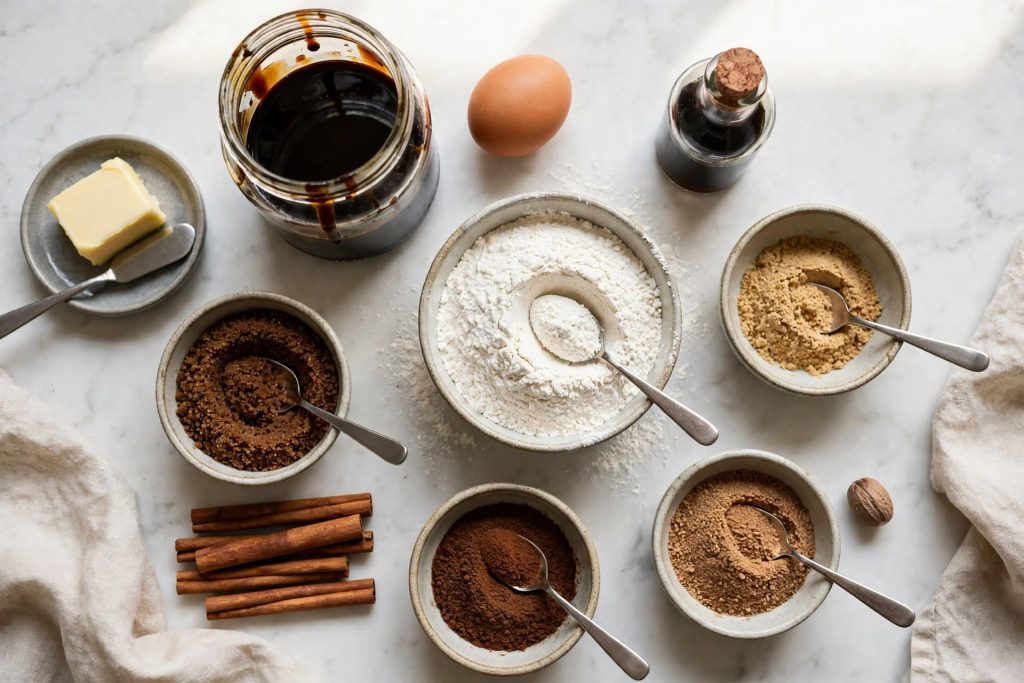
The Cookie Dough
| Ingredient | Amount | What It Does | Best Substitute + Impact |
|---|---|---|---|
| All-purpose flour | 340g / 3 cups | Structure and body — the backbone of the dough | 1:1 gluten-free flour blend — slightly more crumbly; chill time increases to 3 hours |
| Baking soda | 1 tsp | Slight lift and promotes browning at the edges | No substitute — do not skip |
| Baking powder | ½ tsp | Small amount of rise to prevent a completely flat, dense cookie | No substitute |
| Salt | ¼ tsp | Balances the sweetness and amplifies the spice flavour | N/A |
| Unsalted butter, softened | 115g / ½ cup | Fat for tenderness, flavour, and workable dough texture | Salted butter — omit the added salt; slightly saltier result |
| Packed dark brown sugar | 150g / ¾ cup | Sweetness, moisture, and amplified molasses depth | Light brown sugar — milder molasses flavour; add 1 extra tsp molasses to compensate |
| Unsulphured molasses | 80ml / ⅓ cup | Defines the gingerbread flavour; dark colour; natural preservative | Dark treacle — 1:1 substitute; blackstrap molasses is too bitter — see The Molasses Guide |
| Egg, room temperature | 1 large | Binds the dough and adds structure for clean cutting | Flax egg (1 tbsp flaxmeal + 3 tbsp water, rested 5 min) — slightly softer dough; extend chill to 3 hours |
| Vanilla extract | 1 tsp | Background warmth that rounds out the spice blend | Vanilla bean paste — same quantity, slightly stronger |
The Spice Blend
| Spice | Amount | Flavour Role | Adjustment |
|---|---|---|---|
| Ground ginger | 1½ tsp | The primary spice — warm, slightly sharp, defines gingerbread | Increase to 2 tsp for a more pronounced ginger punch |
| Ground cinnamon | 1½ tsp | Sweet warmth that balances the sharpness of the ginger | Decrease to 1 tsp if you want ginger to dominate more clearly |
| Ground cloves | ¼ tsp | Deep, pungent warmth — lingers on the palate | Do not increase beyond ½ tsp — cloves become overpowering quickly |
| Ground nutmeg | ¼ tsp | Soft, slightly floral note that rounds the whole blend | Freshly grated nutmeg gives a noticeably more vibrant result |
Key Ingredient Notes
Molasses: Use unsulphured molasses — Grandma’s Original or Brer Rabbit are the two most commonly available brands. Blackstrap molasses is too bitter and too intense for cookies. Do not use light or fancy molasses — it lacks the depth the recipe requires. See The Molasses Guide below for the full breakdown.
Butter: Softened at room temperature — not melted. If the butter is too soft, the dough will be greasy and difficult to chill to a workable temperature. If it is cold, it will not cream properly and the dough will be tough.
Dark brown sugar: Pack it firmly into the measuring cup. The molasses in the brown sugar contributes real moisture to the dough — loosely packed brown sugar gives you a drier, less flavourful result.
Flour: Measure by weight where possible (340g). If measuring by cup, spoon the flour into the cup and level off — scooping directly from the bag packs the flour and adds up to 40g more than intended, which makes the dough stiff and difficult to roll.
Equipment You Need
- Stand mixer or electric hand mixer
- Two baking sheets lined with parchment paper
- Rolling pin (a pin with adjustable thickness rings is ideal)
- Multiple sheets of parchment paper for rolling
- Cookie cutters in desired shapes (gingerbread men, stars, trees)
- Thin metal spatula for lifting cut shapes without distorting them
- Wire cooling rack
- Kitchen scales
The Molasses Guide
Molasses is the most important and most misunderstood ingredient in gingerbread cookies. The type you use determines the flavour, colour, and texture of the finished cookie more than any other single ingredient.
| Type | Flavour | Colour | Use for This Recipe? |
|---|---|---|---|
| Unsulphured molasses (Grandma’s, Brer Rabbit — regular) | Deep, dark caramel, slightly bittersweet — the classic gingerbread flavour | Dark brown | ✅ Best — this is what the recipe is designed around |
| Dark treacle (UK/Australian equivalent) | Very similar to unsulphured molasses — slightly more bitter | Very dark brown, almost black | ✅ Excellent substitute at 1:1 ratio |
| Blackstrap molasses | Very bitter, intensely strong — medicinal in large quantities | Almost black | ❌ Do not use — overwhelmingly bitter in cookies |
| Light / fancy molasses | Mild, sweet, more like golden syrup | Pale amber | ⚠️ Not recommended — produces a bland, pale, under-flavoured gingerbread |
| Golden syrup | Sweet, buttery, no bitterness | Amber | ⚠️ Emergency substitute only — produces a very different flavour profile |
| Pomegranate molasses | Tart, fruity, completely different | Deep red-brown | ❌ Not suitable — this is a savoury/Middle Eastern ingredient |
🍯 How to Measure Molasses Without the Mess
- Spray or lightly oil the inside of your measuring cup before pouring in the molasses.
- The molasses slides out cleanly instead of sticking to the sides and leaving residue.
- Alternatively, measure the flour into the bowl first, then use the same cup (now empty) to measure the molasses — residual flour on the cup sides helps the molasses slide free.
- If your molasses has thickened in cold storage, sit the jar in warm water for 5 minutes to loosen it before measuring.
Visual cue: the right molasses pours slowly off a spoon in a thick, dark ribbon. Blackstrap molasses looks nearly identical but tastes sharply bitter when you lick the spoon — the flavour difference is immediate and unmistakable.
How to Make Gingerbread Cookies — Step by Step
The dough comes together quickly — it is the chill time that takes most of the total time. Plan accordingly: mix the dough the night before for a morning of rolling and baking.
Step 1: Mix the Dry Ingredients
Whisk the flour, baking soda, baking powder, ginger, cinnamon, cloves, nutmeg, and salt together in a large bowl until the spices are evenly distributed through the flour. Set aside. This pre-mixing prevents pockets of concentrated spice in the finished cookie.
What to look for: the flour should have a light tan colour from the spices, with no visible streaks of any individual spice clumped together.
Step 2: Cream the Butter and Brown Sugar
Beat the softened butter and packed dark brown sugar together on medium speed for 3 minutes until the mixture lightens slightly in colour and feels less grainy between your fingers. Dark brown sugar will not cream to the same pale, fluffy stage as white sugar — the result will still look darker and denser than a standard cookie batter, and that is correct.
What to look for: the mixture should be smooth and slightly fluffy, with no visible sugar grains when you rub a small amount between your fingers.
Step 3: Add Molasses, Egg, and Vanilla
⚠️ Critical step: Add the molasses, egg, and vanilla extract all at once and beat on medium speed for 30 to 40 seconds. The mixture may look slightly curdled or separated at first — this is normal. It will smooth out when the flour is added. Do not overbeat — too much air at this stage can cause the cookies to puff and lose their shape during baking.
What to look for: a dark, glossy mixture that smells strongly of molasses. Some variation in smoothness at this point is fine.
Step 4: Combine Wet and Dry Ingredients
⚠️ Critical step: Add the flour mixture in two additions, mixing on low speed between each. Stop mixing the moment the dough pulls away from the sides of the bowl and looks uniform — no dry streaks, no wet patches. The dough should be soft but not sticky. Once you are confident with this technique, [our sugar cookie guide] uses the same rolling method with a different flavour profile. [IL-2 — replace before publishing]
What to look for: a smooth, firm dough that holds its shape when pressed and does not stick to your fingers. If it feels sticky, add flour 1 tablespoon at a time, mixing after each addition, until it no longer clings to your hands.
Step 5: Chill the Dough
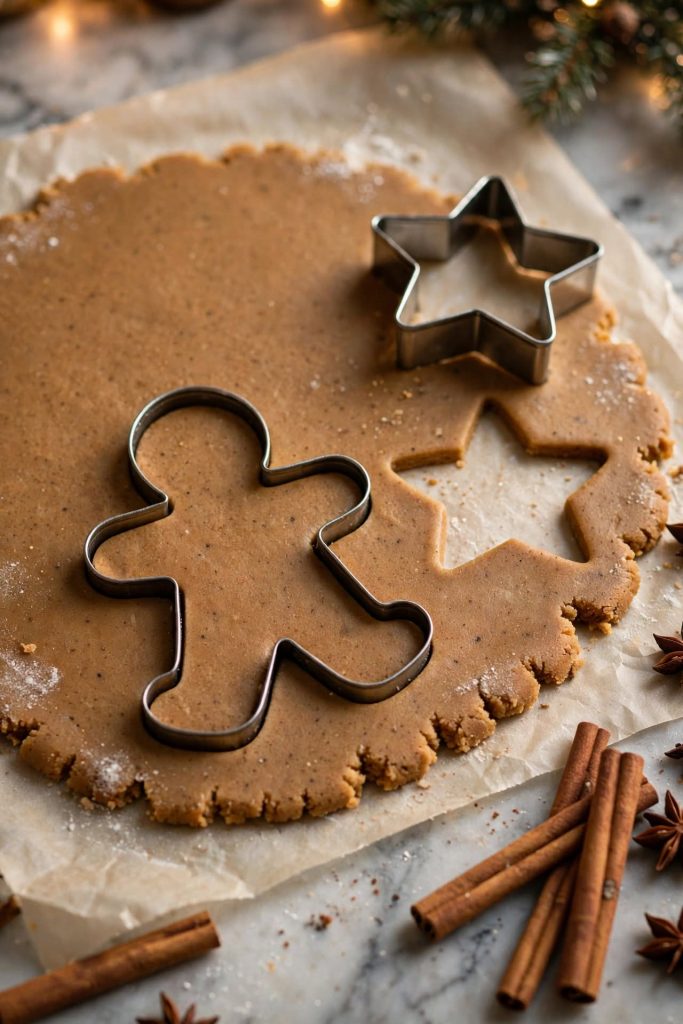
Divide the dough into two equal portions. Flatten each portion into a disc roughly 2cm thick — a disc chills and rolls more evenly than a ball. Wrap each disc tightly in cling film, pressing out any air pockets. Refrigerate for at least 2 hours. Overnight is better — the flavour deepens with a longer rest and the dough rolls more cleanly when fully cold.
What to look for: after chilling, the dough should feel firm and cold throughout — similar in consistency to cold marzipan. If it still feels soft at the centre, chill for another 30 minutes.
Step 6: Roll, Cut, and Transfer
Preheat your oven to 175°C / 350°F (160°C fan). Line baking sheets with parchment. Work with one disc at a time, keeping the other in the refrigerator. Place the disc between two sheets of parchment paper and roll to 5mm / ¼ inch thickness for soft cookies, or 3mm / ⅛ inch for crispier ones. Cut shapes and lift them using a thin spatula, transferring to the lined baking sheet. Gather scraps into a ball, re-wrap, and return to the refrigerator before re-rolling.
What to look for: cut shapes should have clean, sharp edges. If the edges look ragged or the dough is sticking to the cutter, the dough has warmed up — return the entire parchment sheet to the refrigerator for 10 minutes before continuing.
Step 7: Bake and Cool
Bake one sheet at a time on the centre rack for 8 to 10 minutes. For soft gingerbread cookies, pull at 8 to 9 minutes when the edges look set and the centres still look very slightly underdone. For crispier cookies, bake for 10 to 11 minutes until the surface looks dry all the way to the centre. Cool on the baking sheet for 5 minutes, then transfer to a wire rack. Cool completely before decorating — at least 30 minutes, or the icing will melt on contact.
What to look for: soft cookies will feel slightly soft when you press the centre very gently — this is correct and they will firm up as they cool. Crispy cookies should feel completely set and dry when pressed. Both types will be noticeably darker than they looked going in.
The Science Behind Perfect Shape and Spice
Three specific elements of this recipe work together to solve the two biggest gingerbread problems: shape loss and flavour depth.
Why Molasses Is Non-Negotiable
Molasses is the byproduct of refining sugar cane into white sugar — it contains the minerals, colour compounds, and complex flavour molecules that were removed from the cane juice during processing. Those compounds are what give gingerbread its dark colour and its characteristic deep, slightly bitter caramel flavour. You cannot replicate this with any other sweetener. Brown sugar contains molasses, but only around 3 to 6% by weight — nowhere near enough on its own. This recipe uses both brown sugar and additional molasses to build the deepest possible gingerbread flavour. Reducing or replacing the molasses gives you a spiced sugar cookie, not a gingerbread cookie.
Why the Chill Time Cannot Be Shortened
Gingerbread dough contains a significant amount of fat from the butter and moisture from the molasses. At room temperature, that fat is soft enough that the dough deforms under its own weight when lifted — cut shapes stretch on the spatula and lose their sharp edges before they even reach the tray. Chilling re-solidifies the fat to the point where the dough holds its shape from cutter to tray to oven without deforming. Two hours is the minimum to firm the fat throughout a 2cm disc; overnight chill allows the spices to fully hydrate into the flour as well, which produces a more rounded, cohesive spice flavour in the finished cookie.
Why Rolling Between Parchment Changes Everything
When you roll cookie dough on a floured surface, you add extra flour at every pass of the rolling pin. That extra flour changes the ratio in the outer layers of the dough — the parts that become the surface of the cookie. More flour means less fat and moisture in those layers, which makes the surface of the cookie tougher and drier than the interior. This effect compounds with each re-roll of the scraps, which is why scraps produce noticeably tougher cookies than first-roll dough. Rolling between two sheets of parchment eliminates the problem entirely — the ratio stays consistent from the first roll to the last.
Tips for the Best Results
Keep the Dough Cold at Every Stage
Work quickly and in small portions. Take one disc from the refrigerator, roll it, cut your shapes, and get the tray into the oven before the second disc comes out. If you notice the dough beginning to stick to the top parchment sheet or the cut shapes starting to lose their definition, it has warmed up — slide the entire bottom parchment and all its cut shapes onto a tray and return to the refrigerator for 10 minutes before proceeding.
Roll to a Consistent Thickness
Inconsistent thickness means inconsistent bake times within the same tray. A thin gingerbread man arm bakes faster than the body it is attached to — when the body is done, the arm is already overdone. A rolling pin with adjustable thickness rings takes the guesswork out completely. If you are using a standard rolling pin, place two equal-height objects (stacked chopsticks, two books of the same thickness) on either side of the dough and rest the rolling pin on them — the pin cannot go below that height and the thickness stays consistent.
Re-roll Scraps Only Once
Gather all scraps from the first cut into a disc, re-wrap in cling film, and refrigerate for at least 15 minutes before re-rolling. The handling has warmed the dough and worked the gluten — a rest period relaxes it back to a workable state. Only re-roll once: third-generation scraps become noticeably tougher regardless of how carefully you handle them. Those last scraps are better baked as rough shapes or used for decorating practice.
Bake Similar-Sized Cookies Together
A large gingerbread man and a small star shape have very different bake times even at the same dough thickness. Separate your cut shapes by size before baking — all large shapes on one tray, all small shapes on another. This lets you pull the small shapes first and give the large ones the extra minute they need without burning the edges of the small ones.
Adjust Bake Time for Texture
This recipe gives you two different cookies depending on bake time and rolling thickness:
- Soft and tender: Roll to 5mm / ¼ inch — bake 8 to 9 minutes. Pull when centres look very slightly underdone. Soft enough to eat without dunking, holds icing well. Best for gifting and eating.
- Crispy and firm: Roll to 3mm / ⅛ inch — bake 10 to 11 minutes. Pull when the surface looks dry all the way to the centre. Strong enough to hang as ornaments after baking a hanging hole before baking. Better for intricate icing detail.
Cool Completely Before Decorating
A warm gingerbread cookie melts royal icing on contact — the icing thins out, bleeds, and cannot hold a defined piped line. Wait at least 30 minutes at room temperature after transferring to the rack. For royal icing flooding, the cookies should be completely room temperature all the way through — pick one up and hold it for 10 seconds. If you feel warmth through the cookie, wait longer.
Common Mistakes to Avoid
These are the six errors that consistently produce gingerbread cookies that spread, harden, or taste wrong.
❌ Using Blackstrap Molasses
Blackstrap molasses is the third-extraction byproduct of sugar refining — it contains most of the minerals and very little of the remaining sugar, which makes it intensely bitter, almost medicinal. It looks almost identical to unsulphured molasses in the jar and on the label, but tastes completely different. Always check the type on the label: the word “blackstrap” means do not use it for baking cookies. If in doubt, dip a spoon in and taste it — the bitterness of blackstrap is immediately apparent.
❌ Skipping or Shortening the Chill Time
Unchilled gingerbread dough is workable but produces cookies that spread and lose their shape. The cut edges that looked crisp on the tray blur during baking as the soft fat melts and pulls the dough outward before the structure sets. A gingerbread man cut from unchilled dough arrives at the dinner table looking like a blob. Two hours minimum; overnight produces the best result.
❌ Rolling on a Floured Surface
Every additional dusting of flour on the rolling surface changes the dough composition at its outer layers. A single extra 10g of flour incorporated through rolling can make the difference between a tender gingerbread cookie and a tough one. Rolling between two sheets of parchment eliminates the problem at every stage. For more guides like this, [our cut-out cookie baking guide] covers the parchment technique in more detail. [IL-3 — replace before publishing]
❌ Overbaking
Gingerbread cookies continue to firm up significantly as they cool — a cookie that feels perfectly firm at the 10-minute mark will be noticeably harder at room temperature. The deep colour of gingerbread also makes it difficult to judge by appearance — it is already dark when it goes into the oven and does not show the visual browning cue that lighter cookies do. Trust the clock and pull them at the times stated, regardless of how they look.
❌ Cutting Intricate Shapes from Warm Dough
Fine detail on gingerbread men — fingers, buttons, facial features — requires cold, firm dough to transfer cleanly. Warm dough stretches as it lifts from the surface and the fine details blur or detach entirely. If you are working with detailed cutters, cut the shape, slide the spatula underneath, and transfer it to the tray without stopping to check or admire the cut — every second of handling warms the dough further.
❌ Decorating Before the Cookies Are Fully Cool
Royal icing applied to a warm cookie melts on contact and bleeds outward. Buttercream and cream cheese frostings melt even faster. The only safe approach is complete room-temperature cooling — a minimum of 30 minutes on the rack. If you are in a hurry, spread the cookies on a tray and place in the refrigerator for 10 minutes, which accelerates the cooling without condensation forming on the surface.
Variations Worth Trying

Chocolate Gingerbread Cookies
What changes: Replace 30g / ¼ cup of the flour with 30g of Dutch-processed cocoa powder. The chocolate deepens the dark colour and adds a slight bitterness that complements the molasses.
When: At the dry ingredient stage — whisk the cocoa in with the flour and spices.
Result: A darker, richer gingerbread with a subtle chocolate depth. Particularly good paired with white royal icing — the contrast between the nearly-black cookie and the white icing is visually striking.
Lemon-Iced Gingerbread Cookies
What changes: Add 1 tsp finely grated lemon zest to the dough at the creaming stage. Ice with a simple lemon glaze: 120g / 1 cup sifted icing sugar + 2 to 3 tbsp fresh lemon juice, stirred to a thick drizzling consistency.
When: Lemon zest at the butter-and-sugar creaming stage; glaze applied after the cookies are fully cooled.
Result: The bright citrus of the lemon glaze cuts through the richness of the molasses base — a lighter-tasting gingerbread that works particularly well at spring and autumn events, not just Christmas.
Gingerbread Men with Royal Icing
What changes: The base recipe is unchanged. Make royal icing: 2 large egg whites (or 60ml aquafaba) + 240g / 2 cups sifted icing sugar + ½ tsp cream of tartar, beaten on high speed for 4 to 5 minutes until glossy and stiff. Thin with water 1 tsp at a time for flooding consistency.
When: Applied after the cookies are completely cooled — minimum 30 minutes on the wire rack.
Result: Royal icing sets hard and dry within 2 to 4 hours at room temperature. It is the only icing that can be stacked without smudging, making it ideal for gift boxes and cookie platters.
Crispy Gingerbread Cookies (for ornaments)
What changes: Roll to 3mm / ⅛ inch instead of 5mm. Before baking, use a skewer or straw to press a small hanging hole near the top of each shape. Bake for 10 to 11 minutes until completely dry throughout.
When: At the rolling and cutting stage; hole pressed before baking, not after.
Result: A very crisp, firm cookie that holds its shape indefinitely and can support a ribbon for hanging. Not as pleasant for eating as the 5mm version but excellent for decoration. Thread a thin ribbon through the hanging hole once the cookie has fully cooled.
Chewy Gingerbread Cookies
What changes: Add 1 extra tablespoon of molasses to the dough. Roll to 5mm / ¼ inch and do not roll thinner. Pull from the oven at exactly 8 minutes — even at 9 minutes the chewiness begins to decrease.
When: Extra molasses at the wet ingredient stage; strict bake time.
Result: A noticeably chewier, slightly stickier cookie with an even deeper molasses flavour. The extra molasses also darkens the colour further. Best eaten within 2 to 3 days as the extra moisture shortens their shelf life compared to the standard version.
How to Store
Room Temperature
Undecorated gingerbread cookies keep for best quality for up to 2 weeks at room temperature in an airtight container — the molasses acts as a natural preservative. Store in a single layer or with parchment paper between layers to prevent them sticking together or picking up condensation.
Decorated cookies with royal icing keep for up to 1 week at room temperature — royal icing acts as a protective seal over the surface of the cookie.
Cookies decorated with cream cheese or buttercream must be refrigerated — see the Refrigerator section below.
Softening trick: if your cookies have hardened, place a slice of white bread in the container alongside them. The cookies absorb moisture from the bread and soften noticeably within 12 hours.
Refrigerator
Gingerbread cookies decorated with cream cheese or buttercream icing keep for up to 4 days refrigerated in an airtight container. Bring to room temperature for 15 minutes before serving — cold cream cheese frosting is firmer than most people prefer.
Unbaked dough discs keep refrigerated for up to 5 days. The flavour deepens with time — dough rested for 24 hours produces a noticeably more rounded spice flavour than freshly made dough.
Freezer — Complete Guide
Can you freeze gingerbread cookies? Yes — baked cookies, decorated cookies (with royal icing only), and unbaked dough all freeze well.
To freeze baked undecorated cookies: cool completely, freeze in a single layer until firm (about 1 hour), then transfer to an airtight container with parchment between layers. Best quality for up to 3 months. Thaw at room temperature for 20 to 30 minutes.
To freeze baked royal icing-decorated cookies: royal icing sets hard and survives freezing well. Freeze in a single layer first, then box. Thaw at room temperature — do not thaw in the refrigerator as condensation can dissolve the icing surface.
Do not freeze cookies decorated with cream cheese or buttercream — the icing becomes watery after thawing.
To freeze unbaked dough: wrap each disc tightly in cling film, then a layer of foil. Freeze for up to 3 months. Thaw overnight in the refrigerator — do not thaw at room temperature as the outside softens before the inside thaws and the dough becomes sticky and uneven.
Use your judgment — if any baked cookies smell rancid or show visible mould after extended storage, discard them.
🔗 IL-4: “If you are planning a full holiday baking schedule, [our Christmas baking timeline] helps you sequence everything from dough-making to decorating.” — Replace before publishing.
How to Serve

Classic Ways to Serve
- Arranged on a tiered cookie platter at room temperature as part of a Christmas dessert spread — the variety of shapes creates visual interest without any additional effort
- Packaged in decorative tins or cellophane bags tied with ribbon for gifting — gingerbread cookies hold their shape and flavour for up to 2 weeks, making them one of the best cookies for advance-made gifts
- Served alongside mulled wine, hot apple cider, or spiced hot chocolate — the warm spices in the cookie echo the warm spices in the drinks
Upgraded and Occasion-Worthy
- Use as place card holders at a Christmas dinner table — pipe guests’ names onto each cookie in royal icing and prop them against a glass at each setting
- Hang crispy versions as edible tree ornaments threaded with thin red or green ribbon — remove for eating after Christmas, or leave as decoration if the cookies are for display only
- Build a gingerbread cookie tower by stacking round-cut cookies of decreasing size, each layer attached with a dot of royal icing — a centrepiece dessert for a children’s Christmas party that doubles as the activity
Pairs well with: mulled wine, spiced apple cider, hot chocolate, peppermint tea, eggnog, or a strong black coffee.
Best occasions: Christmas cookie exchanges, holiday gifting, school events, Advent baking sessions with children, Thanksgiving dessert tables, and any event where decorating the cookie is part of the activity.
Frequently Asked Questions
Can I make gingerbread cookies without molasses?
You can, but the result will not taste like gingerbread. Molasses provides the deep, dark, slightly bitter flavour that defines gingerbread — without it you get a spiced sugar cookie that lacks the characteristic depth. If you cannot find unsulphured molasses, dark treacle is the closest substitute at a 1:1 ratio. Golden syrup or honey can replace the liquid but will change the flavour profile dramatically and produce a much lighter-coloured, milder-tasting cookie.
Why did my gingerbread cookies spread and lose their shape?
Shape loss is almost always caused by insufficient chilling, cutting from dough that was too warm, or placing cut shapes on hot baking sheets. Chill the dough for at least 2 hours — overnight is better. Work with one disc at a time and keep the rest refrigerated. Let baking sheets cool completely between batches. If cut shapes begin to soften while you are working, return the entire parchment sheet with the cut shapes to the refrigerator for 10 minutes before baking.
How do I know when gingerbread cookies are done?
For soft cookies, pull at 8 to 9 minutes when the edges look set and the centres still look slightly underdone. They will feel soft but firm up as they cool on the tray. For crispier cookies, bake for 10 to 11 minutes until the surface looks dry all the way to the centre. Gingerbread darkens quickly after the right point — the shift from done to overdone happens in about 1 minute.
Can I make the dough ahead of time?
Yes — and it is strongly recommended. The dough keeps in the refrigerator for up to 5 days, tightly wrapped in cling film. The flavour deepens noticeably with an overnight rest as the spices fully hydrate into the flour. The dough also freezes for up to 3 months — thaw overnight in the refrigerator before rolling.
How long do gingerbread cookies last?
Undecorated gingerbread cookies keep for best quality for up to 2 weeks at room temperature — the molasses and brown sugar act as natural preservatives. Decorated cookies with royal icing keep for up to 1 week. If you enjoyed making this recipe, [our gingerbread loaf cake] uses the same spice balance in a simpler format. [IL-5 — replace before publishing]
Can I freeze gingerbread cookies?
Yes. Baked undecorated cookies freeze well for up to 3 months — cool completely, freeze in a single layer first, then transfer to an airtight container with parchment between layers. Royal icing-decorated cookies also freeze well. Do not freeze cookies decorated with cream cheese or buttercream. Unbaked dough discs freeze for up to 3 months — thaw overnight in the refrigerator.
What can I substitute for dark brown sugar?
Light brown sugar works as a 1:1 substitute but produces a slightly lighter colour and milder flavour. To compensate, add 1 extra teaspoon of molasses to the dough. White granulated sugar is not a suitable substitute — it lacks the moisture and molasses content that give gingerbread its characteristic texture and flavour depth.
Can I double this recipe?
Yes. Double every ingredient. Divide the doubled dough into four discs for easier rolling. Doubled dough keeps refrigerated for up to 5 days — ideal for baking across multiple sessions over the holidays. Bake in batches one tray at a time.
Why are my gingerbread cookies too hard?
Hard gingerbread is caused by overbaking, rolling too thin, or both. Gingerbread hardens as it cools — a cookie that feels soft in the oven will be firmer at room temperature. Roll to 5mm for soft results. Pull soft-style gingerbread at 8 to 9 minutes when centres still look slightly underdone. Store with a slice of white bread in the container — the cookies absorb moisture from the bread and soften overnight.
What rolling pin thickness should I use?
Roll to 5mm / ¼ inch for soft, chewy gingerbread cookies, or 3mm / ⅛ inch for crispier cookies that hold intricate decorating details better. A rolling pin with adjustable thickness rings takes the guesswork out — the rings sit beside the dough and the pin rests on them, preventing you from rolling too thin in any one area. Without guides, use two equally-thick items (like stacked rulers or chopsticks) on either side of the dough as height guides.
Do I need to chill the dough between cuts?
If your kitchen is warm (above 22°C / 72°F) or you are working slowly, yes. Gingerbread dough that has been handled warms up quickly and cut shapes begin to lose their definition at the edges. If you notice the dough sticking to the cutter or the cut edges looking ragged, the dough has warmed — slide the parchment and all cut shapes onto a tray and refrigerate for 10 minutes before continuing.
Can I make gingerbread cookies without eggs?
Yes. Replace the egg with a flax egg: 1 tablespoon of flaxseed meal combined with 3 tablespoons of water, rested for 5 minutes until it forms a gel. The dough will be slightly softer and the chill time should be extended to 3 to 4 hours. The finished cookies will be slightly denser and may not hold very fine cutter detail as cleanly, but the flavour is essentially identical to the standard version.

Gingerbread Cookies
Ingredients
Method
- Whisk flour, baking soda, baking powder, ginger, cinnamon, cloves, nutmeg, and salt in a large bowl until the spices are evenly distributed. Set aside.
- Beat softened butter and packed dark brown sugar on medium speed for 3 minutes until smooth and slightly fluffy.
- Add the molasses, egg, and vanilla extract. Beat on medium speed for 30 to 40 seconds until combined. The mixture may look slightly curdled — this is normal.
- Add the flour mixture in two additions, mixing on low speed until the dough pulls away from the sides of the bowl and looks uniform — no dry streaks, no wet patches.
- Divide the dough into two equal discs, wrap each tightly in cling film, and refrigerate for at least 2 hours (overnight preferred).
- Preheat oven to 175°C / 350°F (160°C fan). Line baking sheets with parchment.
- Working with one disc at a time (keep the other refrigerated), roll between two sheets of parchment to 5mm / ¼ inch for soft cookies or 3mm / ⅛ inch for crispier ones. Cut shapes with cookie cutters and transfer to the lined baking sheets using a thin spatula.
- Bake one sheet at a time on the centre rack. For soft cookies: 8 to 9 minutes, edges set, centres slightly underdone. For crispier cookies: 10 to 11 minutes, surface dry to the centre.
- Cool on the baking sheet for 5 minutes, then transfer to a wire rack. Cool completely — at least 30 minutes — before decorating.
Notes
- Molasses: Use unsulphured molasses — not blackstrap (too bitter) and not light molasses (too mild). Dark treacle is the best 1:1 substitute.
- Chill time: 2 hours minimum — overnight is better. This is the single most important step for shape retention.
- Rolling: Always roll between two sheets of parchment — never on a floured surface. Extra flour toughens the dough.
- Shape loss? Dough too warm — return to the refrigerator for 10 to 15 minutes before continuing.
- Too hard? Overbaked or rolled too thin. Store with a slice of white bread to soften overnight.
- Spice substitution: Use 1½ tsp of commercial pumpkin pie spice in place of the four individual spices as a shortcut.
More Holiday Cookie Recipes You Will Love
- Christmas Sugar Cookies — a buttery, vanilla-forward cut-out cookie that uses the same parchment rolling technique; ideal for lighter-coloured decorating with vibrant royal icing.
- Snickerdoodles — the cinnamon-sugar rolled cookie that shares the warm spice spirit of gingerbread in a much quicker, no-chill format.
- Gingerbread Loaf Cake — the same four-spice blend and molasses base in a simple one-tin loaf that requires no rolling or cutting; ideal when you want gingerbread flavour without the decoration session.
- Christmas Shortbread — a classic buttery shortbread that decorates beautifully alongside gingerbread on a holiday cookie platter.
Did you make these gingerbread cookies? Leave a ⭐⭐⭐⭐⭐ rating below and let me know in the comments how they turned out — especially which shapes you cut and how you decorated them. I read every comment and would love to see what you made.